Pool Chemistry Field Guide
Chlorine · Saltwater (SWG) · Bromine — everything that gets measured, every common treatment chemical, what its label says it does, what else it's good for, and how much to use per 10,000 gallons.
Last updated: 2026-10-08 · Base volume: 10,000 US gallons (37,854 L) · Residential pools and spas
⚠️ Read §0.2 Safety, storage & the law before using anything in this guide. Product labels override everything here. Many "off-label" uses below are documented so you understand the chemistry, not as a recommendation to do them. Using an EPA-registered sanitizer or algaecide in a way its label doesn't allow can violate federal law. Public and commercial pools follow their health code, not this guide.
Contents
- 0 · How to use this guide
- 1 · What gets measured
- 2 · Pool types
- 3 · Chemical monographs
- 3A Chlorine sources — A1 Sodium hypochlorite · A2 Calcium hypochlorite · A3 Lithium hypochlorite · A4 Dichlor · A5 Trichlor · A6 Sodium chloride (salt) · A7 Chlorine gas
- 3B Bromine sources — B1 BCDMH · B2 DBDMH · B3 Sodium bromide
- 3C Non-chlorine oxidizers — C1 Potassium monopersulfate (MPS) · C2 Hydrogen peroxide
- 3D Stabilizer — D1 Cyanuric acid · D2 Biological CYA reducer
- 3E pH & alkalinity — E1 Muriatic acid · E2 Sodium bisulfate · E3 Sulfuric acid · E4 Carbon dioxide · E5 Soda ash · E6 Baking soda · E7 Sodium hydroxide · E8 Borax · E9 Boric acid
- 3F Hardness & minerals — F1 Calcium chloride · F2 Magnesium & potassium chloride
- 3G Algaecides — G1 Polyquat · G2 Quaternary ammonium · G3 Copper · G4 Silver & mineral cartridges · G5 Mustard-algae boosters
- 3H Clarifiers, flocs & phosphate removers — H1 Polymer clarifiers · H2 Chitosan · H3 Alum · H4 Liquid flocs (PAC) · H5 Phosphate removers
- 3I Sequestrants, stain & scale — I1 Phosphonates · I2 EDTA · I3 Ascorbic acid · I4 Citric acid · I5 Oxalic acid · I6 Sodium dithionite · I7 Cleaning-only acids
- 3J Dechlorinators — J1 Sodium thiosulfate · J2 Sulfites
- 3K Enzymes & foam — K1 Enzymes · K2 Line flush · K3 Antifoam
- 3L Filter media & cleaners — L1 Diatomaceous earth · L2 Perlite & cellulose · L3 Filter degreasers
- 3M Evaporation, winterizing & diagnostics — M1 Liquid solar cover · M2 Pool antifreeze · M3 Phenol red & dyes
- 4 · Goal index — "I want to…"
- 5 · Never mix — hazards & compatibility
- 6 · Appendices — formulas · pH dose tables · conversions · household equivalents · method notes · sources
0 · How to use this guide
0.1 Structure & legend
The guide is organized by chemical, because muriatic acid lowers pH the same way in all three pool types. Where a pool type changes the answer, it says so with a tag. You can approach it from any direction:
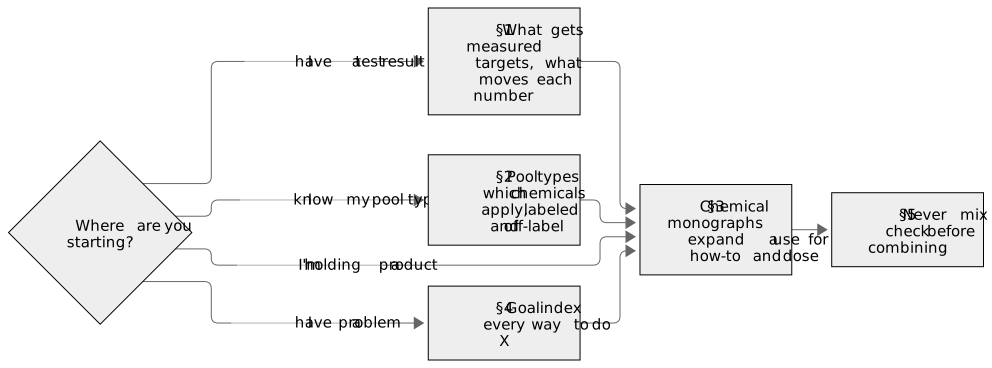
Each monograph has a fact box, a dose card with every common strength, and expandable labeled (L) and off-label (O) uses. Each expandable block covers the effect and benefit, how to use it, how much to use per 10,000 gal, and cautions.
| Symbol | Meaning |
|---|---|
| Cl | Traditional chlorine pool — liquid chlorine, tablets, cal-hypo, or dichlor |
| SWG | Saltwater pool — a salt chlorine generator (SWG / "salt cell") makes chlorine from dissolved salt |
| Br | Bromine pool or spa |
| ✅ | Normal / primary use in that pool type |
| ➕ | Occasional or supplemental use |
| ⚠️ | Works, but with a real downside — read the cautions |
| ⛔ | Don't |
| L1, L2… | Labeled uses — the purpose printed on typical pool-product labels |
| O1, O2… | Off-label uses — techniques not on a typical label (SLAM, acid washing…) and uses away from the pool |
basis: stoichiometry |
Exact chemistry from molecular weights and the stated strength |
basis: model |
Carbonate + cyanurate + borate buffer model (±15%); your TA, CYA, borates and temperature shift it |
basis: label |
Typical manufacturer direction — brands differ; your label wins |
basis: rule of thumb |
Widely used field practice, not a precise calculation |
0.2 Safety, storage & the law
Handling
- Label first. Label directions override this guide, and strengths vary by brand and batch.
- Chemical into water, never water into chemical. This matters most for acid, cal-hypo, and calcium chloride, which gets hot when it dissolves. Pre-dissolve granular products in a clean bucket of pool water when the label calls for it.
- One chemical at a time. Let each one circulate before adding the next (at least 15–30 min; longer for TA changes). Never premix two chemicals in a bucket. Never pour two products into the skimmer, and never put acid and chlorine into the same spot in the pool.
- Separate scoops and buckets for each chemical. A damp scoop that touched trichlor and then goes into cal-hypo can start a fire.
- Protection. Splash goggles and nitrile or neoprene gloves for acids and oxidizers. Stand upwind, pour low and slow, and never lean over an open acid jug.
Storage
- Cool, dry, ventilated, out of direct sun, in the original labeled containers, and away from children and pets.
- Store acids away from chlorine products. Fumes from muriatic-acid jugs corrode metal and can react with chlorine. Never store liquids above solids.
- Keep oxidizers apart: cal-hypo, trichlor, dichlor, and MPS go away from each other and away from fuels, fertilizers, oils, brake fluid, and other organics. See §5.
Discharge and disposal. Before backwashing or draining, bring chlorine/bromine down (see §3J) and keep pH near neutral. Many cities prohibit pool water in storm drains; check local rules. Don't put unused chemicals in household trash. Use a household-hazardous-waste drop-off.
Emergencies (US). Poison Control: 1-800-222-1222. For a gas or fume release (acid plus chlorine, or wet/contaminated cal-hypo), leave the area, get to fresh air, and call 911.
The law (US). Chlorine, bromine, and algaecide products, plus clarifiers that make algae or germ claims, are EPA-registered pesticides under FIFRA. Their labels carry the line "It is a violation of Federal law to use this product in a manner inconsistent with its labeling." FIFRA §2(ee) does not count as misuse:
- a lower dose or frequency than the label,
- a pest the label doesn't list, at a site the label does list,
- an application method the label doesn't prohibit.
A different site (deck, drinking water, fountain) or a higher dose than the label allows is misuse unless the label permits it. Non-pesticide products — acids, bases, calcium, salt, stabilizer, enzymes, sequestrants — aren't FIFRA-regulated, but their labels still describe safe use. Off-label sanitizer and algaecide uses below are flagged FIFRA.
0.3 Units, strengths & scaling
Concentration units
- ppm = mg/L.
- TA and CH are reported "as CaCO₃".
- Free chlorine (FC) is reported "as Cl₂".
- Bromine is reported "as Br₂". A DPD test reads bromine at 2.25× the chlorine scale, because Br₂ weighs 2.25× as much as Cl₂ for the same oxidizing power.
- 1 ppm of a 100%-active substance in 10,000 gal = 37.85 g = 1.335 oz. Every dose in this guide derives from that number divided by the product's active fraction.
Scaling to your pool. Amount for your pool = amount per 10,000 gal × (your gallons ÷ 10,000).
| Your volume | Multiply 10k-gal doses by | Your volume | Multiply by |
|---|---|---|---|
| 400 gal spa | 0.04 | 15,000 gal | 1.5 |
| 1,000 gal | 0.1 | 20,000 gal | 2.0 |
| 5,000 gal | 0.5 | 25,000 gal | 2.5 |
| 12,000 gal | 1.2 | 30,000 gal | 3.0 |
Estimating volume (dimensions in feet; average depth = (shallow + deep) ÷ 2 for an even slope):
| Shape | US gallons |
|---|---|
| Rectangle | length × width × average depth × 7.48 |
| Round | diameter × diameter × average depth × 5.87 |
| Oval | length × width × average depth × 5.87 |
| Freeform | surface area (ft²) × average depth × 7.48 |
You can also measure volume with a chlorine dose: see A1 · O8.
How product strengths are stated
| Product | What the % means here |
|---|---|
| Liquid chlorine / bleach | Treated as % available chlorine (g Cl₂ per 100 mL), the convention pool calculators use. Household bleach labels state % sodium hypochlorite by weight; the two differ by under ~10%. |
| Cal-hypo | % calcium hypochlorite ≈ % available chlorine |
| Dichlor / trichlor | Use the label's available chlorine (56% or 62% dichlor; 90% trichlor), not the % of the chemical |
| Acids and bases | % by weight of the active (e.g., 31.45% HCl). Dry acid is 93.2% sodium bisulfate. |
| Calcium chloride | % CaCl₂ by weight (77% flake is mostly the dihydrate; 94–97% is anhydrous) |
Measuring
- Weigh solids. Cup measures vary up to ±30% with grind and settling, so this guide gives weights.
- 1 US fl oz = 29.57 mL · 1 qt = 32 fl oz · 1 gal = 128 fl oz = 3.785 L · 1 lb = 16 oz = 453.6 g.
Liquid chlorine weakens on the shelf. Higher strength and heat mean faster loss: a jug stored hot for weeks can be noticeably weaker than its label. Buy fresh, store it cool, and confirm every dose with a test.
Partial doses for pH and TA. For pH and TA changes, add about 75% of the calculated amount, circulate, retest, then finish. Real pools (borates, temperature, aeration) drift from any calculation.
1 · What gets measured
1.1 Core parameters & targets
These are the numbers a good home test kit reports. The targets are common residential ranges. Your surface (plaster, vinyl, fiberglass), equipment maker, and local code can narrow them.
| Parameter | What it tells you | Unit · test | Chlorine (Cl) | Saltwater (SWG) | Bromine (Br) |
|---|---|---|---|---|---|
| Free chlorine (FC) | Sanitizer reserve: HOCl + OCl⁻, including the share held by CYA | ppm · DPD-FAS titration (best), DPD color, strips | Scale to CYA — see §1.4. No CYA (indoor): 1–3 ppm | Same rule; steady output lets you run the low end of target | — (reads as bromine) |
| Combined chlorine (CC) | Chloramines: chlorine tied to ammonia or nitrogen. Causes "chlorine smell" and red eyes | ppm · total − free | ≤ 0.5 (ideally ~0) | ≤ 0.5 | — (bromamines still sanitize) |
| Total bromine | HOBr/OBr⁻ plus bromamines, all active | ppm as Br₂ · DPD × 2.25 | — | — | Labels: pools 1–3 ppm, spas 2–4 (residential). CDC MAHC: pools ≥ 3, spas ≥ 4, max 8 |
| pH | Acid/base level: sets sanitizer strength, comfort, scale vs. etch | phenol red | 7.2–7.8 (most aim 7.4–7.6) | 7.4–7.8 (tends to rise) | 7.2–7.8 (bromine tolerates the high end) |
| Total alkalinity (TA) | The buffer. High TA makes pH climb as CO₂ escapes | ppm as CaCO₃ · acid titration | 60–100 with liquid chlorine or cal-hypo (PHTA ideal 80–100); 100–120 with trichlor/dichlor | 60–80 (lower TA = less pH rise) | 80–120 (tablets are acidic) |
| Calcium hardness (CH) | Dissolved calcium: plaster needs it to avoid etching; too much scales | ppm as CaCO₃ · EDTA titration | 200–400 (PHTA ideal; min 150, max 1,000). Plaster wants the upper half; vinyl and fiberglass tolerate the low end | Same, but keep CSI ≤ 0 — the cell scales | Pools 200–400 · spas 150–250 (PHTA) |
| Cyanuric acid (CYA) | Stabilizer: shields chlorine from sunlight but lowers its active fraction | ppm · melamine turbidity | Outdoor 30–50 (PHTA ideal; TFP 30–60); indoor 0–20. Codes often cap CYA at ~100 | 60–90 (TFP); most cell makers 60–80 | 0 — CYA doesn't stabilize bromine |
| Salt (NaCl) | SWG feedstock; also builds up in every chlorine pool | ppm · titration strip, meter, cell readout | Not a target. Rises with use (often 500–2,000) | Cell maker's range: Hayward 2,700–3,400 (3,200 ideal) · Jandy 3,000–3,500 · Pentair IntelliChlor 3,600–4,500 (current guides) · CircuPool 3,000–4,000 | Bromide-salt systems: per maker |
| Total dissolved solids (TDS) | Everything dissolved | ppm · conductivity meter | Rising TDS > ~1,500 above fill water is a common drain trigger | Salt dominates; track salt separately | Spas climb fast; drain on a schedule |
| Temperature | Speeds chlorine loss and shifts the saturation index | °F | — | Cells pause in cold water (~50–60 °F, model-dependent) | — |
| Saturation index (CSI/LSI) | Scale-forming vs. etching tendency | calculated — §1.6 | −0.3 to +0.3 | −0.3 to 0 (cell surfaces run high-pH and scale) | −0.3 to +0.3 |
| Borates | Optional pH buffer and algistat; softer feel | ppm as boron · titration or strips | 0 or 30–50 | 30–50 commonly recommended | 0 or 30–50 |
| Phosphates | Algae nutrient | ppb · colorimetric | Two schools — see §1.2 | Same; check your cell manual | Same |
1.2 Secondary & occasional measurements
| Measurement | Why test it | Typical guidance | Usual sources | Fixes |
|---|---|---|---|---|
| Copper | Blue-green/teal stains, green hair, plating on SWG cells | Ideally not detectable; staining risk climbs above ~0.2 ppm | Copper algaecides, ionizers, some multi-function tablets, corroding heater (low pH) | I1, I3/I4, partial drain |
| Iron | Brown/rust stains; water turns green-brown or brown when chlorinated | Ideally < 0.1 ppm | Well water, rusting fixtures and rebar | I1, I3, A1 · O4 |
| Manganese | Purple, brown, or black stains | Ideally 0 | Well water | Same as iron |
| Silver / zinc | Mineral-sanitizer systems | Per system maker | Ionizers, mineral cartridges (G4) | Replace or adjust cartridge |
| Magnesium / total hardness | Total hardness − CH = mostly magnesium. Mg doesn't count toward CSI calcium | Context only | Fill water, magnesium "mineral" pools (F2) | — |
| Nitrate | Algae nutrient; nothing removes it chemically | Lower is better. Nitrate doesn't consume chlorine (nitrite and ammonia do) | Fertilizer runoff, some fill water | Dilution, RO |
| Ammonia / ammonium | Large chlorine demand; forms chloramines | 0 | Fertilizer, urine, ammonium-based mustard boosters (G5) | Breakpoint with chlorine (A1 · O1) |
| Sulfate | Builds up from sulfur-based chemicals; high levels can degrade cement grout and plaster over years | No universal limit; concern rises in plaster pools at several hundred ppm and up | Dry acid, MPS, alum, sulfuric acid | Dilution |
| Silica | Silicate scale — glassy, very hard to remove | Context (regional well water) | Fill water | Dilution, RO |
| Bromide | Bromine "bank" in Br pools; a contaminant in Cl/SWG pools | Br: ~30 ppm reserve (spa labels: ½ oz NaBr per 100 gal) · Cl/SWG: 0 | NaBr, BCDMH, sodium-bromide mustard products | Only dilution removes it |
| DMH (dimethylhydantoin) | Builds up from BCDMH tablets; high levels slow bromine | Lab test only; manage by scheduled partial drains | B1 | Dilution |
| MPS | Shows up as false "combined chlorine" on DPD tests | — | C1 | MPS-deactivating reagent before reading CC |
| Hydrogen peroxide | Destroys chlorine and bromine (it's the biguanide oxidizer) | 0 in Cl/SWG/Br pools | C2 | Let chlorine burn it off |
| Chlorate / bromate | Oxidation byproducts with drinking-water health limits | Lab only | Old or heat-stored bleach, SWG cells, ozone plus bromide | Dilution; buy fresh chlorine |
| ORP | Electrode estimate of oxidizing power, used by automation | ~650–750 mV is typical. CYA lowers the reading for the same sanitizing power | — | Adjust FC/pH; calibrate the probe |
| Turbidity / clarity | Filtration and sanitation status | You should see the main-drain grate clearly. Codes use NTU | — | H1–H4, L1–L3 |
| Biguanide (PHMB) | Only matters if switching systems | ⛔ incompatible with chlorine and bromine | Baquacil/SoftSwim systems | Drain or a full conversion (C2 · O2) |
Two schools on phosphates.
- Phosphates don't matter if FC stays at the CYA-indexed level. Algae can't grow in properly chlorinated water regardless of nutrients. This is the Trouble Free Pool position.
- Remove phosphates (often to < 100–500 ppb) as insurance, because chlorine lapses happen. This is the phosphate-remover makers' and many service pros' position.
Both are internally consistent. Removers cost money; chlorine lapses cost algae.
1.3 How the numbers interact
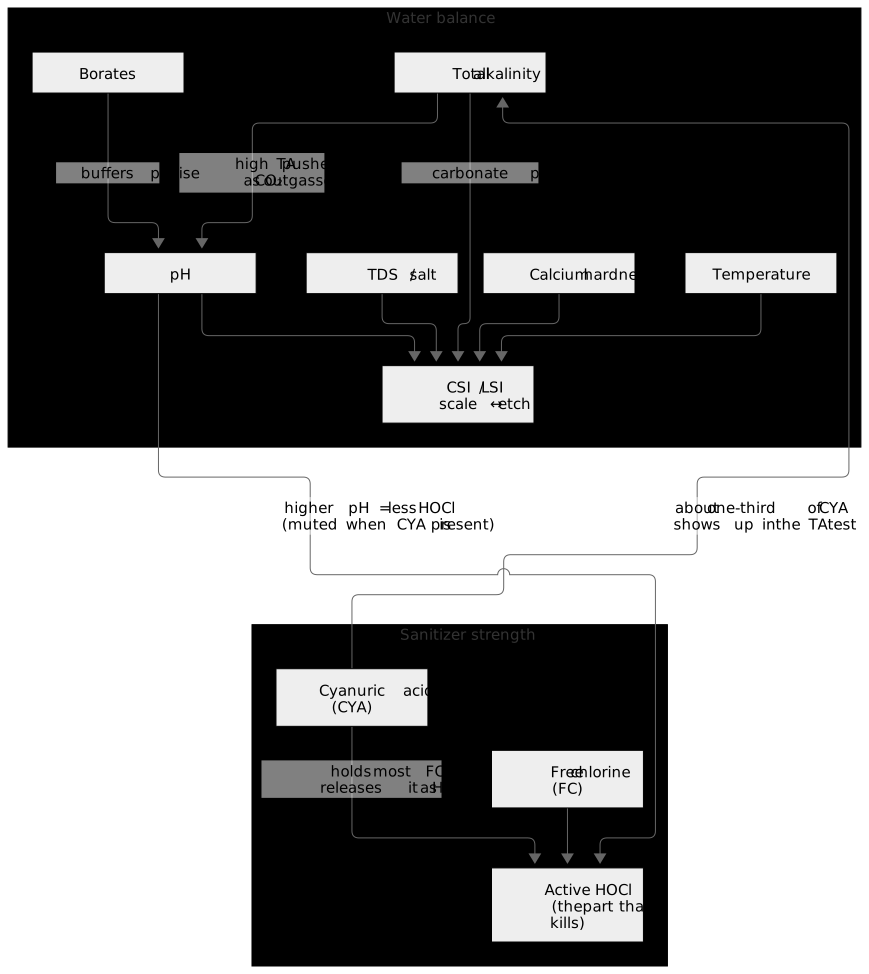
Three relationships cause most of the confusion:
- FC means nothing without CYA. The same 3 ppm FC is strong at CYA 0 and weak at CYA 80. Set FC from CYA (§1.4).
- TA drives pH drift. CO₂ escaping from the water raises pH without changing TA. Spillovers, waterfalls, SWG hydrogen bubbles, and heat all speed this up. Lower TA means less drift, so SWG pools run lower TA.
- pH, TA, and CH trade off through the saturation index. You can hold the same CSI with higher CH and lower pH or TA, or the reverse (§1.6).
1.4 Chlorine and CYA
With CYA present, the active HOCl is roughly proportional to FC ÷ CYA. That's why chlorine targets scale with stabilizer.
Trouble Free Pool's chart (liquid chlorine, tablets, cal-hypo) is roughly minimum ≈ 7.5% of CYA, target ≈ 11.5%, SLAM ≈ 40%, mustard-algae SLAM ≈ 60%. Salt pools can hold a 5% minimum, because the cell adds chlorine continuously.
| CYA (ppm) | 30 | 40 | 50 | 60 | 70 | 80 | 90 | 100 |
|---|---|---|---|---|---|---|---|---|
| Minimum FC | 2 | 3 | 4 | 5 | 5 | 6 | 7 | 8 |
| Target FC | 4–6 | 5–7 | 6–8 | 7–9 | 8–10 | 9–11 | 10–12 | 11–13 |
| SLAM FC (A1 · O1) | 12 | 16 | 20 | 24 | 28 | 31 | 35 | 39 |
| Mustard-algae SLAM (≈ 60%) | 18 | 24 | 30 | 36 | 42 | 48 | 54 | 60 |
| SWG minimum / target | — | — | — | 3 / 4–9 | 3 / 5–10 | 4 / 6–11 | 4 / 6–12 | — |
- CYA targets: 30–60 for liquid chlorine (PHTA's ideal is 30–50), 60–90 for SWG pools.
- No CYA (indoor): run 1–3 ppm FC and SLAM at 10 ppm.
- Codes vs this chart: public-pool codes cap FC (PHTA lists 5 ppm max for pools). That's why this CYA-scaled approach is for residential pools.
- Bromine can't be stabilized, so this table doesn't apply (§2.3).
1.5 pH and sanitizer strength
Share of free chlorine present as active hypochlorous acid (HOCl) with no CYA, and share of bromine present as hypobromous acid (HOBr). Values are for 77 °F (25 °C) at typical pool salinity (basis: model).
| pH | 6.8 | 7.0 | 7.2 | 7.4 | 7.5 | 7.6 | 7.8 | 8.0 | 8.2 | 8.5 |
|---|---|---|---|---|---|---|---|---|---|---|
| HOCl (chlorine) | 82% | 75% | 65% | 54% | 48% | 42% | 32% | 23% | 16% | 8% |
| HOBr (bromine) | 98% | 97% | 96% | 94% | 92% | 91% | 86% | 79% | 71% | 55% |
- Bromine keeps working at high pH, which suits hot, aerated spas where pH climbs.
- With CYA present, most chlorine sits in a CYA-bound reserve and pH has a much smaller effect on active HOCl than this table suggests. Still keep pH ≤ 7.8 for comfort and scale control.
1.6 Saturation index (CSI/LSI)
The saturation index predicts whether water will deposit calcium carbonate (scale, cloudy water, rough plaster, crusted salt cells) or dissolve it (etched plaster, pitted grout, leached calcium). Calculators such as Pool Math and Orenda compute it exactly. The classic pool-industry approximation:
LSI ≈ pH + TF + CF + AF − C

CF = log10(CH) − 0.4                 CH in ppm as CaCO3
AF = log10(carbonate alkalinity)     carbonate alk = TA − (CYA × factor) − borate alk
TF = temperature factor (table)      C = TDS factor: 12.10 (TDS ≤ 1,000), 12.29 (2,000),
                                       12.35 (3,000), 12.44 (5,000)   — NPC
| Water °F | 32 | 37 | 46 | 53 | 60 | 66 | 76 | 84 | 94 | 105 |
|---|---|---|---|---|---|---|---|---|---|---|
| TF | 0.0 | 0.1 | 0.2 | 0.3 | 0.4 | 0.5 | 0.6 | 0.7 | 0.8 | 0.9 |
CYA correction — ppm of measured TA contributed by each 1 ppm CYA (basis: model):
| pH | 7.0 | 7.2 | 7.4 | 7.5 | 7.6 | 7.8 | 8.0 |
|---|---|---|---|---|---|---|---|
| factor | 0.24 | 0.28 | 0.31 | 0.32 | 0.33 | 0.35 | 0.36 |
- Borates contribute a little TA: about 5 ppm at pH 7.5 and 8 ppm at pH 7.8 for 50 ppm borates.
- Worked example. pH 7.5, 82 °F (TF ≈ 0.65), CH 300 (CF 2.08), TA 80, CYA 40:
- Carbonate alkalinity = 80 − 0.32 × 40 = 67, so AF = 1.83.
- LSI ≈ 7.5 + 0.65 + 2.08 + 1.83 − 12.1 = −0.04, which is balanced.
| Index | Meaning | What to change |
|---|---|---|
| below −0.3 | Aggressive: etches plaster and grout, dissolves calcium | Raise CH, pH, or TA |
| −0.3 to +0.3 | Balanced | — |
| above +0.3 | Scale-forming: cloudy water, crust, scaled SWG cell and heater | Lower pH or TA; dilute CH |
1.7 Testing notes & interferences
-
Use a DPD-FAS titration kit (drop-count FAS titration) for FC and CC. Test strips and DPD color blocks are fine for a quick check but poor at the high FC levels SLAM uses.
-
High chlorine distorts pH. Above ~10 ppm FC, chlorine can turn phenol red purple and read falsely high. Add one drop of sodium thiosulfate (test kits include it as a "chlorine neutralizer") to the sample before the pH reagent.
-
MPS non-chlorine shock reads as combined chlorine in the DPD test. Use an MPS-deactivating reagent, or wait until the MPS has been consumed.
-
Bromine reads on the same DPD chemistry: bromine ppm = chlorine-scale reading × 2.25.
-
CYA (turbidity) test. Most accurate between ~30 and 90 ppm. Above ~100, dilute the sample 1:1 with tap water and double the result. Warm a cold sample to ~70–80 °F first.
-
The TA test counts cyanurate and borate alkalinity. Use the §1.6 correction for CSI.
-
Verify salt independently. Cell readouts drift; check with a titration strip or meter monthly.
-
Sample from elbow depth, away from returns and chemical feeders.
-
Typical cadence:
Test Frequency FC and pH daily to every other day in season TA weekly CH, CYA, salt every 2–4 weeks Metals, phosphates, borates as needed
2 · Pool types
Every chemical below is fully covered in its §3 monograph. Expand the L and O blocks there for how-to and dosing. These sections show which chemicals apply to each pool type, what role they play, and what to avoid.
2.1 Chlorine pools
You add chlorine yourself: liquid chlorine, tablets, cal-hypo, or dichlor. Each source carries a side effect. Liquid chlorine adds salt; cal-hypo adds calcium; dichlor and trichlor add CYA, and trichlor also adds acid. Choosing a source means choosing which number you'll manage over the season.
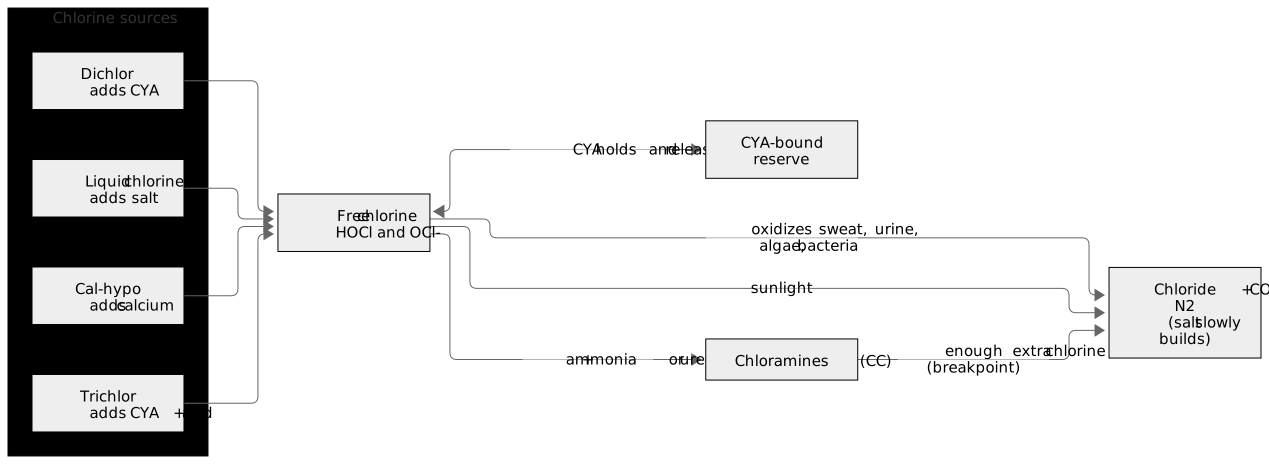
| Source | +1 ppm FC per 10k gal | Also adds per ppm FC | Best for |
|---|---|---|---|
| Liquid chlorine 10% / 12.5% | 12.8 / 10.2 fl oz | 1.65 ppm salt | Daily dosing, SLAM; no CYA or calcium buildup |
| Cal-hypo 65% / 73% | 2.05 / 1.83 oz | 0.7 ppm CH | Shock; plaster pools short on calcium |
| Dichlor 56% | 2.38 oz | 0.9 ppm CYA | Spas; building CYA at startup |
| Trichlor 90% | 1.48 oz | 0.6 ppm CYA, −0.7 ppm TA | Floaters/feeders; requires CYA management |
Typical targets: FC per CYA (§1.4), pH 7.4–7.6, TA 60–90 (80–120 with trichlor), CYA 30–50, CH per surface, CSI −0.3…+0.3.
Chemicals for chlorine pools
| Chemical | Role here | Labeled effect & benefit | Off-label uses (expand in monograph) |
|---|---|---|---|
| A1 · Sodium hypochlorite (liquid chlorine, bleach) | ✅ Primary chlorine source; adds 1.65 ppm salt per ppm FC | Unstabilized chlorine for daily dosing, shock, and algae; pH-neutral over its life cycle | O1 SLAM · O2 overnight chlorine-loss test · O3 regenerate bromine · O4 oxidize iron/manganese/H₂S in fill water · O5 disinfect deck, toys, gear · O6 emergency drinking water · O7 spot-bleach organic stains · O8 measure pool volume |
| A2 · Calcium hypochlorite (cal-hypo) | ✅ Shock or feeder; CH rises 0.7 ppm per ppm FC | Fast unstabilized shock; tablets for cal-hypo feeders; algae treatment | O1 chlorine + calcium for low-CH plaster · O2 sock spot-treatment on plaster · O3 emergency drinking-water stock |
| A3 · Lithium hypochlorite | ➕ Legacy stock only | Fast-dissolving, calcium-free shock (legacy product) | — |
| A4 · Dichlor (sodium dichloroisocyanurate) | ➕ Spas, startups; CYA rises 0.9 ppm per ppm FC | Stabilized, fast-dissolving granular chlorine for daily use and shock | O1 bootstrap CYA, then switch to bleach · O2 spot-treat algae on plaster |
| A5 · Trichlor (trichloroisocyanuric acid) | ✅ Convenient; CYA +0.6 and TA −0.7 per ppm FC — watch CYA creep | Slow-dissolving stabilized tablets for floaters and feeders | O1 stain diagnosis by rubbing a tablet · O2 offset pH rise + add CYA in SWG pools |
| A7 · Chlorine gas | ➕ Commercial only | Commercial chlorination by licensed operators | — |
| B3 · Sodium bromide | ⚠️ Mustard booster only; converts the pool to bromine, and US labels now bar outdoor pools (O1) | Builds the bromide bank for two-part bromine systems | O1 mustard-algae booster in chlorine pools · O2 bleach-activated bromine (no tablets) |
| C1 · Potassium monopersulfate (MPS, non-chlorine shock) | ➕ Oxidizer between chlorine doses; not a sanitizer; reads as CC | Oxidizes contaminants without chlorine; quick reentry; activates bromide | O1 mild acid source in spas |
| C2 · Hydrogen peroxide | ➕ Off-label neutralizer only | Labeled only for biguanide systems | O1 neutralize excess chlorine/bromine · O2 convert to biguanide |
| D1 · Cyanuric acid (stabilizer) | ✅ 30–50 outdoors | Shields chlorine from sunlight so it lasts | O1 moderate CYA to tame harshness in spas/indoor pools |
| D2 · Biological CYA reducer | ➕ | Lowers CYA without draining | — |
| E1 · Muriatic acid (hydrochloric acid) | ✅ | Lowers pH; with aeration, lowers TA | O1 salt-cell descaling · O2 acid wash a drained plaster pool · O3 no-drain scale removal · O4 acid rinse for filters · O5 masonry & deck cleaning |
| E2 · Sodium bisulfate (dry acid) | ✅ Adds sulfate | Granular pH and TA reducer | O1 toilet-bowl / hard-water stain cleaner |
| E3 · Sulfuric acid | ➕ Commercial feeders | Commercial pH control | — |
| E4 · Carbon dioxide | ➕ | Lowers pH without lowering TA (commercial feeders) | — |
| E5 · Soda ash (sodium carbonate) | ✅ | Raises pH (and TA) | O1 lower calcium hardness by precipitation · O2 neutralize acid spills · O3 tie-dye fixer · O4 laundry booster |
| E6 · Baking soda (sodium bicarbonate) | ✅ | Raises TA with little pH change | O1 bicarb start-up for new plaster · O2 gentle acid-spill neutralizer · O3 waterline scum paste · O4 smother a small grease fire |
| E7 · Sodium hydroxide (caustic soda) | ➕ Commercial | Raises pH (commercial feeders) | O1 lower CH and TA together |
| E8 · Borax (sodium tetraborate) | ➕ | Raises pH with less TA increase; with acid, builds a borate buffer | O1 laundry borax as a pool chemical · O2 laundry booster |
| E9 · Boric acid | ➕ | Adds borates without raising pH | O1 bulk technical boric acid instead of branded borates |
| F1 · Calcium chloride | ✅ Plaster pools | Raises calcium hardness to protect plaster and grout | O1 reduce foaming in soft-water spas · O2 de-ice walkways · O3 DIY moisture absorber |
| G1 · Polyquat 60 | ➕ | Non-foaming, metal-free algae prevention and treatment | O1 decorative fountains (FIFRA; no fish) |
| G2 · Quaternary ammonium (linear quat) | ⚠️ Foams | Low-cost algaecide (foams) | — |
| G3 · Copper algaecides | ⚠️ Stains, green hair | Algae control, especially mustard and black | O1 ionizer-substitute copper residual (not recommended) |
| G4 · Silver algaecide & mineral cartridges | ➕ | Colloidal-silver algaecide; mineral cartridges for reduced-chlorine operation | — |
| G5 · Mustard-algae boosters | ⚠️ Bromide or ammonium side effects | Boost a shock against yellow/mustard algae (ammonium sulfate or sodium bromide) | — |
| H1 · Polymer clarifiers | ➕ | Clump fine particles so the filter catches them | — |
| H2 · Chitosan | ➕ | Natural clarifier | — |
| H3 · Aluminum sulfate (alum) | ➕ Lowers TA ~6 ppm per lb | Floc to the floor for vacuum-to-waste; sand-filter aid | O1 blue hydrangeas |
| H4 · Liquid flocs (PAC, aluminum chloride) | ➕ | Settle fine particles overnight for vacuum-to-waste; commercial continuous coagulant feed | — |
| H5 · Phosphate removers (lanthanum chloride and others) | ➕ | Remove phosphates (algae nutrient) | O1 fishless water features |
| I1 · Phosphonate sequestrants (HEDP, PBTC…) | ➕ | Prevent metal stains and scale | O1 lock metals after an ascorbic-acid treatment |
| I2 · EDTA salts | ➕ | Stain- and scale-remover active | O1 no-drain calcium scale removal |
| I3 · Ascorbic acid (vitamin C) | ➕ | Removes metal (iron) stains | O1 whole-pool ascorbic treatment · O2 vitamin-C tablet spot test · O3 dechlorinate |
| I4 · Citric acid | ➕ | Metal-stain remover | O1 copper stain treatment · O2 hard-water spot descaling |
| I5 · Oxalic acid | ⚠️ Spot use only | Not a pool-water product (deck brighteners, rust removers) | O1 spot rust/organic stains |
| I6 · Sodium dithionite (hydrosulfite) | ⚠️ Spot use only | Not a pool-water product (household rust removers) | O1 spot rust-stain treatment |
| I7 · Cleaning-only acids (sulfamic, phosphoric, vinegar) | ➕ Cleaning only | Tile and fixture descalers | O1 descale cells/fixtures where allowed |
| J1 · Sodium thiosulfate | ➕ | Lowers excess chlorine/bromine; neutralizes before draining | O1 dechlorinate water for aquariums/ponds |
| J2 · Sulfites (sulfite, bisulfite, metabisulfite) | ➕ | Chlorine neutralizers | O1 dechlorinate discharge water |
| K1 · Enzyme blends | ➕ | Break down oils, lotions, and scum | O1 cartridge-filter soak · O2 waterline scum spot treatment |
| K2 · Surfactant line flush (spa purge) | ➕ Spas | Purges plumbing biofilm before a drain | — |
| K3 · Silicone antifoam | ➕ | Knocks down foam | O1 fountain foam |
| L1 · Diatomaceous earth (pool grade) | ✅ DE filters | Filter media for DE filters | O1 DE-assist for sand filters |
| L2 · Perlite & cellulose fiber | ➕ | DE alternatives and filter aids | O1 cellulose as a sand/cartridge filter aid |
| L3 · Filter degreasers (TSP, metasilicate, cleaners) | ✅ | Degrease cartridges and grids | O1 TSP for deck/house prep |
| M1 · Liquid solar cover (fatty alcohol) | ➕ | Reduces evaporation and heat loss | O1 fountains and water features |
| M2 · Propylene glycol pool antifreeze | ➕ Cold climates | Winterizes plumbing lines | O1 RV/boat plumbing |
| M3 · Phenol red & leak dyes | ➕ | pH test reagent; leak-detection dye | O1 find leaks with your test kit's phenol red |
Avoid in chlorine pools
- ⛔ B1 · BCDMH (bromine tablets) — Converts the pool to bromine
- ⛔ B2 · DBDMH
2.2 Saltwater (SWG) pools
A saltwater pool is a chlorine pool. The cell makes the chlorine from dissolved salt, so you aren't hauling jugs or tablets. Electrolysis is pH-neutral overall, but hydrogen bubbles and aeration strip CO₂, so pH rises and you'll add acid regularly. High pH and calcium at the hot cell plates cause scale. That's why SWG pools run lower TA, higher CYA, slightly negative CSI, and often borates.

Typical targets: salt per cell maker (most ~3,200 ppm), CYA 60–80, FC per CYA (low end is fine), pH 7.4–7.8, TA 60–80, borates 30–50 recommended, CSI −0.3…0. Salt isn't consumed. You replace what's lost to splash-out, backwash, and rain dilution.
Chemicals for SWG pools
| Chemical | Role here | Labeled effect & benefit | Off-label uses (expand in monograph) |
|---|---|---|---|
| A1 · Sodium hypochlorite (liquid chlorine, bleach) | ➕ Backup when the cell is down, for SLAM, or a quick boost | Unstabilized chlorine for daily dosing, shock, and algae; pH-neutral over its life cycle | O1 SLAM · O2 overnight chlorine-loss test · O3 regenerate bromine · O4 oxidize iron/manganese/H₂S in fill water · O5 disinfect deck, toys, gear · O6 emergency drinking water · O7 spot-bleach organic stains · O8 measure pool volume |
| A2 · Calcium hypochlorite (cal-hypo) | ⚠️ Extra calcium scales the cell; occasional shock only | Fast unstabilized shock; tablets for cal-hypo feeders; algae treatment | O1 chlorine + calcium for low-CH plaster · O2 sock spot-treatment on plaster · O3 emergency drinking-water stock |
| A3 · Lithium hypochlorite | ➕ Legacy stock only | Fast-dissolving, calcium-free shock (legacy product) | — |
| A4 · Dichlor (sodium dichloroisocyanurate) | ➕ Startup CYA + chlorine in one product | Stabilized, fast-dissolving granular chlorine for daily use and shock | O1 bootstrap CYA, then switch to bleach · O2 spot-treat algae on plaster |
| A5 · Trichlor (trichloroisocyanuric acid) | ➕ Small amounts offset pH rise and top up CYA (O2) | Slow-dissolving stabilized tablets for floaters and feeders | O1 stain diagnosis by rubbing a tablet · O2 offset pH rise + add CYA in SWG pools |
| A6 · Sodium chloride (pool salt) | ✅ Required; hold the cell's range | Feedstock that the salt cell turns into chlorine | O1 water-softener regeneration · O2 ice-bath / ice-cream brine |
| B3 · Sodium bromide | ⚠️ The cell will make bromine, which CYA can't protect from the sun | Builds the bromide bank for two-part bromine systems | O1 mustard-algae booster in chlorine pools · O2 bleach-activated bromine (no tablets) |
| C1 · Potassium monopersulfate (MPS, non-chlorine shock) | ➕ Same as Cl | Oxidizes contaminants without chlorine; quick reentry; activates bromide | O1 mild acid source in spas |
| C2 · Hydrogen peroxide | ➕ Off-label neutralizer only | Labeled only for biguanide systems | O1 neutralize excess chlorine/bromine · O2 convert to biguanide |
| D1 · Cyanuric acid (stabilizer) | ✅ 60–80, per cell maker | Shields chlorine from sunlight so it lasts | O1 moderate CYA to tame harshness in spas/indoor pools |
| D2 · Biological CYA reducer | ➕ | Lowers CYA without draining | — |
| E1 · Muriatic acid (hydrochloric acid) | ✅ Used most here — pH rises steadily | Lowers pH; with aeration, lowers TA | O1 salt-cell descaling · O2 acid wash a drained plaster pool · O3 no-drain scale removal · O4 acid rinse for filters · O5 masonry & deck cleaning |
| E2 · Sodium bisulfate (dry acid) | ➕ Works; adds sulfate — muriatic preferred for heavy use | Granular pH and TA reducer | O1 toilet-bowl / hard-water stain cleaner |
| E3 · Sulfuric acid | ➕ Commercial feeders | Commercial pH control | — |
| E4 · Carbon dioxide | ➕ | Lowers pH without lowering TA (commercial feeders) | — |
| E5 · Soda ash (sodium carbonate) | ➕ Rarely needed — pH rises on its own | Raises pH (and TA) | O1 lower calcium hardness by precipitation · O2 neutralize acid spills · O3 tie-dye fixer · O4 laundry booster |
| E6 · Baking soda (sodium bicarbonate) | ➕ Rarely — TA is kept low | Raises TA with little pH change | O1 bicarb start-up for new plaster · O2 gentle acid-spill neutralizer · O3 waterline scum paste · O4 smother a small grease fire |
| E7 · Sodium hydroxide (caustic soda) | ➕ Commercial | Raises pH (commercial feeders) | O1 lower CH and TA together |
| E8 · Borax (sodium tetraborate) | ✅ Borates 30–50 steady the pH | Raises pH with less TA increase; with acid, builds a borate buffer | O1 laundry borax as a pool chemical · O2 laundry booster |
| E9 · Boric acid | ✅ | Adds borates without raising pH | O1 bulk technical boric acid instead of branded borates |
| F1 · Calcium chloride | ✅ Keep CSI ≤ 0 — the cell scales | Raises calcium hardness to protect plaster and grout | O1 reduce foaming in soft-water spas · O2 de-ice walkways · O3 DIY moisture absorber |
| F2 · Magnesium & potassium chloride (mineral salts) | ➕ Only systems designed for it | Electrolyte for magnesium/mineral chlorination systems | O1 magnesium-chloride de-icer |
| G1 · Polyquat 60 | ➕ | Non-foaming, metal-free algae prevention and treatment | O1 decorative fountains (FIFRA; no fish) |
| G2 · Quaternary ammonium (linear quat) | ⚠️ Foams | Low-cost algaecide (foams) | — |
| G4 · Silver algaecide & mineral cartridges | ➕ Check maker compatibility | Colloidal-silver algaecide; mineral cartridges for reduced-chlorine operation | — |
| G5 · Mustard-algae boosters | ⚠️ Same | Boost a shock against yellow/mustard algae (ammonium sulfate or sodium bromide) | — |
| H1 · Polymer clarifiers | ➕ | Clump fine particles so the filter catches them | — |
| H2 · Chitosan | ➕ | Natural clarifier | — |
| H3 · Aluminum sulfate (alum) | ➕ | Floc to the floor for vacuum-to-waste; sand-filter aid | O1 blue hydrangeas |
| H4 · Liquid flocs (PAC, aluminum chloride) | ➕ | Settle fine particles overnight for vacuum-to-waste; commercial continuous coagulant feed | — |
| H5 · Phosphate removers (lanthanum chloride and others) | ➕ | Remove phosphates (algae nutrient) | O1 fishless water features |
| I1 · Phosphonate sequestrants (HEDP, PBTC…) | ✅ Helps keep the cell clean | Prevent metal stains and scale | O1 lock metals after an ascorbic-acid treatment |
| I2 · EDTA salts | ➕ | Stain- and scale-remover active | O1 no-drain calcium scale removal |
| I3 · Ascorbic acid (vitamin C) | ➕ | Removes metal (iron) stains | O1 whole-pool ascorbic treatment · O2 vitamin-C tablet spot test · O3 dechlorinate |
| I4 · Citric acid | ➕ | Metal-stain remover | O1 copper stain treatment · O2 hard-water spot descaling |
| I5 · Oxalic acid | ⚠️ Spot use only | Not a pool-water product (deck brighteners, rust removers) | O1 spot rust/organic stains |
| I6 · Sodium dithionite (hydrosulfite) | ⚠️ Spot use only | Not a pool-water product (household rust removers) | O1 spot rust-stain treatment |
| I7 · Cleaning-only acids (sulfamic, phosphoric, vinegar) | ➕ Cleaning only | Tile and fixture descalers | O1 descale cells/fixtures where allowed |
| J1 · Sodium thiosulfate | ➕ | Lowers excess chlorine/bromine; neutralizes before draining | O1 dechlorinate water for aquariums/ponds |
| J2 · Sulfites (sulfite, bisulfite, metabisulfite) | ➕ | Chlorine neutralizers | O1 dechlorinate discharge water |
| K1 · Enzyme blends | ➕ | Break down oils, lotions, and scum | O1 cartridge-filter soak · O2 waterline scum spot treatment |
| K2 · Surfactant line flush (spa purge) | ➕ Spas | Purges plumbing biofilm before a drain | — |
| K3 · Silicone antifoam | ➕ | Knocks down foam | O1 fountain foam |
| L1 · Diatomaceous earth (pool grade) | ✅ DE filters | Filter media for DE filters | O1 DE-assist for sand filters |
| L2 · Perlite & cellulose fiber | ➕ | DE alternatives and filter aids | O1 cellulose as a sand/cartridge filter aid |
| L3 · Filter degreasers (TSP, metasilicate, cleaners) | ✅ | Degrease cartridges and grids | O1 TSP for deck/house prep |
| M1 · Liquid solar cover (fatty alcohol) | ➕ | Reduces evaporation and heat loss | O1 fountains and water features |
| M2 · Propylene glycol pool antifreeze | ➕ Cold climates | Winterizes plumbing lines | O1 RV/boat plumbing |
| M3 · Phenol red & leak dyes | ➕ | pH test reagent; leak-detection dye | O1 find leaks with your test kit's phenol red |
Avoid in SWG pools
- ⛔ B1 · BCDMH (bromine tablets) — Converts the pool to bromine
- ⛔ B2 · DBDMH
- ⛔ G3 · Copper algaecides — Plates on the cell; stains
2.3 Bromine pools
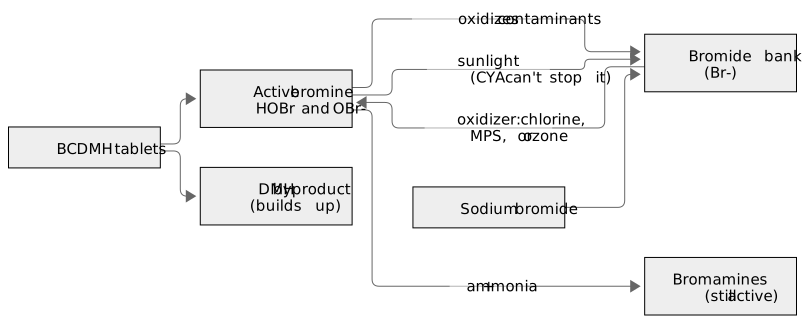
Bromine works differently from chlorine:
- It recycles. Spent bromine becomes bromide, which an oxidizer (chlorine, MPS, ozone) turns back into active bromine.
- Its combined forms (bromamines) still sanitize and smell less than chloramines.
- HOBr stays active at higher pH (§1.5), which suits hot, aerated spas.
- CYA can't protect it from sunlight, so outdoor bromine pools burn through product.
- Once bromide is in the water, the only way out is draining.
⚠️ US label change: bromine is now an indoor-pool and covered-spa sanitizer. EPA's 2021 amended interim decision on inorganic halides requires these labels to state "This product is not for use in outdoor pools" and "Outdoor hot tubs and spas must be covered when not in use." Sunlight converts bromine plus bromide into bromate, a regulated carcinogen. The rule covers bromine tablets (BCDMH) and sodium bromide. Older outdoor bromine pools must comply with the label on the product they buy now.
Typical targets:
- Total bromine per your label: residential pools 1–3 ppm, spas 2–4 ppm. CDC's MAHC for public venues: ≥ 3 ppm (spas ≥ 4), max 8.
- pH 7.2–7.8, TA 80–120, CH per surface, no CYA. Drain partially on a schedule to keep DMH and TDS in check.
Chemicals for bromine pools
| Chemical | Role here | Labeled effect & benefit | Off-label uses (expand in monograph) |
|---|---|---|---|
| A1 · Sodium hypochlorite (liquid chlorine, bleach) | ➕ Oxidizer that turns the bromide bank back into bromine (O3) | Unstabilized chlorine for daily dosing, shock, and algae; pH-neutral over its life cycle | O1 SLAM · O2 overnight chlorine-loss test · O3 regenerate bromine · O4 oxidize iron/manganese/H₂S in fill water · O5 disinfect deck, toys, gear · O6 emergency drinking water · O7 spot-bleach organic stains · O8 measure pool volume |
| A2 · Calcium hypochlorite (cal-hypo) | ➕ Shock/oxidizer; watch CH | Fast unstabilized shock; tablets for cal-hypo feeders; algae treatment | O1 chlorine + calcium for low-CH plaster · O2 sock spot-treatment on plaster · O3 emergency drinking-water stock |
| A3 · Lithium hypochlorite | ➕ Legacy spa shock | Fast-dissolving, calcium-free shock (legacy product) | — |
| A4 · Dichlor (sodium dichloroisocyanurate) | ⚠️ Oxidizes bromide but adds CYA that does nothing for bromine | Stabilized, fast-dissolving granular chlorine for daily use and shock | O1 bootstrap CYA, then switch to bleach · O2 spot-treat algae on plaster |
| B1 · BCDMH (bromine tablets) | ✅ Primary — indoor pools and covered spas (US labels) | Slow-dissolving bromine tablets for erosion feeders and floaters | O1 decorative fountains (FIFRA) |
| B2 · DBDMH | ➕ Where sold | Bromine-only hydantoin tablets (uncommon in residential use) | — |
| B3 · Sodium bromide | ✅ Bank/reserve | Builds the bromide bank for two-part bromine systems | O1 mustard-algae booster in chlorine pools · O2 bleach-activated bromine (no tablets) |
| C1 · Potassium monopersulfate (MPS, non-chlorine shock) | ✅ Regenerates bromine in two-part systems | Oxidizes contaminants without chlorine; quick reentry; activates bromide | O1 mild acid source in spas |
| C2 · Hydrogen peroxide | ➕ Off-label neutralizer only | Labeled only for biguanide systems | O1 neutralize excess chlorine/bromine · O2 convert to biguanide |
| E1 · Muriatic acid (hydrochloric acid) | ✅ | Lowers pH; with aeration, lowers TA | O1 salt-cell descaling · O2 acid wash a drained plaster pool · O3 no-drain scale removal · O4 acid rinse for filters · O5 masonry & deck cleaning |
| E2 · Sodium bisulfate (dry acid) | ✅ Popular for spas | Granular pH and TA reducer | O1 toilet-bowl / hard-water stain cleaner |
| E3 · Sulfuric acid | ➕ Commercial feeders | Commercial pH control | — |
| E4 · Carbon dioxide | ➕ | Lowers pH without lowering TA (commercial feeders) | — |
| E5 · Soda ash (sodium carbonate) | ✅ Tablets are acidic | Raises pH (and TA) | O1 lower calcium hardness by precipitation · O2 neutralize acid spills · O3 tie-dye fixer · O4 laundry booster |
| E6 · Baking soda (sodium bicarbonate) | ✅ | Raises TA with little pH change | O1 bicarb start-up for new plaster · O2 gentle acid-spill neutralizer · O3 waterline scum paste · O4 smother a small grease fire |
| E7 · Sodium hydroxide (caustic soda) | ➕ Commercial | Raises pH (commercial feeders) | O1 lower CH and TA together |
| E8 · Borax (sodium tetraborate) | ➕ | Raises pH with less TA increase; with acid, builds a borate buffer | O1 laundry borax as a pool chemical · O2 laundry booster |
| E9 · Boric acid | ➕ | Adds borates without raising pH | O1 bulk technical boric acid instead of branded borates |
| F1 · Calcium chloride | ✅ | Raises calcium hardness to protect plaster and grout | O1 reduce foaming in soft-water spas · O2 de-ice walkways · O3 DIY moisture absorber |
| G1 · Polyquat 60 | ➕ | Non-foaming, metal-free algae prevention and treatment | O1 decorative fountains (FIFRA; no fish) |
| G2 · Quaternary ammonium (linear quat) | ⚠️ Foams badly in spas | Low-cost algaecide (foams) | — |
| G3 · Copper algaecides | ⚠️ Stains | Algae control, especially mustard and black | O1 ionizer-substitute copper residual (not recommended) |
| G4 · Silver algaecide & mineral cartridges | ➕ | Colloidal-silver algaecide; mineral cartridges for reduced-chlorine operation | — |
| H1 · Polymer clarifiers | ➕ | Clump fine particles so the filter catches them | — |
| H2 · Chitosan | ➕ | Natural clarifier | — |
| H3 · Aluminum sulfate (alum) | ➕ | Floc to the floor for vacuum-to-waste; sand-filter aid | O1 blue hydrangeas |
| H4 · Liquid flocs (PAC, aluminum chloride) | ➕ | Settle fine particles overnight for vacuum-to-waste; commercial continuous coagulant feed | — |
| H5 · Phosphate removers (lanthanum chloride and others) | ➕ | Remove phosphates (algae nutrient) | O1 fishless water features |
| I1 · Phosphonate sequestrants (HEDP, PBTC…) | ➕ | Prevent metal stains and scale | O1 lock metals after an ascorbic-acid treatment |
| I2 · EDTA salts | ➕ | Stain- and scale-remover active | O1 no-drain calcium scale removal |
| I3 · Ascorbic acid (vitamin C) | ➕ | Removes metal (iron) stains | O1 whole-pool ascorbic treatment · O2 vitamin-C tablet spot test · O3 dechlorinate |
| I4 · Citric acid | ➕ | Metal-stain remover | O1 copper stain treatment · O2 hard-water spot descaling |
| I5 · Oxalic acid | ⚠️ Spot use only | Not a pool-water product (deck brighteners, rust removers) | O1 spot rust/organic stains |
| I6 · Sodium dithionite (hydrosulfite) | ⚠️ Spot use only | Not a pool-water product (household rust removers) | O1 spot rust-stain treatment |
| I7 · Cleaning-only acids (sulfamic, phosphoric, vinegar) | ➕ Cleaning only | Tile and fixture descalers | O1 descale cells/fixtures where allowed |
| J1 · Sodium thiosulfate | ➕ | Lowers excess chlorine/bromine; neutralizes before draining | O1 dechlorinate water for aquariums/ponds |
| J2 · Sulfites (sulfite, bisulfite, metabisulfite) | ➕ | Chlorine neutralizers | O1 dechlorinate discharge water |
| K1 · Enzyme blends | ➕ | Break down oils, lotions, and scum | O1 cartridge-filter soak · O2 waterline scum spot treatment |
| K2 · Surfactant line flush (spa purge) | ✅ Spas | Purges plumbing biofilm before a drain | — |
| K3 · Silicone antifoam | ➕ | Knocks down foam | O1 fountain foam |
| L1 · Diatomaceous earth (pool grade) | ✅ DE filters | Filter media for DE filters | O1 DE-assist for sand filters |
| L2 · Perlite & cellulose fiber | ➕ | DE alternatives and filter aids | O1 cellulose as a sand/cartridge filter aid |
| L3 · Filter degreasers (TSP, metasilicate, cleaners) | ✅ | Degrease cartridges and grids | O1 TSP for deck/house prep |
| M1 · Liquid solar cover (fatty alcohol) | ➕ | Reduces evaporation and heat loss | O1 fountains and water features |
| M2 · Propylene glycol pool antifreeze | ➕ Cold climates | Winterizes plumbing lines | O1 RV/boat plumbing |
| M3 · Phenol red & leak dyes | ➕ | pH test reagent; leak-detection dye | O1 find leaks with your test kit's phenol red |
Avoid in bromine pools
- ⛔ A5 · Trichlor (trichloroisocyanuric acid) — Adds CYA; never share a feeder with bromine tablets
- ⛔ D1 · Cyanuric acid (stabilizer) — Doesn't stabilize bromine
2.4 Supplemental systems
These systems don't replace a chlorine or bromine residual. They change what you measure.
| System | What it does | What it adds or changes | What to watch |
|---|---|---|---|
| UV (in-line) | Kills pathogens passing through; breaks down chloramines | Nothing added; raises chlorine use somewhat | FC demand; no residual of its own |
| Ozone | Oxidizes organics in the plumbing | With bromide, forms more bromine and some bromate | Off-gas venting; ORP; FC/bromine still required |
| AOP (UV + ozone or peroxide) | Hydroxyl radicals oxidize organics and chloramines | — | Same as above |
| Copper/silver ionizer | Releases Cu and Ag ions as algistat and bactericide | Copper, silver | Copper (stains, green hair); still need chlorine |
| Mineral cartridges (G4) | Silver, zinc, or limestone media for reduced-chlorine operation | Silver, zinc; limestone raises CH/TA | Follow the system's FC target |
| Chemical feeders / ORP controllers | Automate chlorine and acid dosing | — | CYA lowers ORP readings; calibrate probes |
2.5 Switching between pool types
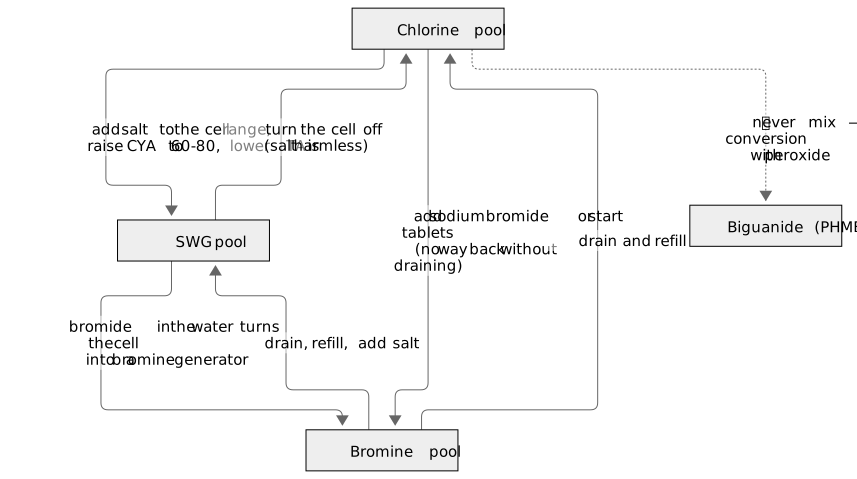
| Switch | Steps | Gotchas |
|---|---|---|
| Chlorine → SWG | 1. Remove metals first (they plate on the cell). 2. Add salt (A6). 3. Raise CYA to the cell maker's range (D1). 4. Lower TA to 60–80 (E1). 5. Consider borates (E8). | Check CSI: a high-CH pool will scale the cell |
| SWG → chlorine | Turn the cell off and dose chlorine yourself (A1) | Leftover salt is harmless; pH rises more slowly without the cell |
| Chlorine or SWG → bromine | Add sodium bromide to build a bank (B3) or switch to BCDMH tablets (B1) | Permanent until drained. Existing CYA is useless but harmless |
| Bromine → chlorine or SWG | Drain and refill | Any chlorine you add turns leftover bromide into bromine, which sunlight destroys |
| Anything ↔ biguanide | Follow the biguanide maker's conversion | ⛔ Chlorine and biguanide react — gummy precipitate, staining |
3 · Chemical monographs
Each monograph opens with a fact box and a dose card. Expand any L (labeled) or O (off-label) block for the effect and benefit, step-by-step use, the amount per 10,000 gal at each strength, and cautions.
3A · Chlorine sources
A1 · Sodium hypochlorite — liquid chlorine, bleach
| Chemistry | NaOCl in water. It's made from chlorine and caustic soda, so every jug also contains an equal amount of salt (NaCl) and a little excess lye that keeps it stable (product pH ~11–13). |
| Sold as | Household bleach 6%, 7.5%, 8.25% (older jugs 5.25%) · pool "liquid chlorine" / "liquid shock" 10% and 12.5% |
| Pool types | Cl ✅ primary · SWG ➕ backup and boost · Br ➕ oxidizer that regenerates bromine |
| Moves | FC ↑ · pH ↑ briefly as added; ≈ 0 over its life apart from the small lye excess · TA ≈ 0 · CH 0 · CYA 0 · salt ↑ 1.65 ppm per ppm FC |
| Never mix with | Acids (chlorine gas) · ammonia (chloramine gas) · other chlorine products or concentrated peroxide in the jug |
| Household equivalent | Plain, unscented household bleach. Avoid "splash-less", scented, color-safe, or "with cleaners" versions. |
Dose card — per 10,000 gal · basis: stoichiometry Memory aid: 1 gallon of N% liquid chlorine raises 10,000 gal by N ppm.
| Strength | +1 ppm FC | +2 ppm | +5 ppm | +10 ppm |
|---|---|---|---|---|
| 5.25% | 24.4 fl oz | 1.52 qt (49 fl oz) | 3.81 qt (122 fl oz) | 1.90 gal (244 fl oz) |
| 6% | 21.3 fl oz | 1.33 qt (43 fl oz) | 3.33 qt (107 fl oz) | 1.67 gal (213 fl oz) |
| 7.5% | 17.1 fl oz | 1.07 qt (34 fl oz) | 2.67 qt (85 fl oz) | 1.33 gal (171 fl oz) |
| 8.25% | 15.5 fl oz | 31.0 fl oz | 2.42 qt (78 fl oz) | 1.21 gal (155 fl oz) |
| 10% | 12.8 fl oz | 25.6 fl oz | 2.00 qt (64 fl oz) | 1.00 gal (128 fl oz) |
| 12.5% | 10.2 fl oz | 20.5 fl oz | 1.60 qt (51 fl oz) | 3.20 qt (102 fl oz) |
Labeled uses
L1 · Routine chlorination — Cl · SWG (backup)
Effect & benefit: Keeps free chlorine at the CYA-indexed target (§1.4). That kills bacteria and viruses, oxidizes sweat and urine, and keeps algae from starting. Unlike tablets or cal-hypo, it adds no CYA and no calcium, so nothing creeps up over the season except salt.
How to use:
- Test FC (and CYA monthly so you know the target).
- Calculate the dose: (target FC − current FC) × amount per +1 ppm from the dose card.
- With the pump running, pour slowly into the deep end in front of a return, or along the wall away from vinyl seams. Keep the jug low to avoid splashing.
- Dose in the evening if you can. An evening dose isn't eaten by sun before it circulates.
- Retest next day. Your daily loss tells you the routine dose.
- SWG pools: use this when the cell is down, in water too cold for the cell, or to catch up after heavy use.
How much (per 10,000 gal) · basis: stoichiometry
| Strength | Typical daily dose, +2 ppm | +3 ppm | +4 ppm |
|---|---|---|---|
| 6% | 1.33 qt (43 fl oz) | 2.00 qt (64 fl oz) | 2.67 qt (85 fl oz) |
| 8.25% | 31.0 fl oz | 1.45 qt (47 fl oz) | 1.94 qt (62 fl oz) |
| 10% | 25.6 fl oz | 1.20 qt (38 fl oz) | 1.60 qt (51 fl oz) |
| 12.5% | 20.5 fl oz | 30.7 fl oz | 1.28 qt (41 fl oz) |
Outdoor pools with CYA 30–50 typically lose 1–4 ppm a day in summer sun. Use your own measured loss, not this range.
Cautions:
- The jug weakens in heat and with age. Dose by test result, not by habit.
- Every ppm adds ~1.65 ppm salt, plus chlorate as it ages. Long-running bleach pools reach 1,000–2,000 ppm salt, which is harmless.
- Don't pour it into the skimmer right after acid.
- Never pour concentrate straight onto a vinyl liner.
L2 · Superchlorination / shock — Cl · SWG · Br
Effect & benefit: A one-time high dose. It burns off combined chlorine (chloramines), body oils, and other organic load after heavy use, a storm, or an opening. The water clears and the "chlorine smell" goes away.
How to use:
- Brush walls and floor, empty the baskets, and make sure the filter is clean.
- Pump on. Add the dose in the evening, poured slowly in front of a return.
- Keep the pump running at least 8 h.
- Retest FC and CC next morning. If CC is still > 0.5, the shock wasn't strong enough — use O1 SLAM.
- Re-enter only when FC is back down to your label's swimming limit.
How much (per 10,000 gal) · basis: label + stoichiometry
Typical labels say to add enough "to yield 5 to 10 ppm":
| Product | Label shock dose |
|---|---|
| 12.5% | 52–104 fl oz |
| 10% | 64–128 fl oz |
| HTH 10% (FAQ) | ~1 gal for a +5–7 ppm reading after demand |
Exact amounts for a measured rise:
| Strength | Raise FC by 10 ppm | Raise FC by 15 ppm |
|---|---|---|
| 6% | 1.67 gal (213 fl oz) | 2.50 gal (320 fl oz) |
| 8.25% | 1.21 gal (155 fl oz) | 1.82 gal (233 fl oz) |
| 10% | 1.00 gal (128 fl oz) | 1.50 gal (192 fl oz) |
| 12.5% | 3.20 qt (102 fl oz) | 1.20 gal (154 fl oz) |
Cautions: Fixed "1 gallon per 10,000 gallons" directions ignore CYA. At CYA 60+, a 10 ppm shock is weak (use §1.4). At CYA 0 it's very strong. Bromine pools: chlorine shock is also the oxidizer that turns bromide back into bromine (see O3).
L3 · Algae treatment — Cl · SWG
Effect & benefit: Kills suspended and wall algae: green, yellow/mustard, and the surface layer of black algae. Labels for visible algae call for multiples of the shock dose.
How to use:
- Brush every surface hard.
- Add the algae dose.
- Run the pump 24 h a day and brush again daily.
- Vacuum dead algae (to waste if it's heavy), then clean the filter.
- Keep FC up until the water is clear and stays clear overnight.
How much (per 10,000 gal) · basis: label + stoichiometry
Labels call for roughly double the shock dose when algae is visible. HTH's guidance is 2 gal of 10% per 10,000 gal for severe algae, about +20 ppm.
| Strength | 2× shock (+20 ppm) | 3× shock (+30 ppm) |
|---|---|---|
| 6% | 3.33 gal (427 fl oz) | 5.00 gal (640 fl oz) |
| 8.25% | 2.42 gal (310 fl oz) | 3.64 gal (465 fl oz) |
| 10% | 2.00 gal (256 fl oz) | 3.00 gal (384 fl oz) |
| 12.5% | 1.60 gal (205 fl oz) | 2.40 gal (307 fl oz) |
Cautions: One big dose often only knocks algae back. Holding the right level until three tests pass is what kills it, and that's SLAM (O1). Very high FC bleaches the pH indicator (§1.7).
Off-label uses
O1 · SLAM — Shock Level And Maintain — Cl · SWG ⚠️
Effect & benefit: The Trouble Free Pool method for algae, cloudy water, persistent CC, and pool openings. You set FC from CYA (40% of CYA) and hold it there, re-dosing through the day, until three objective tests pass. This kills algae completely instead of knocking it back, and the tests tell you exactly when you're done.
How to use:
- Test CYA (it sets the target) and pH. Lowering pH to ~7.2 at the start makes chlorine work a little faster.
- Brush the whole pool, clean the filter, and run the pump 24/7 throughout. Turn the SWG off or down and dose by hand.
- Raise FC to the SLAM level in the table below.
- Test every few hours while awake. Re-dose back to the SLAM level each time it drops. Brush at least daily.
- Continue until all three pass:
- CC ≤ 0.5 ppm
- the overnight loss test (O2) loses ≤ 1 ppm
- the water is clear (the main-drain grate is crisp)
- Then stop dosing and let FC fall back to its normal target.
How much — reaching the SLAM level from FC 0 (per 10,000 gal) · basis: stoichiometry (targets: TFP chart)
| CYA | SLAM FC | 6% | 8.25% | 10% | 12.5% |
|---|---|---|---|---|---|
| 0 | 10 | 1.67 gal (213 fl oz) | 1.21 gal (155 fl oz) | 1.00 gal (128 fl oz) | 3.20 qt (102 fl oz) |
| 20 | 8 | 1.33 gal (171 fl oz) | 3.88 qt (124 fl oz) | 3.20 qt (102 fl oz) | 2.56 qt (82 fl oz) |
| 30 | 12 | 2.00 gal (256 fl oz) | 1.45 gal (186 fl oz) | 1.20 gal (154 fl oz) | 3.84 qt (123 fl oz) |
| 40 | 16 | 2.67 gal (341 fl oz) | 1.94 gal (248 fl oz) | 1.60 gal (205 fl oz) | 1.28 gal (164 fl oz) |
| 50 | 20 | 3.33 gal (427 fl oz) | 2.42 gal (310 fl oz) | 2.00 gal (256 fl oz) | 1.60 gal (205 fl oz) |
| 60 | 24 | 4.00 gal (512 fl oz) | 2.91 gal (372 fl oz) | 2.40 gal (307 fl oz) | 1.92 gal (246 fl oz) |
| 70 | 28 | 4.67 gal (597 fl oz) | 3.39 gal (434 fl oz) | 2.80 gal (358 fl oz) | 2.24 gal (287 fl oz) |
| 80 | 31 | 5.17 gal (661 fl oz) | 3.76 gal (481 fl oz) | 3.10 gal (397 fl oz) | 2.48 gal (317 fl oz) |
| 90 | 35 | 5.83 gal (747 fl oz) | 4.24 gal (543 fl oz) | 3.50 gal (448 fl oz) | 2.80 gal (358 fl oz) |
| 100 | 39 | 6.50 gal (832 fl oz) | 4.73 gal (605 fl oz) | 3.90 gal (499 fl oz) | 3.12 gal (399 fl oz) |
Mustard (yellow) algae (Trouble Free Pool method):
- First pass a normal SLAM: all three exit tests, CC ≤ 0.5, overnight loss ≤ 1 ppm, and clear water.
- Raise FC to the mustard level, ≈ 60% of CYA, and hold it for 24 hours.
- At the same time, sanitize every swimsuit, toy, float, brush, and vacuum head that touched the water (O5). Mustard algae reinfects from them.
| CYA | SLAM → mustard FC | 6% | 8.25% | 10% | 12.5% |
|---|---|---|---|---|---|
| 30 | 12 → 18 (+6) | 1.00 gal (128 fl oz) | 2.91 qt (93 fl oz) | 2.40 qt (77 fl oz) | 1.92 qt (61 fl oz) |
| 40 | 16 → 24 (+8) | 1.33 gal (171 fl oz) | 3.88 qt (124 fl oz) | 3.20 qt (102 fl oz) | 2.56 qt (82 fl oz) |
| 50 | 20 → 30 (+10) | 1.67 gal (213 fl oz) | 1.21 gal (155 fl oz) | 1.00 gal (128 fl oz) | 3.20 qt (102 fl oz) |
| 60 | 24 → 36 (+12) | 2.00 gal (256 fl oz) | 1.45 gal (186 fl oz) | 1.20 gal (154 fl oz) | 3.84 qt (123 fl oz) |
| 70 | 28 → 42 (+14) | 2.33 gal (299 fl oz) | 1.70 gal (217 fl oz) | 1.40 gal (179 fl oz) | 1.12 gal (143 fl oz) |
| 80 | 31 → 48 (+17) | 2.83 gal (363 fl oz) | 2.06 gal (264 fl oz) | 1.70 gal (218 fl oz) | 1.36 gal (174 fl oz) |
| 90 | 35 → 54 (+19) | 3.17 gal (405 fl oz) | 2.30 gal (295 fl oz) | 1.90 gal (243 fl oz) | 1.52 gal (195 fl oz) |
Cautions:
- FIFRA: SLAM levels can exceed a label's shock dose and re-entry limit. Follow your label for swimming.
- Above CYA ~80, SLAM gets expensive. A partial drain to lower CYA first is often cheaper.
- At these levels, read pH only after neutralizing the sample (§1.7).
- Pour slowly near returns to avoid bleaching vinyl.
O2 · Overnight Chlorine Loss Test (OCLT) — Cl · SWG
Effect & benefit: A free diagnostic for algae or organic load you can't see yet. With no sunlight, clean water loses almost no chlorine overnight. A loss above 1 ppm means something is still consuming it. It's also the second of SLAM's three exit tests.
How to use:
- Make sure FC is at least at your normal target. Turn the SWG off for the night, and add nothing overnight.
- Test FC after the sun is fully off the water. Use a 25 mL FAS-DPD sample, which reads to 0.2 ppm.
- Test again just before sunrise, the same way.
- A loss of ≤ 1 ppm passes. More than 1 ppm fails: something is still consuming chlorine (algae, organics, a dirty filter). SLAM, or keep SLAMming.
How much (per 10,000 gal) · basis: stoichiometry
There's no special dose. Just be at or above target, using the dose card above. As a reference, a 1 ppm loss in 10,000 gal equals 12.8 fl oz of 10% (10.2 fl oz of 12.5%) chlorine consumed overnight.
Cautions:
- A cover doesn't change the result; just do it the same way every time.
- Test-strip or color-block precision isn't good enough for this test.
O3 · Regenerate bromine in a bromine pool ("bleach-bromine") — Br
Effect & benefit: Once a bromine pool or spa has a bromide bank (B3), plain liquid chlorine turns spent bromide back into active bromine (HOCl + Br⁻ → HOBr + Cl⁻). This can replace BCDMH tablets entirely. You get no DMH buildup, the cost is lower, and you control the dose exactly.
How to use:
- Confirm a bromide bank exists: B3 · L1, or an established tablet-fed pool.
- Test total bromine with a DPD kit; bromine = chlorine-scale reading × 2.25.
- Add liquid chlorine as below with the pump running. It converts to bromine within minutes.
- Dose daily or as needed to hold your bromine target.
How much (per 10,000 gal) · basis: stoichiometry (each 1 ppm bromine needs 0.444 ppm FC)
| Strength | +1 ppm bromine | +3 ppm bromine | +5 ppm bromine |
|---|---|---|---|
| 6% | 9.5 fl oz | 28.4 fl oz | 1.48 qt (47 fl oz) |
| 8.25% | 6.9 fl oz | 20.7 fl oz | 1.08 qt (34 fl oz) |
| 10% | 5.7 fl oz | 17.0 fl oz | 28.4 fl oz |
| 12.5% | 4.5 fl oz | 13.6 fl oz | 22.7 fl oz |
Cautions:
- Label limits: since EPA's 2021 decision on inorganic halides, US sodium-bromide and bromine labels say "not for use in outdoor pools", and outdoor spas must be covered when not in use. Sunlight turns bromine plus bromide into bromate. This method is for indoor pools and covered spas.
- Bromine can't be stabilized, so outdoor sun burns it off quickly.
- Without a bank, chlorine stays chlorine.
- In a 400 gal spa, the +1 ppm dose is only 0.18–0.38 fl oz. Measure with a syringe.
O4 · Oxidize iron, manganese, or sulfide in well-water fill — Cl · SWG · Br ⚠️
Effect & benefit: Well water often carries dissolved ferrous iron, manganese, or hydrogen sulfide (rotten-egg smell). Chlorine oxidizes them. Iron becomes brown ferric hydroxide, manganese becomes black/brown MnO₂, and sulfide becomes sulfur or sulfate. Doing this on purpose, before the water touches the surface for long, lets you floc or filter the metals out instead of finding them as stains later.
How to use:
- Test the fill water (or the freshly filled pool) for iron and manganese.
- Choose a strategy:
- Keep the metals in solution with a sequestrant (I1). This is simpler and best for low levels.
- Remove them, as follows. Best for > ~0.5 ppm iron.
- Raise pH to ~7.6–7.8 and FC to ~10 ppm. The water will turn tea-colored or cloudy brown; manganese is slower and darker.
- Run the filter 24 h. Then either let the filter catch the precipitate (clean it after), or floc (H3) and vacuum the settled layer to waste.
- Brush any settled precipitate off plaster promptly, before it stains.
- Add a sequestrant afterward to hold whatever remains.
How much (per 10,000 gal) · basis: stoichiometry (oxidant demand) + rule of thumb (holding level)
| Contaminant | Chlorine demand per 1 ppm of contaminant | 10% liquid chlorine per 1 ppm of contaminant |
|---|---|---|
| Iron (Fe²⁺ → Fe³⁺) | 0.64 ppm FC | 8.1 fl oz |
| Manganese (Mn²⁺ → MnO₂) | 1.29 ppm FC | 16.5 fl oz |
| Hydrogen sulfide (to sulfur) | 2.1 ppm FC | 26.6 fl oz |
| Hydrogen sulfide (to sulfate) | 8.3 ppm FC | 106 fl oz (3.32 qt) |
Then hold FC ~10 ppm (1 gal of 10% per 10k gal) until the water clears. Other strengths: multiply the 10% volume by 1.67 (6%), 1.21 (8.25%), or 0.8 (12.5%).
Cautions:
- Precipitated iron stains plaster if it sits. Brush and vacuum the same day.
- If iron is above ~1–2 ppm, a pre-filter or trucked-in water is often cheaper.
O5 · Disinfect deck, furniture, toys, covers, and gear; remove mildew — around the pool ⚠️
Effect & benefit: The same chemical that sanitizes the pool kills mildew and germs on hard surfaces. It also bleaches organic stains on concrete. This is essential after mustard algae, which hides on swimsuits, toys, floats, and brushes and reinfects the pool.
How to use:
- Clean off dirt first; chlorine is used up by soil.
- To disinfect: wipe or spray the diluted solution, keep the surface wet ≥ 5 min, then rinse.
- For gear after mustard algae: submerge brushes, toys, floats, and suits in the pool during a SLAM (O1), or soak them in a bucket of the disinfecting mix for 30 min, then rinse.
- For mildew on concrete or pavers: wet the plants nearby first, apply the stronger mix, wait 10–15 min, scrub, and rinse well.
How much (per gallon of water, not per pool) · basis: label (CDC/EPA household dilution)
| Strength | Disinfecting mix (~1,000–1,300 ppm) | Mildew/stain mix (~3× stronger) |
|---|---|---|
| 6% | 5 tbsp (⅓ cup) per gallon | 1 cup per gallon |
| 8.25% | 4 tbsp (¼ cup) per gallon | ¾ cup per gallon |
| 10% | 3 tbsp per gallon | ⅔ cup per gallon |
| 12.5% | 2½ tbsp per gallon | ½ cup per gallon |
Cautions:
- FIFRA: use a bleach whose label lists surface disinfection when you can.
- Never mix with ammonia or acidic cleaners.
- It bleaches fabrics, cushions, and colored concrete stains — test a small spot first.
- Rinse treated wood and nearby plants.
O6 · Emergency drinking-water disinfection — household bleach only ⚠️
Effect & benefit: When tap water is unsafe (boil-water notice, no power to boil), EPA's emergency method uses plain household bleach to kill bacteria and viruses in clear water. It's not effective against chemical contamination.
How to use (EPA method):
- If the water is cloudy, let it settle and filter it through a clean cloth or coffee filter first.
- Add the drops below, stir, and let it stand 30 minutes.
- It should have a slight chlorine odor. If not, repeat the dose and wait 15 more minutes.
- Double the dose if the water is cloudy, colored, or very cold.
How much (per gallon of water) · basis: label (EPA)
| Water | 6% bleach | 8.25% bleach |
|---|---|---|
| 1 quart | 2 drops | 2 drops |
| 1 gallon | 8 drops | 6 drops |
| 2 gallons | 16 drops (¼ tsp) | 12 drops (⅛ tsp) |
| 4 gallons | ⅓ tsp | ¼ tsp |
| 8 gallons | ⅔ tsp | ½ tsp |
Current Clorox bleach is 7.5% (7.1% available chlorine). EPA's table covers 6% and 8.25%, so use the drinking-water directions on the bottle. For 10% and 12.5% pool chlorine, see Cautions.
Cautions:
- Use only plain, unscented bleach with no additives, ideally one whose label gives drinking-water directions.
- Pool "liquid chlorine" isn't labeled for drinking water (FIFRA), and it may carry more
chlorate as it ages. Use it only if nothing else exists and the product is certified to NSF/ANSI 60.
- The same chlorine as EPA's 6% rate is about 5 drops per gallon of 10% or 4 drops per gallon of 12.5%. That's arithmetic, not EPA guidance.
- For well or cistern shock-chlorination, follow your state or county extension procedure.
O7 · Spot-bleach organic stains — Cl · SWG · Br (plaster)
Effect & benefit: Leaf, berry, acorn, and tannin stains on plaster lighten much faster with concentrated chlorine applied right at the stain than with whole-pool shock. Liquid chlorine is denser than water, so poured slowly from just above the surface, it sinks onto the stain.
How to use:
- Confirm the stain is organic: it lightens with a trichlor tablet (A5 · O1) and not with vitamin C (I3 · O2).
- Turn the pump off.
- Pour liquid chlorine slowly from just above the water directly over the stain. For deep spots, guide it down a length of PVC pipe held over the stain.
- Wait 15–30 min, brush, then restart the pump.
- Repeat if needed.
How much (per stain area; counts toward pool FC) · basis: rule of thumb + stoichiometry
| Strength | Per stain | FC added to 10,000 gal per cup |
|---|---|---|
| 6% | 1–2 cups | +0.38 ppm |
| 8.25% | 1–2 cups | +0.52 ppm |
| 10% | 1–2 cups | +0.63 ppm |
| 12.5% | ½–1 cup | +0.78 ppm |
Cautions:
- ⛔ Not on vinyl liners: concentrated chlorine bleaches the print.
- Test colored plaster or pebble finishes in an inconspicuous spot first.
O8 · Measure your pool's real volume with a chlorine dose — Cl · SWG · Br
Effect & benefit: Every dose in this guide depends on volume, and estimates from dimensions are often 10–30% off. A measured dose of fresh liquid chlorine, read with a precise FC test, gives you the actual gallons. The underlying fact: 1 gal of N% chlorine raises 10,000 gal by N ppm.
How to use:
- Pass an overnight loss test first (O2). Chlorine demand would make the volume read high.
- After sunset, with the pump running and the SWG off, test FC with a 25 mL FAS-DPD sample.
- Add a measured volume of fresh liquid chlorine and circulate 30–60 min. Aim for a rise of 5–10 ppm.
- Retest FC the same way.
- Calculate: Volume (gal) = gallons added × strength % × 10,000 ÷ FC rise For example, 1 gal of 10% that raised FC by 6.4 ppm gives 1 × 10 × 10,000 ÷ 6.4 = 15,600 gal.
How much (per 10,000 gal of expected volume) · basis: stoichiometry
| Strength | Amount for a ~6 ppm rise |
|---|---|
| 6% | 1.00 gal |
| 8.25% | 3.0 qt (0.73 gal) |
| 10% | 2.4 qt (0.60 gal) |
| 12.5% | 1.9 qt (0.48 gal) |
Cautions:
- Liquid chlorine loses strength in storage. Old product makes the pool look bigger than it is, so use a fresh jug.
- Repeat on a second night and average the results.
Hazards & storage:
- Store cool, shaded, upright, and vented as supplied, away from acids.
- Old or hot-stored bleach is weaker and higher in chlorate.
- It dissolves skin oils (slippery feel) and bleaches clothing. Rinse spills with plenty of water.
A2 · Calcium hypochlorite — cal-hypo, granular shock, cal-hypo tablets
| Chemistry | Ca(OCl)₂ granules or tablets, the balance mostly salts and water. It releases unstabilized chlorine plus calcium. Labels give % calcium hypochlorite and a guaranteed minimum available chlorine (73% cal-hypo = ≥ 70% available). Dose by available chlorine. |
| Sold as | 52% (HTH Pool Care Shock) · 56% (HTH Shock Advanced, Super Shock!, Ultimate Shock, Shock Ultra) · 68% cal-hypo / 65% min. available (In The Swim Pool Shock; Accu-Tab Blue feeder tablets; Pulsar Plus briquettes ≥ 65%) · 73% / 70% min. available (Leslie's Power Powder Plus and Pro 73; In The Swim Super Pool Shock). Not cal-hypo despite the "shock" name: Clorox Pool&Spa Shock XtraBlue (dichlor + copper, A4) and Pool Essentials shock (trichlor blend, A5). |
| Pool types | Cl ✅ shock or feeder tablets · SWG ⚠️ extra calcium scales the cell; occasional shock only · Br ➕ shock and oxidizer (watch CH) |
| Moves | FC ↑ · CH ↑ ~0.7 ppm per ppm FC · pH ↑ slightly (alkaline product) · TA ≈ 0 over its life · CYA 0 · chloride ↑ |
| Never mix with | Trichlor or dichlor (fire or explosion) · acids (chlorine gas) · oils, brake fluid, fertilizer, pool cleaners, or any organic material (fire) · ammonia · small amounts of water in a closed container (heat, gas) |
Dose card — per 10,000 gal · basis: stoichiometry (strength = % available chlorine)
| Available chlorine | +1 ppm FC | +5 ppm | +10 ppm | +15 ppm | 1 lb raises FC / CH by |
|---|---|---|---|---|---|
| 52% | 2.57 oz | 12.8 oz | 1.60 lb (25.7 oz) | 2.41 lb (38.5 oz) | +6.2 / +4.4 ppm |
| 56% | 2.38 oz | 11.9 oz | 1.49 lb (23.8 oz) | 2.24 lb (35.8 oz) | +6.7 / +4.7 ppm |
| 65% | 2.05 oz | 10.3 oz | 1.28 lb (20.5 oz) | 1.93 lb (30.8 oz) | +7.8 / +5.5 ppm |
| 68% | 1.96 oz | 9.8 oz | 1.23 lb (19.6 oz) | 1.84 lb (29.5 oz) | +8.2 / +5.8 ppm |
| 70% | 1.91 oz | 9.5 oz | 1.19 lb (19.1 oz) | 1.79 lb (28.6 oz) | +8.4 / +5.9 ppm |
| 73% | 1.83 oz | 9.1 oz | 1.14 lb (18.3 oz) | 1.71 lb (27.4 oz) | +8.8 / +6.2 ppm |
Use the row for your label's minimum available chlorine. A "73% cal-hypo" bag doses on the 70% row and lands slightly above target, which is the safe side.
Labeled uses
L1 · Shock / superchlorinate — Cl · Br · SWG (occasional)
Effect & benefit: A fast, strong, unstabilized dose. It burns off chloramines, body oils, and other organic load after heavy use, storms, or an opening, and adds no CYA. It comes as dry granules in 1-lb bags, so it's easy to store and carry compared with jugs.
How to use:
- Brush the pool, empty the baskets, and confirm the filter is clean. Pump on.
- Fill a clean 5-gal bucket about ¾ with pool water, then add the granules to the water. Never add water to the granules. Stir with a clean stick and let the undissolved residue settle.
- Pour the solution slowly around the deep end or in front of a return, at dusk. Over plaster, some labels allow broadcasting dry. Over vinyl or fiberglass, always pre-dissolve: undissolved granules sitting on a liner bleach and weaken it.
- Run the pump at least 8 h, brush again, then test FC and CC.
- Swim only when FC has fallen to your label's re-entry limit.
How much (per 10,000 gal) · basis: label + stoichiometry
| Product (available chlorine) | Label shock dose | Equivalent |
|---|---|---|
| HTH Shock Advanced / Super Shock! (56%) | 1 lb per 13,500 gal → 5 ppm | 1 lb per 10k ≈ +6.8 ppm |
| HTH Ultimate Shock / Shock Ultra (56%) | 1 lb per 16,750 gal → 4 ppm | 1 lb per 10k ≈ +6.7 ppm |
| HTH Pool Care Shock (52%) | 1 lb per 12,500 gal → ~5 ppm | 1 lb per 10k ≈ +6.2 ppm |
| In The Swim Pool Shock (68%, ≥ 65% available) | 1 lb per 10,000 gal → 5–10 ppm | ≈ +7.8–8.2 ppm |
| Leslie's Power Powder Plus/Pro 73 (≥ 70% available) | 9–18 oz per 10,000 gal → 5–10 ppm | 9 oz ≈ +4.7 ppm; 18 oz ≈ +9.4 ppm |
To hit a specific FC, use the dose card above.
Cautions:
- Each shock leaves calcium behind: about +7 ppm CH per 10 ppm FC. That's harmless in a soft-water plaster pool and a scaling problem in a high-CH pool or on an SWG cell.
- Fixed "1 lb per 10,000 gal" directions ignore CYA. A 5–10 ppm shock is weak above CYA ~50 (§1.4).
- For multi-day SLAM, use liquid chlorine (A1 · O1). Five days of SLAM with cal-hypo can add 40–70 ppm CH.
- Undissolved residue and temporary cloudiness are normal. Brush them out.
L2 · Routine chlorination (feeder tablets or granular dosing) — Cl · Br
Effect & benefit: Day-to-day chlorine without adding CYA, either from cal-hypo tablets in a dedicated cal-hypo feeder (common on commercial pools) or from small granular doses. It suits indoor pools (no CYA wanted) and pools that also need calcium.
How to use:
- Tablets: use only a feeder built for cal-hypo tablets: Accu-Tab Blue (68%) or Pulsar Plus briquettes (≥ 65% available, ~7 g each). Never use a trichlor feeder, and never mix product types in one feeder.
- Set the feeder to hold FC at target. Accu-Tab Blue's label says to adjust to 1–3 ppm. For outdoor pools with CYA, scale the target to CYA (§1.4).
- Test FC daily the first week and adjust the feeder setting.
- Granular: pre-dissolve small daily doses in a bucket of pool water, as in L1.
- Test CH monthly. It climbs steadily (see O1).
How much (per 10,000 gal) · basis: label + stoichiometry
| Product | Label maintenance dose | FC added per dose |
|---|---|---|
| Leslie's Power Powder 73 — unstabilized pool | 5–7 oz daily | ≈ +2.6–3.7 ppm |
| Leslie's Power Powder 73 — stabilized pool | 3–5 oz every other day | ≈ +1.6–2.6 ppm |
| Accu-Tab Blue 68% (feeder) | Feeder setting to hold 1–3 ppm (label: one tablet treats 10,000 gal for up to 7 days) | — |
| Available chlorine | Daily dose for +2 ppm | +3 ppm | +4 ppm |
|---|---|---|---|
| 52% | 5.1 oz | 7.7 oz | 10.3 oz |
| 56% | 4.8 oz | 7.2 oz | 9.5 oz |
| 65% | 4.1 oz | 6.2 oz | 8.2 oz |
| 68% | 3.9 oz | 5.9 oz | 7.9 oz |
| 70% | 3.8 oz | 5.7 oz | 7.6 oz |
| 73% | 3.7 oz | 5.5 oz | 7.3 oz |
Cautions:
- The "industrial" Accu-Tab (325 g tablets, EPA 748-295) is labeled not for swimming pools. Buy the pool-registered Accu-Tab Blue.
- CH rises about 0.7 ppm for every ppm of FC you add.
- Calcium scale can clog feeder outlets; descale per the feeder maker.
L3 · Algae treatment — Cl · Br
Effect & benefit: A doubled shock kills suspended and early wall algae. HTH tells users to double the dose for cloudy water or early algae. Brushing is what exposes the algae to the chlorine.
How to use:
- Brush every surface hard. Use a stainless brush on black-algae spots, on plaster only.
- Pre-dissolve and add the doubled dose (as in L1), pump running 24 h.
- Brush daily, vacuum dead algae (to waste if heavy), and clean the filter.
- If the water isn't clear and holding chlorine overnight within 2–3 days, switch to a full SLAM with liquid chlorine (A1 · O1).
How much (per 10,000 gal) · basis: label + stoichiometry
| Available chlorine | 2× shock (+15 ppm) | +20 ppm | CH added |
|---|---|---|---|
| 52% | 2.41 lb (38.5 oz) | 3.21 lb (51.4 oz) | +11–14 ppm |
| 56% | 2.24 lb (35.8 oz) | 2.98 lb (47.7 oz) | +11–14 ppm |
| 65% | 1.93 lb (30.8 oz) | 2.57 lb (41.1 oz) | +11–14 ppm |
| 68% | 1.84 lb (29.5 oz) | 2.45 lb (39.3 oz) | +11–14 ppm |
| 70% | 1.79 lb (28.6 oz) | 2.38 lb (38.2 oz) | +11–14 ppm |
| 73% | 1.71 lb (27.4 oz) | 2.29 lb (36.6 oz) | +11–14 ppm |
Cautions:
Off-label uses
O1 · Chlorine and calcium in one dose for low-CH plaster pools — Cl · Br (plaster)
Effect & benefit: Every ppm of FC from cal-hypo leaves ~0.7 ppm CH behind. If your fill water is soft and a plaster pool sits below its calcium target, using cal-hypo as the daily chlorine for a few weeks raises CH "for free." You don't buy or dissolve calcium chloride, and the water stops being aggressive to the plaster.
How to use:
- Test CH, TA, pH, and CYA and work out CSI (§1.6). This only makes sense if CH is below target and CSI is negative.
- Switch your daily chlorine from liquid chlorine to pre-dissolved cal-hypo (L1/L2 method).
- Retest CH weekly.
- When CH reaches target, or CSI approaches 0, switch back to liquid chlorine.
- If you need a big CH jump fast, use calcium chloride (F1) instead. Cal-hypo only adds calcium as fast as you use chlorine.
How much (per 10,000 gal) · basis: stoichiometry (0.706 ppm CH per ppm FC)
| Daily chlorine use | CH added per day | per week | per 30 days |
|---|---|---|---|
| 2 ppm FC/day | +1.4 ppm | +10 ppm | +42 ppm |
| 3 ppm FC/day | +2.1 ppm | +15 ppm | +64 ppm |
| 4 ppm FC/day | +2.8 ppm | +20 ppm | +85 ppm |
For per-pound FC and CH by strength, see the dose card above (e.g., 1 lb of 73% ≈ +8.8 ppm FC and +6.2 ppm CH). The 0.7 ratio counts only the hypochlorite. Blends with extra calcium salts add a little more, so treat 0.7 as a floor.
Cautions:
- Not for SWG pools (scale on the cell) or pools already at or above target CH.
- Watch for cloudiness, a sign CSI has gone positive. Return to liquid chlorine if you see it.
O2 · "Sock" spot treatment of black algae and organic stains on plaster — Cl · Br (plaster only) ⚠️
Effect & benefit: Granules sealed in a sock deliver very concentrated chlorine directly onto one spot without dosing the whole pool to that level. Black-algae colonies hide under protective layers; after you break them with a stainless brush, the sock's local blast penetrates. Leaf and berry stains on plaster lighten in minutes.
How to use:
- Wear gloves and goggles.
- Put 2–4 oz of cal-hypo in a clean cotton sock or nylon knee-high and knot it closed. Use a new sock that has never touched trichlor or any other chemical.
- For black algae, scrub the spot hard with a stainless-steel brush first.
- Turn the pump off. Hold the sock against the spot, or drag it slowly over it, for 30–60 s at a time. A sock tied to a pole or brush head reaches deep spots. Don't leave it lying there.
- Repeat on each spot, brush again, then restart the pump.
- Dissolve any granules left in the sock in a bucket of pool water and pour that into the pool. Never return a wet sock to the chemical container.
- For black algae, repeat daily alongside a SLAM (A1 · O1).
How much (per 10,000 gal) · basis: rule of thumb (per sock) + stoichiometry (FC added)
| Available chlorine | Per sock | FC added to 10,000 gal when fully dissolved |
|---|---|---|
| 65% | 2–4 oz | +1.0–1.9 ppm |
| 73% | 2–4 oz | +1.1–2.2 ppm |
Cautions:
- ⛔ Never on vinyl, fiberglass, or painted surfaces: it bleaches and damages them.
- Colored plaster and pebble finishes can lighten; test an inconspicuous spot.
- A sock left resting in one spot can bleach a pale halo into plaster.
O3 · Emergency drinking-water disinfection (EPA stock-solution method) — household emergency ⚠️
Effect & benefit: When there's no plain household bleach, EPA's emergency-disinfection page describes making a chlorine stock solution from granular calcium hypochlorite, then diluting it into clear water to kill bacteria and viruses. It doesn't remove chemical contamination.
How to use (EPA's words, quoted):
"Add one heaping teaspoon (approximately ¼ ounce) of high-test granular calcium hypochlorite (HTH) to two gallons of water and stir until the particles have dissolved. The mixture will produce a chlorine solution of approximately 500 milligrams per liter. To disinfect water, add one part of the chlorine solution to each 100 parts of water you are treating. This is about the same as adding 1 pint (16 ounces) of the chlorine solution to 12.5 gallons of water."
- Use a product whose only active ingredient is calcium hypochlorite, ideally 65–73%. Avoid blends with clarifiers, algaecides, or "blue" additives, and never use dichlor or trichlor.
- Filter cloudy water through a clean cloth first.
- After adding the stock, stir and let the water stand at least 30 minutes before drinking. That's the same contact time EPA gives for its bleach method.
- Label the stock container "POISON — chlorine stock, do not drink." Make it fresh; it weakens over days.
How much · basis: label (EPA) + stoichiometry
| Step | Amount |
|---|---|
| Stock solution | 1 heaping tsp (≈ ¼ oz, ~7 g) cal-hypo in 2 gal water → ≈ 500 mg/L |
| Treat 1 gal of water | 1.28 fl oz stock (≈ 2½ tbsp) |
| Treat 5 gal | 6.4 fl oz stock |
| Treat 12.5 gal | 1 pint (16 fl oz) stock — EPA's example |
| Treat a 55-gal drum | 70 fl oz (2.2 qt) stock |
For reference, ¼ oz of 56–73% product in 2 gal works out to ~520–680 mg/L. "Approximately 500" covers a loosely heaped teaspoon, and the 1:100 dilution lands at ~5 mg/L.
Cautions:
- FIFRA: pool-shock labels don't list drinking water. This is EPA's emergency procedure for when nothing better exists.
- Store the dry product sealed and dry. The stock solution is corrosive.
Hazards & storage:
- Cal-hypo is a strong oxidizer. Keep it dry, sealed, cool, and away from acids, trichlor and dichlor, and anything organic: oil, gasoline, brake fluid, fertilizer, leaves.
- A trickle of water or contamination can start a fire.
- Use dedicated, dry scoops, and never put cal-hypo into a trichlor feeder.
- Sweep up spills with clean, dry tools, dissolve them in a large bucket of water, and add the solution to the pool. Don't throw cal-hypo in the trash.
A3 · Lithium hypochlorite — legacy fast-dissolving shock
| Chemistry | LiOCl, sold as ~29% lithium hypochlorite blended with salts = 35% available chlorine. Dissolves almost instantly with no residue. |
| Sold as | 35% available-chlorine granules. Largely gone from US and Canadian retail since ~2018–2020, when lithium went to batteries; the main producer lists it as eliminated. Mostly found as old stock. |
| Pool types | Cl ➕ legacy shock · SWG ➕ (no calcium, so no cell scale) · Br ➕ legacy spa shock |
| Moves | FC ↑ · pH ↑ slightly · TA ≈ 0 over its life · CH 0 · CYA 0 · trace lithium and chloride |
| Never mix with | Acids (chlorine gas) · cal-hypo, trichlor, dichlor · organics · ammonia |
Dose card — per 10,000 gal · basis: stoichiometry
| Available chlorine | +1 ppm FC | +5 ppm | +10 ppm | +15 ppm | 1 lb raises FC by |
|---|---|---|---|---|---|
| 35% | 3.82 oz | 1.19 lb (19.1 oz) | 2.38 lb (38.2 oz) | 3.58 lb (57.2 oz) | +4.2 ppm |
Labeled uses
L1 · Fast-dissolving shock for vinyl, fiberglass, spas — Cl · SWG · Br
Effect & benefit: An unstabilized shock that dissolves completely in seconds and adds no calcium and no CYA. Granules don't sit on a liner and bleach it, and nothing clouds the water. That made it the classic shock for vinyl, fiberglass, spas, and SWG pools. It's also a quick chlorine boost when you don't want any CH or CYA side effects.
How to use:
- Pump on, filter clean.
- Broadcast the granules over the deep end, or pre-dissolve them in a bucket of pool water. Always add granules to water.
- Brush, run the pump at least 8 h, then test FC.
- Swim per the label's re-entry limit.
How much (per 10,000 gal) · basis: stoichiometry
Use the dose card. A typical 5–10 ppm shock is 19–38 oz (1.2–2.4 lb). Retest after dosing: old stock may have weakened, so the dose card is a ceiling, not a guarantee.
Cautions:
- Per ppm of chlorine, it costs several times what liquid chlorine costs.
- Caked or damp product may have lost strength or contaminated itself. Dispose of it through a household-hazardous-waste drop-off.
Off-label uses
No off-label uses worth recommending. Everything lithium hypochlorite does, liquid chlorine (A1) does with the same "no calcium, no CYA" profile at a fraction of the price. If you still have a sealed, dry container, use it up as an ordinary shock (L1) and verify each dose with an FC test.
Hazards & storage:
- Oxidizer: keep dry, sealed, and away from acids, other chlorine products, and organics.
- Never store it opened in a humid shed.
A4 · Sodium dichloroisocyanurate — dichlor, stabilized granular chlorine
| Chemistry | Sodium dichloro-s-triazinetrione. It dissolves fast into free chlorine plus cyanuric acid (CYA). Product pH is near neutral. |
| Sold as | Dihydrate 55–56% available chlorine (e.g., Leslie's Chlor Brite 55%) · anhydrous 62% (e.g., Nissan D.C.C.Na) · branded blends: Clorox Pool&Spa Shock XtraBlue (dichlor 63% → 39% available chlorine, plus 0.26% copper from copper citrate) and XtraBlue+ (dichlor dihydrate 72% → 40% available) |
| Pool types | Cl ➕ spas, small pools, startups · SWG ➕ adds startup CYA and chlorine together · Br ⚠️ oxidizes bromide but adds CYA that does nothing for bromine |
| Moves | FC ↑ · CYA ↑ 0.9 ppm per ppm FC · pH ≈ neutral · TA ↓ ~0.35 ppm per ppm FC as the chlorine is used · CH 0 |
| Never mix with | Cal-hypo (fire or explosion) · acids (chlorine gas) · ammonia · organics · moisture in a closed container |
| Household equivalent | None. Certified drinking-water tablets made of the same chemical (e.g., Aquatabs) are a different, NSF-certified product. |
Dose card — per 10,000 gal · basis: stoichiometry
| Available chlorine | +1 ppm FC | +5 ppm | +10 ppm | 1 lb raises FC / CYA by |
|---|---|---|---|---|
| 39% (XtraBlue blend) | 3.42 oz | 1.07 lb (17.1 oz) | 2.14 lb (34.2 oz) | +4.7 / +4.3 ppm |
| 40% (XtraBlue+ blend) | 3.34 oz | 1.04 lb (16.7 oz) | 2.09 lb (33.4 oz) | +4.8 / +4.4 ppm |
| 55% (dihydrate) | 2.43 oz | 12.1 oz | 1.52 lb (24.3 oz) | +6.6 / +6.0 ppm |
| 56% (dihydrate) | 2.38 oz | 11.9 oz | 1.49 lb (23.8 oz) | +6.7 / +6.1 ppm |
| 62% (anhydrous) | 2.15 oz | 10.8 oz | 1.35 lb (21.5 oz) | +7.4 / +6.8 ppm |
| CYA added | +0.9 ppm | +4.6 ppm | +9.1 ppm | — |
Labeled uses
L1 · Routine chlorination (spas and small pools) — Cl · SWG (startup)
Effect & benefit: Granular chlorine that dissolves in seconds and barely moves pH. Small, precise doses are easy, which is why it's the classic hot-tub sanitizer. The built-in stabilizer keeps chlorine from burning off in sun. The catch: CYA rises with every dose.
How to use:
- Test FC (and CYA every couple of weeks; it climbs fast).
- Spa: after each soak, sprinkle the dose into the water with the jets running. Pool: broadcast over the deep end with the pump running, or pre-dissolve in a bucket of pool water.
- Retest FC before the next use.
- When CYA reaches your target, switch to unstabilized chlorine (A1). That's the "dichlor-then-bleach" pattern (O1).
How much (per 10,000 gal) · basis: label + stoichiometry
| Product | Label routine dose | FC / CYA added per dose |
|---|---|---|
| Leslie's Chlor Brite (55%) | 3 oz every other day | ≈ +1.2 / +1.1 ppm |
| Nissan D.C.C.Na (62%) | 4 oz → "2 ppm" | ≈ +1.9 / +1.7 ppm |
Spa (400 gal) · basis: stoichiometry
| Available chlorine | +1 ppm FC | +3 ppm (typical after-soak dose) | CYA added per +3 ppm |
|---|---|---|---|
| 55% | 2.8 g | 8.3 g | +2.7 ppm |
| 56% | 2.7 g | 8.1 g | +2.7 ppm |
| 62% | 2.4 g | 7.3 g | +2.7 ppm |
Use a small kitchen scale. Weigh once, then mark a measuring spoon for your dose.
Cautions:
- At 10 ppm FC a week, a pool gains ~9 ppm CYA a week, roughly 36 ppm a month. The minimum FC rises with it (§1.4).
- In spas, plan a drain-and-refill on schedule. That resets CYA and TDS.
L2 · Shock (vinyl-friendly) — Cl · SWG
Effect & benefit: Dichlor dissolves almost completely and is near-neutral, so it can be broadcast over vinyl, fiberglass, and spa shells at shock doses with little risk of bleaching or residue. That's why "swim in 15 minutes"-style blends (e.g., XtraBlue) are built on it.
How to use:
- Pump on. Broadcast over the deep end in front of a return, or pre-dissolve for very lightweight liners.
- Brush, run the pump at least 8 h, and test FC and CC.
- Swim per your label.
How much (per 10,000 gal) · basis: label + stoichiometry
| Product (available chlorine) | Label shock dose | FC / CYA added |
|---|---|---|
| Leslie's Chlor Brite (55%) — weekly superchlorination | 11 oz | ≈ +4.5 / +4.1 ppm |
| Leslie's Chlor Brite (55%) — problem water | 21 oz | ≈ +8.7 / +7.9 ppm |
| Nissan D.C.C.Na (62%) | 10 oz → "5 ppm" | ≈ +4.6 / +4.2 ppm |
| Clorox Shock XtraBlue (39%) | 1 lb per 12,000 gal | ≈ +3.9 / +3.5 ppm at label rate; 1 lb per 10k = +4.7 / +4.3, plus ~0.03 ppm copper |
The FC and CYA columns are our arithmetic. One label's printed ppm doesn't match its own dose, so trust the math.
Cautions:
- Every 10 ppm of dichlor shock adds ~9 ppm CYA. Repeated dichlor shocking is the fastest way to over-stabilize a pool. For SLAM, use liquid chlorine (A1 · O1).
- Copper-containing blends (XtraBlue: 0.26% Cu) add ~0.03 ppm copper per lb per 10,000 gal, and copper only leaves by dilution. A pound a week for 20 weeks can approach 0.6 ppm, well past the ~0.2 ppm where blue-green stains and green hair start. That's especially bad with SWG cells and later ascorbic-acid treatments.
L3 · Stabilize while chlorinating — Cl · SWG
Effect & benefit: When CYA is below target (fresh water, after rain dilution, after a drain), dichlor raises FC and CYA together. You don't need to sock-dissolve stabilizer separately.
How to use:
- Test CYA and decide the target (outdoor chlorine 30–50; SWG per cell maker).
- Use dichlor for your chlorine doses until CYA reaches target.
- Switch to unstabilized chlorine, or the SWG, before you overshoot.
- Retest CYA weekly while doing this.
How much (per 10,000 gal) · basis: stoichiometry (0.91 ppm CYA per ppm FC)
| Available chlorine | 1 lb adds FC | 1 lb adds CYA |
|---|---|---|
| 39% | +4.7 ppm | +4.3 ppm |
| 40% | +4.8 ppm | +4.4 ppm |
| 55% | +6.6 ppm | +6.0 ppm |
| 56% | +6.7 ppm | +6.1 ppm |
| 62% | +7.4 ppm | +6.8 ppm |
Cautions:
- CYA leaves only by dilution or a biological reducer (D2).
- Overshooting costs a partial drain.
Off-label uses
O1 · Bootstrap CYA in a new or refilled pool or spa, then switch to bleach — Cl · SWG
Effect & benefit: A fresh fill has CYA 0, so outdoor chlorine burns off within hours. Dosing dichlor for the first days builds the stabilizer with the same product that sanitizes. In spas, this is the well-known "dichlor-then-bleach" routine: dichlor until CYA ≈ 30, then plain bleach, so CYA stops climbing.
How to use:
- Test CYA (expect 0 after a fill) and pick a target: ~30 for a spa, 30–50 for an outdoor pool, or the cell maker's range for SWG.
- Pool: add dichlor in portions, about +10 ppm CYA per day. Each portion also brings ~11 ppm FC. Keep swimmers out until FC falls to your label's re-entry limit. Retest CYA after the last portion; dichlor's CYA reads right away.
- Spa: use dichlor for the normal after-soak doses (about +3 ppm FC, which adds +2.7 ppm CYA each). After roughly 11 doses CYA is near 30, so switch to liquid chlorine.
- From then on, chlorinate with liquid chlorine (A1). Top up CYA only after dilution.
How much (per 10,000 gal) · basis: stoichiometry
| CYA rise | FC that comes with it | 55% dihydrate | 56% dihydrate | 62% anhydrous |
|---|---|---|---|---|
| +10 ppm | +11 ppm | 1.67 lb (26.7 oz) | 1.64 lb (26.2 oz) | 1.48 lb (23.7 oz) |
| +20 ppm | +22 ppm | 3.33 lb (53.4 oz) | 3.28 lb (52.4 oz) | 2.96 lb (47.3 oz) |
| +30 ppm | +33 ppm | 5.00 lb (80.0 oz) | 4.91 lb (78.6 oz) | 4.44 lb (71.0 oz) |
For a 400 gal spa, +30 ppm CYA takes ~3.1 oz (89 g) of 56% in total. Normally you spread it across the routine doses rather than adding it at once.
Cautions:
- For big pools, granular stabilizer (D1) plus liquid chlorine is cheaper. Dichlor bootstrapping makes sense when you need the chlorine anyway.
- On day one the FC-to-CYA ratio is very high (FC 11 with CYA 10), so honor the label's re-entry limit.
O2 · Spot-treat algae spots on plaster — Cl · SWG (plaster only) ⚠️
Effect & benefit: Granules sprinkled right onto an algae spot dissolve on it and give a local burst of chlorine. Dichlor is near-neutral, so it's gentler on plaster than resting trichlor.
How to use:
- Brush the spot hard. Use a stainless brush on plaster for black algae.
- Turn the pump off.
- Sprinkle 1–2 oz of granules from just above the water so they land on the spot. A pole-mounted cup reaches deep spots.
- Wait 15–30 min, brush again, and restart the pump.
- Repeat daily alongside whole-pool treatment (A1 · O1).
How much (per spot; counts toward the pool) · basis: rule of thumb + stoichiometry
| Available chlorine | Per spot | Added to 10,000 gal |
|---|---|---|
| 55–56% | 1–2 oz | +0.4–0.8 ppm FC, +0.4–0.8 ppm CYA |
| 62% | 1–2 oz | +0.5–0.9 ppm FC, +0.4–0.9 ppm CYA |
Cautions:
- ⛔ Not on vinyl or fiberglass, where resting granules bleach spots.
- Colored plaster and pebble finishes can lighten; test first.
Hazards & storage:
- ⛔ Never mix with cal-hypo (fire or explosion). Keep dichlor dry, cool, and away from acids and organics.
- ⛔ Drinking water: don't use pool dichlor. Use certified NaDCC tablets or household bleach (A1 · O6).
A5 · Trichloroisocyanuric acid — trichlor tablets, sticks, granular
| Chemistry | C₃N₃O₃Cl₃. It dissolves slowly into free chlorine plus CYA, and it's strongly acidic (solution pH ≈ 3). 99% trichlor = 90% available chlorine. |
| Sold as | 3-inch tablets (6 oz or 8 oz), 1-inch tablets, sticks, granular · straight trichlor 90% (some brands 95% trichlor = 85.5%) · multi-function tablets ≈ 84% with extra ingredients: zinc sulfate monohydrate 3.5% (HTH Advanced 3-in-1 / Ultra 5-in-1), copper sulfate pentahydrate 1.5% = 0.38% copper (HTH Triple Action 3-in-1), or boric acid plus scale inhibitors (Clorox XtraBlue 3", Leslie's 6-in-1) · granular "shock" blends (Pool Essentials shock: 43.47% trichlor = 40% available) |
| Pool types | Cl ✅ floaters and feeders · SWG ➕ offsets pH rise and tops up CYA (O2) · Br ⛔ adds CYA; never share a feeder with bromine tablets |
| Moves | FC ↑ · CYA ↑ 0.61 ppm per ppm FC · TA ↓ 0.71 ppm per ppm FC · pH ↓ · CH 0 · chloride ↑ |
| Never mix with | Cal-hypo (fire or explosion) · acids · ammonia · bromine tablets in the same feeder · organics · water inside a closed tablet bucket |
Dose card — per 10,000 gal · basis: stoichiometry
| Product (available chlorine) | +1 ppm FC | +5 ppm | +10 ppm | 1 lb adds FC / CYA / TA |
|---|---|---|---|---|
| 99% trichlor (90%) | 1.48 oz | 7.4 oz | 14.8 oz | +10.8 / +6.6 / −7.7 ppm |
| 95% trichlor (85.5%) | 1.56 oz | 7.8 oz | 15.6 oz | +10.2 / +6.2 / −7.2 ppm |
| Multi-function tablet (≈ 84%) | 1.59 oz | 7.9 oz | 15.9 oz | +10.1 / +6.1 / −7.1 ppm |
| Granular blend (40%) | 3.34 oz | 1.04 lb (16.7 oz) | 2.09 lb (33.4 oz) | +4.8 / +2.9 / −3.4 ppm |
| One tablet in 10,000 gal (90%) | FC added | CYA added | TA change |
|---|---|---|---|
| 8 oz | +5.4 ppm | +3.3 ppm | −3.9 ppm |
| 6 oz | +4.0 ppm | +2.5 ppm | −2.9 ppm |
Labeled uses
L1 · Continuous chlorination via floater or feeder — Cl · SWG (supplement)
Effect & benefit: Slow-dissolving tablets meter chlorine into the water around the clock, and their built-in CYA protects that chlorine from sunlight. It's the most hands-off chlorine source, which is why it's on every store shelf.
How to use:
- Put tablets in a floater (adjust the vents) or an in-line or off-line erosion feeder. The feeder must be installed after the heater, with a check valve, per the feeder and heater instructions.
- Start at the label rate below. Test FC daily for the first week, then adjust the vents or dial.
- Top up with liquid chlorine (A1) on hot or busy days. Tablets rarely keep up with peak summer demand alone.
- Test CYA monthly (L2) and TA weekly. Tablets drag TA and pH down, so offset with baking soda (E6).
- Never let tablets rest on a step or the floor, and don't use the skimmer basket if a heater or salt cell is downstream.
How much (per 10,000 gal) · basis: label + stoichiometry
| Product | Label rate |
|---|---|
| Leslie's Jumbo 3" (99% / 90%) | 1 tablet per 10,000 gal per week |
| HTH 3" tablets | 1 tablet per 10,000 gal per week |
| Clorox XtraBlue 3" | 2 tablets (16 oz) per 10,000 gal per week, or 1 tablet per 5,000 gal in a skimmer |
| HTH Triple Action 3-in-1 | 1 tablet per 10,000 gal per week |
| 8-oz tablets per week | Average FC delivered | CYA added per week | TA lost per week |
|---|---|---|---|
| 1 | ≈ 0.8 ppm/day | +3.3 ppm | −3.9 ppm |
| 2 | ≈ 1.5 ppm/day | +6.6 ppm | −7.7 ppm |
| 3 | ≈ 2.3 ppm/day | +9.9 ppm | −11.6 ppm |
| 4 | ≈ 3.1 ppm/day | +13.2 ppm | −15.5 ppm |
Summer losses of 1–4 ppm/day mean many pools need 2–4 tablets a week, or tablets plus liquid chlorine.
Metals in multi-function tablets (per 8-oz tablet per 10,000 gal; they accumulate):
| Tablet type | Per tablet | After 20 tablets |
|---|---|---|
| Copper (HTH Triple Action) | +0.023 ppm Cu | ≈ +0.46 ppm, past the ~0.2 ppm staining zone |
| Zinc (HTH Advanced / Ultra) | +0.08 ppm Zn | ≈ +1.5 ppm |
Boric-acid tablets add negligible borates.
Cautions:
- Copper tablets cause blue-green stains and green hair, and copper plates SWG cells.
- Acidic, concentrated water inside feeders and skimmers corrodes heater heat exchangers and metal parts.
- See L2 for CYA creep.
L2 · Stabilize (adds CYA) — and the CYA creep that follows — Cl
Effect & benefit: Each tablet adds CYA, which keeps chlorine from burning off in sun. That's helpful until CYA reaches target. After that CYA keeps climbing ("CYA creep"), and since the minimum FC is about 7.5% of CYA, you need ever more chlorine just to stay safe. More chlorine means more tablets, which means more CYA: a vicious circle that ends in a cloudy or green pool.
How to use:
- Test CYA monthly while on tablets.
- When CYA reaches the top of your target (≈ 50 for most manually chlorinated pools), switch to liquid chlorine (A1) and let splash-out, backwash, and rain dilute CYA.
- Restore TA lost to tablet acidity with baking soda (E6).
- If CYA is already high, partial drain and refill. Dilution is the only cheap fix (D2 is the alternative).
How much (per 10,000 gal, 8-oz tablets, no dilution) · basis: stoichiometry
| Tablets per week | CYA after 10 weeks | after 20 weeks | after 26 weeks | TA lost over 20 weeks | Baking soda to restore it |
|---|---|---|---|---|---|
| 1 | +33 ppm | +66 ppm | +86 ppm | −76 ppm | ≈ 10.7 lb |
| 2 | +66 ppm | +132 ppm | +172 ppm | −152 ppm | ≈ 21.3 lb |
| 3 | +99 ppm | +198 ppm | +257 ppm | −228 ppm | ≈ 32.0 lb |
The minimum FC needed climbs with CYA:
| CYA | 30 | 50 | 70 | 90 | 110 | 130 |
|---|---|---|---|---|---|---|
| Minimum FC (7.5% of CYA) | 2.2 | 3.8 | 5.2 | 6.8 | 8.2 | 9.8 |
Cautions: Real pools lose some CYA to dilution, so measure rather than trusting the table. CYA leaves only by dilution or D2. Plan the season's switch to unstabilized chlorine before you hit the wall.
Off-label uses
O1 · Stain diagnosis: rub a tablet on the stain — Cl · SWG · Br (plaster, pebble)
Effect & benefit: A free, 60-second test that tells organic stains from metal stains, so you pick the right treatment. Concentrated chlorine bleaches organic stains (leaves, berries, algae, tannins) almost immediately but does nothing to metal stains.
How to use:
- Put on chemical gloves and goggles. Hold a 3" tablet, or clamp it in a pole-mounted holder for deep spots.
- Press and rub the tablet on the stain for 30–60 s.
- Lightens → organic. Treat with chlorine: A1 · O7, A2 · O2, or a SLAM.
- No change → try the vitamin C test (I3 · O2). If vitamin C lightens it, it's metal.
- Put the now-wet tablet in your floater or feeder. Never return it to the dry tablet bucket.
How much (per 10,000 gal) · basis: rule of thumb
One tablet per test. Only a few grams dissolve, which adds a negligible amount of FC and CYA to the pool.
Cautions:
- Rinse the spot with pool water afterward.
- On vinyl, test only a tiny inconspicuous area, or skip the test: trichlor bleaches liner prints.
- Never leave the tablet resting on the surface.
O2 · Offset pH rise and top up CYA in SWG and high-aeration pools — SWG · Cl with waterfalls or spillovers
Effect & benefit: SWG pools (and pools with waterfalls, spillovers, or bubblers) drift up in pH, so you add acid every few days. Trichlor is acid plus chlorine plus CYA in one tablet. A tablet or two in a floater shifts part of the chlorine load off the cell, cuts the muriatic acid you'd otherwise pour, and replaces CYA lost to splash-out and rain. That's three jobs with one product, as long as you stop before CYA overshoots.
How to use:
- Test CYA, FC, and pH, and confirm CYA is below your cell maker's target (often 60–80).
- Put 1–2 tablets in a floater. Tether it away from steps so it can't park on a surface. Never use the skimmer or an in-line feeder upstream of the cell.
- Turn SWG output down a little so FC doesn't overshoot. Each 8-oz tablet supplies about a week's worth of 0.8 ppm/day per 10,000 gal.
- Track how much less acid you need. Test CYA every 2 weeks and pull the floater when CYA reaches target.
How much (per 10,000 gal) · basis: stoichiometry
| Trichlor | FC added | CYA added | Same acid as this much 31.45% muriatic |
|---|---|---|---|
| One 8-oz tablet | +5.4 ppm | +3.3 ppm | ≈ 10 fl oz |
| 1 lb (two 8-oz tablets) | +10.8 ppm | +6.6 ppm | ≈ 19.8 fl oz |
| 1 tablet/week for 6 weeks | ≈ +0.8 ppm/day | +20 ppm | ≈ 60 fl oz over 6 weeks |
| 2 tablets/week for 6 weeks | ≈ +1.5 ppm/day | +40 ppm | ≈ 1 gal (119 fl oz) over 6 weeks |
Cautions:
- The acid credit only works while you want CYA. After that it becomes CYA creep (L2).
- Avoid copper-containing multi-function tablets in SWG pools: copper plates on the cell.
Hazards & storage:
- ⛔ Never let trichlor contact cal-hypo. That includes a shared scoop, bucket, feeder, or trash can. The reaction can be violent and produce fire, toxic gas, or explosive nitrogen trichloride. Replace, don't just rinse, a feeder if you switch chemical types.
- ⛔ Never let tablets rest on plaster or vinyl. They etch and bleach permanent spots.
- ⛔ Never use the skimmer when a heater or salt cell is downstream.
- Keep buckets closed, dry, cool, and away from acids and other oxidizers. Open them outdoors, since tablet buckets off-gas.
- Never put a wet tablet back in the bucket. Moisture in a closed bucket decomposes trichlor and builds pressure and gas.
A6 · Sodium chloride — pool salt for saltwater chlorine generators
| Chemistry | NaCl. The cell turns dissolved chloride into chlorine, and used chlorine turns back into chloride, so salt is barely consumed. You replace what leaves through splash-out, backwash, and dilution. |
| Sold as | 40-lb bags of pool salt: solar or evaporated crystals, ≥ 99–99.8% NaCl, with no additives. "Mineral" blends with magnesium or potassium are only for systems built for them (F2). |
| Pool types | SWG ✅ required · Cl — builds up from chlorine use; never needs adding · Br — not used |
| Moves | Salt and TDS ↑ only. Pure salt doesn't change pH, TA, CH, or CYA. |
| Never mix with | Nothing hazardous. Avoid salts with YPS (yellow prussiate of soda) or other anti-caking agents, iodine, or rock salt. |
| Household equivalent | Water-softener "solar salt" crystals, only if the bag says ≥ 99–99.8% NaCl with no additives. No rust-remover formulas, no pellets with binders. |
Dose card — per 10,000 gal · basis: stoichiometry
| Purity | +100 ppm | +500 ppm | +1,000 ppm |
|---|---|---|---|
| 99% | 8.4 lb | 42.1 lb | 84.3 lb |
| 99.8% | 8.4 lb | 41.8 lb | 83.6 lb |
One 40-lb bag raises 10,000 gal by about 478 ppm.
Cell makers' requirements (from current manuals; ranges changed between model generations, so use your own manual):
| Cell | Salt range | Salt purity | Cell acid wash |
|---|---|---|---|
| Hayward AquaRite / TurboCell | 2,700–3,400 ppm (3,200 optimal) | > 99% NaCl; no rock salt, YPS, anti-caking agents, or iodized salt | 4:1 water:acid (1 gal water + 1 qt acid) |
| Pentair IntelliChlor (2023 guide) | 3,600–4,500 ppm (ideal 3,600); Plus/LT models 2,600–4,500 | ≥ 99.8% NaCl; no YPS | 4:1 water:acid |
| Jandy AquaPure | 3,000–3,500 ppm | ≥ 99.8%, non-iodized; no YPS | 4:1 (1 pint acid into 2 qt water) |
| Jandy TruClear | 3,000 ppm | — | 1 part acid to 10 parts water |
| CircuPool RJ / SJ | ~3,500 ppm (3,000–4,000) | ≥ 99% | 1:4 acid:water |
| CircuPool CORE | 2,000–7,000 ppm | ≥ 99% | 1:10 acid:water |
Always add acid to water, never water to acid. Cell cleaning is covered in E1 · O1.
Labeled uses
L1 · SWG feedstock — bring salt into the cell's range — SWG
Effect & benefit: The cell needs enough dissolved chloride (conductivity) to make chlorine.
- Too low: output drops, "low salt" warnings appear, and plate wear rises.
- Too high: many cells shut down, and corrosion risk to metal fixtures and stone rises.
Holding the maker's range keeps chlorine production steady with no jugs or tablets.
How to use:
- Test salt independently with a titration strip or calibrated meter. Cell readouts drift.
- Calculate from the table below, then plan to add about 75–80% first. Over-salting is only fixed by draining.
- Turn the cell off (or set output to 0) and leave the pump running.
- Broadcast the salt over the deep end, not into the skimmer, and brush the floor until it dissolves. Don't let piles sit.
- Keep the cell off until the salt has fully dissolved and circulated. Your cell manual gives the wait time.
- Retest, add the remainder if needed, then restart the cell.
How much — to reach a target from your current salt (99.8% NaCl, per 10,000 gal) · basis: stoichiometry
| Current salt | to 3,200 | to 3,400 | to 3,600 | to 4,000 |
|---|---|---|---|---|
| 0 | 268 lb (6.7 × 40-lb bags) | 284 lb (7.1 × 40-lb bags) | 301 lb (7.5 × 40-lb bags) | 334 lb (8.4 × 40-lb bags) |
| 500 | 226 lb (5.6 × 40-lb bags) | 243 lb (6.1 × 40-lb bags) | 259 lb (6.5 × 40-lb bags) | 293 lb (7.3 × 40-lb bags) |
| 1,000 | 184 lb (4.6 × 40-lb bags) | 201 lb (5.0 × 40-lb bags) | 217 lb (5.4 × 40-lb bags) | 251 lb (6.3 × 40-lb bags) |
| 1,500 | 142 lb (3.6 × 40-lb bags) | 159 lb (4.0 × 40-lb bags) | 176 lb (4.4 × 40-lb bags) | 209 lb (5.2 × 40-lb bags) |
| 2,000 | 100 lb (2.5 × 40-lb bags) | 117 lb (2.9 × 40-lb bags) | 134 lb (3.3 × 40-lb bags) | 167 lb (4.2 × 40-lb bags) |
| 2,500 | 59 lb (1.5 × 40-lb bags) | 75 lb (1.9 × 40-lb bags) | 92 lb (2.3 × 40-lb bags) | 125 lb (3.1 × 40-lb bags) |
| 3,000 | 17 lb (0.4 × 40-lb bags) | 33 lb (0.8 × 40-lb bags) | 50 lb (1.3 × 40-lb bags) | 84 lb (2.1 × 40-lb bags) |
| 3,400 | — | — | 17 lb (0.4 × 40-lb bags) | 50 lb (1.3 × 40-lb bags) |
Converting from a traditional chlorine pool? Test first. Long-running bleach pools often already carry 1,000–2,000 ppm.
Cautions:
- Over-salted? The only fix is dilution: fraction to replace = (current − target) ÷ (current − fill). Example: 4,500 → 3,400 with 200 ppm fill water means replacing ~26%.
- Salt water is harder on natural stone coping, some deck materials, and exposed metal. Rinse splash zones.
- Recheck salt after heavy rain, backwashing, or a partial drain.
Off-label uses
O1 · Water-softener regeneration with leftover pool salt — around the house
Effect & benefit: Pure pool salt is the same chemical as softener "solar salt." Leftover bags can refill a softener's brine tank instead of sitting in the shed.
How to use:
- Confirm the pool salt is ≥ 99–99.8% NaCl with no additives, and check that your softener manual allows crystal or solar salt. Some recommend pellets.
- Pour it into the brine tank. Coarse solar crystals are the closest match. Finer evaporated pool salt works in most tanks but can compact into "mush" in some.
- Don't mix in rust-remover softener salts if your manual warns against mixing types.
How much (per brine tank, not per pool) · basis: label (softener manual) + rule of thumb
Fill to the level your softener's manual specifies. Many say to keep the salt above the water line and the tank at least one-quarter full. The softener's controller meters what each regeneration uses.
Cautions: Pool salt containing any additive doesn't belong in a softener, and softener salts with rust-remover additives don't belong in a pool.
O2 · Brine for ice baths and ice-cream makers — around the house
Effect & benefit: Salt lowers the freezing point of ice water. The brine gets well below 32 °F, so it freezes a hand-crank ice cream fast or chills drinks in a cooler in minutes instead of an hour.
How to use:
- Ice cream: layer ice and salt around the canister in the outer bucket, add a little cold water to start the brine, then churn. Keep the canister lid sealed so no brine gets in.
- Drinks: stir salt into a cooler of ice and water. Submerged cans and bottles chill much faster than in ice alone.
- Afterward, dump the brine on gravel or down a drain, not on grass or plants.
How much (per batch, not per pool) · basis: rule of thumb
| Use | Amount |
|---|---|
| Ice-cream maker | ~1 cup salt per ~5 lb of ice, layered |
| Drink-chilling cooler | ~½–1 cup salt per gallon of ice water |
Cautions:
- Pool salt isn't labeled as food grade. Keep it in the outer bucket and wipe the canister before opening.
- Brine kills lawns and corrodes metal coolers' hinges. Rinse afterward.
Hazards & storage:
-
Pool salt is low-hazard. Store bags off the ground and dry; caked salt still dissolves.
-
De-icing walkways with pool salt works, but:
- it attacks concrete (especially concrete under a year old), rebar, and car undersides;
- it kills lawns and plants;
- it's less effective than calcium chloride in very cold weather.
If you use it, scatter thinly and sweep up the excess.
A7 · Chlorine gas — commercial and licensed only
| Chemistry | Cl₂, liquefied under pressure. In water: Cl₂ + H₂O → HOCl + HCl. Strongly acidic, and 100% available chlorine. |
| Sold as | Pressurized cylinders and ton containers for licensed commercial operators. Largely phased out of pools in favor of bulk hypochlorite, cal-hypo, and SWG because of the toxic-gas risk. Never a consumer product. |
| Pool types | Cl ➕ commercial only · SWG — · Br — |
| Moves | FC ↑ · pH ↓↓ · TA ↓ ~0.7 ppm per ppm FC immediately (the HCl), and as much again as the chlorine is used: ~1.4 ppm per ppm FC overall · CH 0 · CYA 0 |
| Never mix with | Not a mixing product. Chlorine gas is what acid + bleach accidents release, and it's deadly. |
Dose card — per 10,000 gal · basis: stoichiometry
| Chlorine gas | +1 ppm FC | +5 ppm | +10 ppm | 1 lb raises FC by |
|---|---|---|---|---|
| 100% Cl₂ | 1.34 oz | 6.7 oz | 13.4 oz (0.83 lb) | ≈ +12 ppm |
Labeled uses
L1 · Commercial chlorination via vacuum injector — Cl (commercial, licensed only)
Effect & benefit: Gas chlorination was historically the cheapest chlorine per pound, adds no calcium, CYA, or extra salt, and is easy to automate. Its drawback is a toxic, pressurized gas that needs a dedicated, ventilated room, leak detection, training, and permits.
How to use: Licensed, trained operators only, under the local health code and the equipment maker's procedures. A vacuum-operated gas chlorinator meters gas into the return line, with automatic shutoff and leak detection. Base must be fed alongside to counter the acid. There is no safe do-it-yourself version, so this guide gives no procedure.
How much (per 10,000 gal) · basis: stoichiometry
| Chlorine dose | Cl₂ gas | Soda ash to offset the full acidity (≈ 1.5 lb per lb of Cl₂) |
|---|---|---|
| +1 ppm FC | 1.34 oz | 2.0 oz |
| +5 ppm FC | 6.7 oz | 9.9 oz |
| +10 ppm FC | 13.4 oz (0.83 lb) | 1.24 lb (19.9 oz) |
Cautions: Never attempt this outside a licensed commercial installation. Many jurisdictions restrict or prohibit gas chlorine at public pools.
Off-label uses
No off-label uses worth recommending. Chlorine gas is a regulated industrial chemical with lethal inhalation risk. Every pool job it does is done more safely by liquid chlorine (A1) or a salt cell.
Hazards & storage: Commercial gas rooms only, to code. If anyone smells chlorine gas (sharp, bleach-like, choking), leave upwind immediately and call 911.
3B · Bromine sources
B1 · BCDMH — bromine tablets
| Chemistry | 1-bromo-3-chloro-5,5-dimethylhydantoin (C₅H₆BrClN₂O₂). In water it releases hypobromous acid (HOBr) and hypochlorous acid (HOCl). The HOCl converts bromide back into more HOBr, so all of it ends up working as bromine. The carrier, DMH (dimethylhydantoin), stays in the water. |
| Sold as | 1-inch tablets (~0.70 oz / 20 g) and sticks, 98% BCDMH. Labels state strength differently for the same chemical: Clearon "64.9% available bromine / 29% available chlorine", Allchem "61% / 27%". Also blended tablets, e.g. 86.4% BCDMH + 8.6% DBDMH. |
| Pool types | Br ✅ primary — indoor pools and covered spas only (current US labels) · Cl ⛔ converts the pool to bromine · SWG ⛔ |
| Moves | Bromine ↑ · pH and TA ↓ over time (≈ −5 ppm TA per lb consumed per 10k gal) · DMH ↑ 6.4 ppm per lb · bromide bank ↑ 4.0 ppm per lb · CYA 0 |
| Never mix with | Chlorine tablets or cal-hypo in the same feeder, floater, or bucket · acids · reducers (thiosulfate, sulfites) |
⚠️ Label restriction (US). EPA's 2021 amended interim decision on inorganic halides requires bromine labels to state "This product is not for use in outdoor pools" and "Outdoor hot tubs and spas must be covered when not in use." Sunlight turns bromine plus bromide into bromate, a regulated carcinogen. Current BCDMH labels carry this wording.
Dose card — bromine capacity per 10,000 gal · basis: stoichiometry
Tablets dissolve over days in a feeder, so these are capacity figures, not a one-shot dose. They count the chlorine half as bromine, which is true once a bromide bank exists. Bromine is reported as Br₂ (DPD chlorine-scale reading × 2.25).
| Product | +1 ppm | +2 ppm | +3 ppm | +5 ppm | One 0.70-oz tablet supplies |
|---|---|---|---|---|---|
| BCDMH 98% | 1.03 oz | 2.06 oz | 3.09 oz | 5.15 oz | ≈ 0.68 ppm |
| Blend 86.4% BCDMH + 8.6% DBDMH | 1.08 oz | 2.15 oz | 3.23 oz | 5.39 oz | ≈ 0.65 ppm |
Rule of thumb: about 1 oz of BCDMH = 1 ppm of bromine capacity in 10,000 gal.
Labeled uses
L1 · Continuous bromination via erosion feeder or floater — Br (indoor pools, covered spas)
Effect & benefit: A steady bromine residual sanitizes and oxidizes. Bromine has three advantages over chlorine:
- It stays ~90% active at pH 7.8 (§1.5).
- Its combined forms (bromamines) still sanitize and smell less than chloramines.
- A feeder delivers it for a week at a time.
How to use:
- Confirm the site is allowed: an indoor pool, or a spa that stays covered when not in use.
- Load an erosion feeder plumbed after the heater, with a check valve, or use a floater. Never put tablets in the skimmer: concentrated bromine water corrodes the pump and heater.
- Start at a middle feeder setting.
- Test bromine daily for the first week (DPD; bromine = chlorine-scale reading × 2.25) and turn the dial to hold the label target.
- Refill before the feeder runs empty.
- To start up or catch up quickly, don't overload the feeder. Build a bromide bank (B3) and oxidize it with liquid chlorine (A1 · O3) or MPS (C1 · L2).
- Shock weekly or after heavy use to burn off organics and reactivate spent bromide.
How much (per 10,000 gal) · basis: label
| Situation | Label direction | Weight with 0.70-oz tablets |
|---|---|---|
| Residential pool, hold 2–3 ppm | 17 tablets per 10,000 gal every 5–7 days (Clearon) | ≈ 0.74 lb (11.9 oz) per week |
| Commercial pool | 31 tablets per 10,000 gal every 5–7 days | ≈ 1.36 lb (21.7 oz) per week |
| Spa | 3 tablets per 300 gal; hold ≥ 2 ppm | 300 gal: 3 · 400 gal: 4 · 500 gal: 5 tablets |
At the residential rate, a 10,000-gal pool receives ≈ 11.6 ppm of bromine capacity per week (≈ 1.7 ppm/day), which matches typical indoor demand.
Target residuals:
| Venue | Label target | Public code (CDC MAHC) |
|---|---|---|
| Residential pool | 1–3 ppm | — |
| Residential spa | 2–4 ppm | — |
| Commercial pool | 3–5 ppm | ≥ 3 ppm |
| Commercial spa | 4–6 ppm | ≥ 4 ppm |
| Any venue | No entry above 8 ppm (BioGuard label) | Max 8 ppm |
Cautions:
- Tablets are acidic: watch pH and TA, and top up with baking soda (E6).
- DMH accumulates: about 4–5 ppm a week at the residential rate, and only dilution removes it. High DMH slows bromine, so plan regular partial drains, especially in spas.
- CYA does not protect bromine.
- ⛔ Never load chlorine tablets into a bromine feeder, or the reverse.
L2 · Builds the bromide bank over time — Br
Effect & benefit: Every bromine atom a tablet delivers ends up as bromide after it does its work. Over weeks, a tablet-fed pool accumulates a bromide reserve. Any oxidizer — a chlorine shock, MPS, or ozone — can then turn it back into active bromine instantly. That is why weekly shocking works so well in bromine pools.
How to use:
- Run tablets as in L1. The bank builds on its own.
- For a full bank from day one, add sodium bromide (B3 · L1).
- Shock weekly with liquid chlorine (A1 · O3) or MPS (C1 · L2) to regenerate bromine and oxidize organics.
- After a partial drain, the bank drops in proportion to the water replaced.
How much (per 10,000 gal) · basis: stoichiometry
| BCDMH consumed | Bromide added | Bromine capacity delivered |
|---|---|---|
| 1 lb | +4.0 ppm | ≈ 15.5 ppm |
| Label rate, 0.74 lb/week | +2.9 ppm per week | ≈ 11.6 ppm per week |
| 10 weeks at label rate, no drains | ≈ +29 ppm | — |
Cautions:
- Bromide is permanent. Switching back to chlorine or SWG requires draining (§2.5).
- With a bank present, every chlorine dose becomes bromine, which sunlight destroys.
Off-label uses
O1 · Sanitize decorative fountains and water features — non-potable features only ⚠️
Effect & benefit: Bromine tablets in a small floater keep recirculating fountains, waterfalls, and water walls free of bacterial slime and algae. Bromine tolerates the high pH that constant aeration creates.
How to use:
- Use only in water nobody drinks: no fish, no birdbaths, no pet access, no wildlife watering. Prefer indoor, shaded, or covered features. Sunlight makes bromate here exactly as in a pool.
- Clean the basin and pump.
- Put tablets in a small floater, or in an in-line feeder for larger features.
- After 24 h, test with bromine strips. Add or remove tablets to hold 1–3 ppm.
- Replace evaporated water with fresh water. Drain and refill periodically, since DMH and minerals concentrate as water evaporates.
How much · basis: stoichiometry + rule of thumb
| Feature volume | BCDMH for +2 ppm (theory) | Capacity of one 0.70-oz tablet | Starting point |
|---|---|---|---|
| 100 gal | 0.6 g | ≈ 68 ppm | 1 tablet in a small floater |
| 300 gal | 1.8 g | ≈ 23 ppm | 1–2 tablets |
| 1,000 gal | 5.8 g | ≈ 7 ppm | 2–4 tablets |
| 10,000 gal | 2.06 oz | ≈ 0.68 ppm | Pool label rate (17 per week) |
Cautions:
- FIFRA: a pool-labeled product used in a fountain is off-label. Choose a BCDMH product whose label lists decorative fountains or water features.
- Bromine corrodes copper, bronze, and some fountain pumps.
- ⛔ Fish ponds, birdbaths, pet bowls, potable water.
Hazards & storage:
- BCDMH is an oxidizer: keep it dry, cool, and sealed, away from chlorine products (especially cal-hypo and trichlor), acids, fuels, and organics.
- Tablet dust irritates eyes and lungs. Wear gloves and wash your hands.
- Never mix tablets from different product families.
B2 · DBDMH
| Chemistry | 1,3-dibromo-5,5-dimethylhydantoin (C₅H₆Br₂N₂O₂): an all-bromine hydantoin, with no chlorine half. It releases HOBr and leaves DMH behind. |
| Sold as | Spa granules or tablets (e.g., 99.4% DBDMH spa products) · a minor component of blended BCDMH tablets (~8.6%) · Albrom 100PC (pools and spas; label last updated 2011). No current residential-pool DBDMH product was confirmed. |
| Pool types | Br ➕ where sold — expect the same indoor/covered-spa label restriction as B1 · Cl ⛔ · SWG ⛔ |
| Moves | Bromine ↑ · TA ↓ ≈ 4.2 ppm per lb consumed per 10k gal · DMH ↑ 5.4 ppm per lb · bromide ↑ 6.7 ppm per lb |
| Never mix with | Chlorine products in the same feeder or bucket · acids · reducers |
Dose card — bromine capacity per 10,000 gal · basis: stoichiometry
| Product | +1 ppm | +2 ppm | +3 ppm | +5 ppm | One 0.70-oz tablet supplies |
|---|---|---|---|---|---|
| DBDMH 99.4% | 1.20 oz | 2.40 oz | 3.61 oz | 6.01 oz | ≈ 0.58 ppm |
Labeled uses
L1 · Bromination (where sold) — Br (spas; indoor pools)
Effect & benefit: The same job as BCDMH, with all of its oxidizing power delivered as bromine. Per pound it leaves a little less DMH and a little more bromide.
How to use:
- Follow the product label for feeder or granular dosing.
- Hold the label's bromine target (spas typically 2–4 ppm residential).
- Shock weekly to regenerate the bank.
How much (per 10,000 gal) · basis: label + stoichiometry
Follow your label. As a check, 1.20 oz of 99.4% DBDMH supplies about +1 ppm of bromine capacity per 10,000 gal. For a 400-gal spa that's ≈ 1.4 g per ppm.
Cautions:
- Supply is thin. Most "bromine tablets" are BCDMH or BCDMH-rich blends.
- The same DMH, CYA, and outdoor-use limits as B1 apply.
Off-label uses
No off-label uses worth recommending. Anything DBDMH could do off-label, BCDMH (B1) does with easier-to-find product and clearer labeling.
Hazards & storage:
- Oxidizer: dry, cool, sealed, away from chlorine products, acids, and organics.
- Dust irritates the eyes and airways.
B3 · Sodium bromide
| Chemistry | NaBr: a salt that supplies bromide ions (Br⁻). It doesn't sanitize by itself. Any oxidizer (chlorine, MPS, ozone, BCDMH's chlorine half) turns bromide into active bromine (HOBr). |
| Sold as | Granular 98–100% ("bromide booster", "bromine salt"; e.g., GLB 98%) · liquid ~40% (e.g., Bromide Plus, Trouble Free Algaecide) · mustard-algae boosters: Yellow Treat 88.8%, Yellow Treat 2 67.6%, YellowTrine 98%, Stop Yellow 99%, Jack's Magic The Yellow Stuff 99% |
| Pool types | Br ✅ bank/reserve — indoor pools and covered spas only (current US labels) · Cl ⚠️ mustard booster only, permanent conversion (O1) · SWG ⚠️ the cell will then make bromine |
| Moves | Bromide ↑ (no bromine until oxidized) · TDS ↑ slightly · pH, TA, CH, CYA 0 |
| Never mix with | Dry oxidizers in a bucket or feeder (cal-hypo, trichlor, MPS): releases bromine fumes · acids together with oxidizers |
⚠️ Label restriction (US). Since EPA's 2021 amended interim decision on inorganic halides, sodium-bromide labels — including the mustard boosters — state "not for use in outdoor pools" and require outdoor spas to be covered when not in use. Sunlight plus bromide plus an oxidizer forms bromate.
Dose card — bromide per 10,000 gal · basis: stoichiometry Bromide is reported as the ion, Br⁻. Liquid assumes ~40% NaBr at SG ≈ 1.41; check your label.
| Product | +1 ppm | +15 ppm | +20 ppm | +30 ppm |
|---|---|---|---|---|
| Granular 98% | 1.75 oz | 1.64 lb (26.3 oz) | 2.19 lb (35.1 oz) | 3.29 lb (52.6 oz) |
| Granular 99% | 1.74 oz | 1.63 lb (26.1 oz) | 2.17 lb (34.7 oz) | 3.26 lb (52.1 oz) |
| Granular 100% | 1.72 oz | 1.61 lb (25.8 oz) | 2.15 lb (34.4 oz) | 3.22 lb (51.6 oz) |
| Liquid ~40% | 2.9 fl oz | 1.37 qt (44 fl oz) | 1.83 qt (58 fl oz) | 2.74 qt (88 fl oz) |
Labeled uses
L1 · Establish or replenish the bromide reserve — Br (indoor pools, covered spas)
Effect & benefit: A bromide bank lets any oxidizer produce bromine on demand. This makes start-up immediate and lets a spa run on "two-part bromine": sodium bromide plus MPS, chlorine, or ozone, with no tablets and no DMH. A 30 ppm bank could, fully oxidized, supply ~60 ppm of bromine (as Br₂). The oxidizer, not the bromide, is what limits your residual.
How to use:
- Confirm the site is allowed: an indoor pool or a covered spa.
- Balance pH 7.2–7.8 and TA 80–120 first.
- With the pump running, dissolve granular in a bucket of pool water (or broadcast it), or pour liquid in front of a return.
- Oxidize to make bromine: liquid chlorine (A1 · O3) or MPS (C1 · L2).
- Test with DPD (bromine = chlorine-scale reading × 2.25).
- After any partial drain, re-add in proportion. For example, replacing 25% of the water calls for 25% of the original dose.
How much · basis: label (spa) + stoichiometry (pool)
| Volume | Amount | Result |
|---|---|---|
| Spa, label rate | ½ oz granular per 100 gal | ≈ 30 ppm bromide |
| 300 / 400 / 500 gal spa | 1.5 / 2.0 / 2.5 oz | ≈ 30 ppm |
| 10,000 gal at the spa label rate | 50 oz (3.1 lb) | ≈ 29 ppm |
| 10,000 gal pool | See dose card: 1.6 lb (15 ppm) to 3.3 lb (30 ppm) of 98–99% granular | No current pool label dose was found; these are calculated |
Cautions:
- Bromide is permanent until you drain.
- With ozone, bromide also forms bromate, so spa ozonators and bromide banks need the maker's blessing.
- In an SWG pool, the cell converts bromide to bromine, which CYA can't protect.
Off-label uses
O1 · Mustard-algae booster in a chlorine pool — Cl · SWG ⚠️
Effect & benefit: A few ppm of bromide, followed by a heavy chlorine shock, puts some bromine in the water, and bromine is claimed to reach yellow/mustard algae better than chlorine alone. Most "yellow" products are exactly this. (Natural Chemistry's Yellow Out is different: it's ammonium sulfate — see G5.)
How to use:
- Read the label first. Current US sodium-bromide boosters are labeled not for use in outdoor pools. Most mustard-algae pools are outdoors, so using them there is a FIFRA violation. A SLAM at the mustard level (A1 · O1) treats the same algae with no bromide.
- Brush walls, floor, steps, and behind ladders.
- With the pump running, add the booster per label.
- Shock with chlorine at the label rate, often double the normal shock.
- Run the pump 24 h, brush daily, vacuum, and clean the filter.
- Disinfect swimsuits, toys, brushes, and the vacuum head (A1 · O5).
How much (per 10,000 gal) · basis: label (dose) + stoichiometry (bromide added)
| Product (active) | Label dose | Bromide it adds |
|---|---|---|
| Yellow Treat (NaBr 88.8%) | 5 oz | ≈ 2.6 ppm |
| Yellow Treat 2 (NaBr 67.6%) | 5 oz | ≈ 2.0 ppm |
| YellowTrine (98%), Stop Yellow (99%), Jack's Magic The Yellow Stuff (99%) | 4 oz | ≈ 2.3 ppm |
| Bromide Plus / Trouble Free Algaecide (~40% liquid) | 6 fl oz | ≈ 2.0 ppm |
Cautions:
- It's permanent. Every future chlorine dose partly becomes bromine, which sunlight destroys because CYA can't protect it. Expect chlorine use to climb until you drain.
- In SWG pools, the cell will generate bromine from then on.
- Outdoors, bromine plus sunlight forms bromate, which is why the label changed.
O2 · Bleach-activated bromine (sodium bromide + liquid chlorine, no tablets) — Br (indoor pools, covered spas)
Effect & benefit: Run a bromine pool or spa without BCDMH. You get no DMH buildup, lower cost, and exact control: each chlorine dose becomes the same oxidizing amount of bromine within minutes. It's pH-neutral overall, so pH drifts less than with acidic tablets.
How to use:
- Start with fresh, balanced water: pH 7.2–7.8, TA 80–120, no biguanide.
- Add sodium bromide for a 15–30 ppm bank (L1 table).
- Add liquid chlorine to your bromine target. It converts within minutes; full table in A1 · O3.
- Test daily with DPD (× 2.25) and dose chlorine as needed. After each partial drain, top the bank back up in proportion.
How much · basis: stoichiometry
| Step | 10,000 gal | 400-gal spa |
|---|---|---|
| Bank, ~30 ppm | 3.3 lb granular 98–99% (or the L1 table) | 2 oz (label rate) |
| Raise bromine by +3 ppm, with 6% bleach | 28.4 fl oz | 1.1 fl oz |
| Raise bromine by +3 ppm, with 8.25% | 20.7 fl oz | 0.8 fl oz |
| Raise bromine by +3 ppm, with 10% | 17.0 fl oz | 0.7 fl oz |
| Raise bromine by +3 ppm, with 12.5% | 13.6 fl oz | 0.5 fl oz |
Cautions:
- Indoor pools and covered spas only (US labels).
- Any CYA in the water does nothing for bromine.
- Don't run an SWG cell in this water unless you mean to make bromine.
- Spa ozonators plus bromide form bromate.
Hazards & storage:
- Low toxicity, but keep it dry: granular cakes in humid air.
- Store away from oxidizers. A spill of NaBr into cal-hypo, trichlor, or MPS can release bromine fumes.
3C · Non-chlorine oxidizers
C1 · Potassium monopersulfate (MPS) — non-chlorine shock
| Chemistry | Potassium peroxymonosulfate triple salt (2KHSO₅·KHSO₄·K₂SO₄). KHSO₅ is the active oxidizer, and the label % refers to it. It oxidizes organics and chloramine precursors, then ends up as potassium sulfate. |
| Sold as | Granular "non-chlorine shock" / "oxidizer": 38% KHSO₅ (Leslie's Fresh 'N Clear; 4% available oxygen) · 42.8% (common, e.g., Pool Season) · SDS ranges up to 43–47%. Spa "MPS" or "non-chlorine shock" is the same chemistry. |
| Pool types | Cl ➕ oxidizer between chlorine doses · SWG ➕ same · Br ✅ regenerates bromine in two-part systems |
| Moves | Oxidizes contaminants; not a sanitizer · pH ↓ and TA ↓ (product pH ~2): about −0.8 ppm TA right away and −2.5 ppm once spent, per lb per 10k gal (42.8%) · sulfate ↑ ~6.5 ppm per lb · shows up as combined chlorine on DPD tests |
| Never mix with | Other chemicals in dry form, especially chlorine products · salt or acid in a bucket (concentrated MPS can liberate chlorine from chloride) · water in the bag |
Dose card — what 1 lb does in 10,000 gal · basis: stoichiometry
| Strength (KHSO₅) | Available oxygen | Oxidizing power of 1 lb | TA drop per lb (after use) | Sulfate per lb | For +1 ppm bromine (with a bank) |
|---|---|---|---|---|---|
| 38% | 4.0% | ≈ 2.1 ppm FC-equivalent | 2.2 ppm | 5.8 ppm | 3.35 oz |
| 42.8% | 4.5% | ≈ 2.4 ppm FC-equivalent | 2.5 ppm | 6.5 ppm | 2.97 oz |
| 45% | 4.7% | ≈ 2.5 ppm FC-equivalent | 2.7 ppm | 6.8 ppm | 2.83 oz |
| 47% | 4.9% | ≈ 2.6 ppm FC-equivalent | 2.8 ppm | 7.1 ppm | 2.71 oz |
For scale, a SLAM at CYA 40 holds 16 ppm FC. A pound of MPS is a light oxidizing touch, not an algae treatment.
Labeled uses
L1 · Non-chlorine shock (oxidize contaminants, swim soon after) — Cl · SWG · Br
Effect & benefit: MPS burns off sweat, oils, urine compounds, and the precursors that become chloramines, without raising chlorine. Swimmers can get back in within minutes rather than waiting for a chlorine shock to fall. It also lowers sanitizer demand after heavy use.
How to use:
- Test pH. MPS works across the normal range; it will nudge pH down.
- Broadcast it with the pump running, or pre-dissolve it in a bucket of pool water and pour in front of a return. Evening or right after heavy use is best.
- Keep circulating. Re-enter per your label (see below).
- When you next test combined chlorine, use an MPS-deactivating reagent. Otherwise leftover MPS reads as CC (§1.7).
- Keep FC or bromine in range separately. MPS doesn't replace the sanitizer.
How much (per 10,000 gal) · basis: label
| Situation | Label direction |
|---|---|
| Weekly maintenance | 1 lb (Leslie's Fresh 'N Clear, 38%) |
| Start-up or heavy use | 2 lb (Leslie's); Taylor's training material uses 2 lb as the "oxidizing shock" |
| Spa, scaled from 1 lb per 10k | ≈ 0.64 oz (18 g) per 400 gal; follow your spa label |
| Swim re-entry | "No extended waiting period" (Leslie's) · "within 15 minutes" (42.8% products) · 30–45 min (Taylor) |
Cautions:
- Not a sanitizer and not an algae treatment: 1 lb ≈ 2.4 ppm of FC-equivalent oxidation.
- Regular use lowers pH and TA and adds sulfate. Over years that matters for plaster and grout (§1.2).
- MPS reads as CC on DPD tests until it's consumed.
L2 · Bromide activation in bromine spas and pools — Br (indoor pools, covered spas)
Effect & benefit: With a bromide bank in place, MPS oxidizes bromide to active bromine. This is the classic "non-chlorine bromine" spa system: sodium bromide plus MPS, with no tablets, no chlorine smell, and no DMH. It also oxidizes the organics each soak leaves behind.
How to use:
- Establish the bank: B3 · L1, e.g. ½ oz sodium bromide per 100 gal → ~30 ppm.
- After each use, or as the label directs, add MPS with the jets running.
- Test bromine (DPD × 2.25). If a reading right after dosing looks implausibly high, retest with the MPS-deactivating step.
- Expect pH and TA to drift down over weeks. Restore TA with baking soda (E6).
How much · basis: label + stoichiometry
Follow your label. As a cross-check, each 1 mol of KHSO₅ makes 1 mol of bromine:
| Strength | Per +1 ppm bromine, 10,000 gal | Per +1 ppm, 400-gal spa | +3 ppm, 400-gal spa |
|---|---|---|---|
| 38% | 3.35 oz | 3.8 g | ≈ 11 g (0.40 oz) |
| 42.8% | 2.97 oz | 3.4 g | ≈ 10 g (0.36 oz) |
| 45% | 2.83 oz | 3.2 g | ≈ 10 g (0.34 oz) |
| 47% | 2.71 oz | 3.1 g | ≈ 9 g (0.33 oz) |
Cautions:
- Indoor pools and covered spas only (bromide label restriction).
- Weigh small spa doses. A heaping scoop can be 2–3× the intended amount.
Off-label uses
O1 · Mild acid source in spas — Br · Cl spas
Effect & benefit: MPS is acidic, and the oxidation reaction releases more acid as it's spent. In a spa whose pH creeps up from jet aeration, routine MPS dosing can hold pH steady with little or no separate acid. It isn't worth buying as an acid, though.
How to use:
- Dose MPS as you normally would (L1 or L2).
- Track pH and TA weekly.
- If pH holds in range, skip the separate acid dose. If TA falls below ~60–80, add baking soda.
How much · basis: stoichiometry
| Strength | TA drop per lb per 10k gal (after use) | Pounds to drop TA 10 ppm in 10k gal | TA drop from 1 oz in a 400-gal spa |
|---|---|---|---|
| 38% | 2.2 ppm | ≈ 4.5 lb | ≈ 3.5 ppm |
| 42.8% | 2.5 ppm | ≈ 4.0 lb | ≈ 4.0 ppm |
| 45% | 2.7 ppm | ≈ 3.8 lb | ≈ 4.2 ppm |
| 47% | 2.8 ppm | ≈ 3.6 lb | ≈ 4.3 ppm |
About a third of the drop happens immediately and the rest as the MPS is consumed. For comparison, the same 10 ppm TA drop takes 25.6 fl oz of 31.45% muriatic acid (E1).
Cautions:
- Pound for pound it's many times the price of muriatic acid or dry acid.
- It adds potassium and sulfate to the water.
Hazards & storage:
- Oxidizer and strong irritant (dust pH ~2): goggles and gloves.
- Keep it dry and sealed. Moisture cakes it and slowly releases oxygen.
- Store away from chlorine products, cleaners, and organics.
- Never mix it with other chemicals before adding to the pool.
C2 · Hydrogen peroxide
| Chemistry | H₂O₂. Reacts instantly with chlorine and bromine: H₂O₂ + HOCl → O₂ + H₂O + HCl. Its labeled pool use is as the oxidizer in biguanide (PHMB) systems, which are incompatible with chlorine and bromine. |
| Sold as | 3% (drugstore) · ~27–27.5% (biguanide-system oxidizers) · 35% (pool/spa and "food grade"; corrosive) |
| Pool types | Cl ➕ off-label neutralizer · SWG ➕ same · Br ➕ same — no labeled use in these pool types |
| Moves | FC and bromine ↓ (destroys them) · releases oxygen bubbles · pH and TA ≈ 0 (same as normal chlorine use) · leftover peroxide destroys chlorine added later |
| Never mix with | Concentrated chlorine or bromine products in a jug or bucket (violent oxygen release, heat) · metals, rust, organics, combustibles (35%) |
| Household equivalent | 3% drugstore peroxide: same chemical, ~10× weaker than 27–35% |
Dose card — to LOWER chlorine or bromine, per 10,000 gal · basis: stoichiometry
| Strength | −1 ppm FC | −5 ppm FC | −10 ppm FC | −20 ppm FC | −1 ppm bromine | −1 ppm FC, 400-gal spa |
|---|---|---|---|---|---|---|
| 3% | 20.3 fl oz | 3.17 qt (101 fl oz) | 1.58 gal (203 fl oz) | 3.17 gal (406 fl oz) | 9.0 fl oz | 24 mL |
| 27.5% | 2.0 fl oz | 10.1 fl oz | 20.3 fl oz | 1.27 qt (41 fl oz) | 0.90 fl oz | 2.4 mL |
| 35% | 1.6 fl oz | 7.8 fl oz | 15.5 fl oz | 31.0 fl oz | 0.69 fl oz | 1.8 mL |
Labeled uses
No labeled uses in chlorine, SWG, or bromine pools. Pool hydrogen-peroxide products are labeled as the oxidizer for biguanide (PHMB) systems, a separate, chlorine-free sanitizer family (§2.5).
Off-label uses
O1 · Rapidly neutralize excess chlorine or bromine — Cl · SWG · Br ⚠️
Effect & benefit: Destroys free chlorine and bromine in minutes. It's the fastest way to:
- get under your label's swim limit after an over-shock,
- drain or backwash without killing a lawn,
- reach FC 0 before an ascorbic-acid stain treatment (I3 · O1).
The only byproducts are oxygen and chloride (or bromide). It leaves no sulfur compounds behind, as thiosulfate and sulfites do.
How to use:
- Test FC (or bromine) and decide the target. Usually that's the top of your normal range, not zero.
- Calculate from the dose card and add about 75% of it.
- Pour slowly in front of a return with the pump running. Fizzing is oxygen being released.
- Circulate 30 min, retest, and finish the dose.
- If you overshoot, leftover peroxide will eat the next chlorine you add. Either wait (sunlight and time break it down) or keep adding chlorine until FC holds.
How much (per 10,000 gal) · basis: stoichiometry, cross-checked with field reports
- Use the dose card above.
- Field checks:
- Trouble Free Pool reports that 1 gal of a ~27% product lowers FC by ~55 ppm in 10,000 gal. Stoichiometry predicts ~62.
- In The Swim reports that 7 fl oz of 27% lowers FC by ~3 ppm. Stoichiometry predicts ~3.4.
- Both agree within normal measurement and strength losses.
Cautions:
- 27–35% peroxide causes chemical burns (skin turns white) and eye damage: goggles and gloves.
- ⛔ Never pour it into a chlorine jug or a bucket of chlorine, and never the reverse.
- Store it vented, cool, and dark. It slowly decomposes and the bottle builds pressure.
O2 · Convert a chlorine pool to biguanide (drive FC to zero) — Cl · SWG
Effect & benefit: Biguanide (PHMB) reacts with chlorine and forms a gummy, staining precipitate. Every conversion starts at FC 0. Peroxide gets you there in an afternoon instead of the days chlorine takes to fade.
How to use:
- Turn off the SWG (and remove or bypass the cell) and stop all chlorine products.
- Bring FC to 0.0 with peroxide (dose card), confirmed with a DPD test.
- Clean or replace the filter media.
- Follow the biguanide maker's conversion procedure exactly. Some require metals-free water or fresh media.
- Never add chlorine or bromine afterward.
How much (per 10,000 gal) · basis: stoichiometry
| Starting FC | 35% | 27.5% | 3% |
|---|---|---|---|
| 3 ppm | 4.7 fl oz | 6.1 fl oz | 1.90 qt (61 fl oz) |
| 5 ppm | 7.8 fl oz | 10.1 fl oz | 3.17 qt (101 fl oz) |
| 10 ppm | 15.5 fl oz | 20.3 fl oz | 1.58 gal (203 fl oz) |
Cautions:
- Biguanide is incompatible with chlorine, bromine, copper algaecides, and many clarifiers and sequestrants. The conversion is hard to reverse, and going back is the harder direction.
Hazards & storage:
- 27–35% peroxide is a strong oxidizer. Keep it in its vented original container, cool and out of sun, away from combustibles, metals, and chlorine products.
- Rinse skin contact immediately with plenty of water.
3D · Stabilizer
D1 · Cyanuric acid — stabilizer, conditioner
| Chemistry | Cyanuric acid (C₃H₃N₃O₃, "CYA"), a weak acid (pKa ≈ 6.9). It binds free chlorine reversibly. Bound chlorine is shielded from sunlight and released as active HOCl is used up. Granular products are the acid itself. Liquid "instant" stabilizers are a ~35% suspension of monosodium cyanurate, which is the base form. |
| Sold as | Granular 98–100% ("stabilizer", "conditioner"; e.g., BioGuard Stabilizer 100) · liquid ~35% sodium cyanurate (Natural Chemistry Instant Pool Water Conditioner, BioGuard Instant Stabilizer 100, Regal, Lo-Chlor EZ-Pour; label: 1 gal per 10,000 gal → +32 ppm). Also arrives as a side effect of stabilized chlorine: trichlor and dichlor. |
| Pool types | Cl ✅ outdoors 30–50 · SWG ✅ 60–80 (TFP 60–90) · Br ⛔ doesn't stabilize bromine |
| Moves | CYA ↑ · granular: pH ↓ while dissolving, measured TA ≈ unchanged · liquid: pH ↑, TA ↑ ≈ 0.38 ppm per ppm CYA · raises the FC you need (minimum ≈ 7.5% of CYA, §1.4) · about one-third of the CYA shows up in the TA reading (§1.6) |
| Never mix with | Dry cal-hypo or other oxidizers in storage — CYA is an organic compound. Nothing hazardous once it's dissolved in the pool. |
Dose card — per 10,000 gal · basis: stoichiometry (granular) + label (liquid)
| Product | +1 ppm | +10 ppm | +20 ppm | +30 ppm | Strength check |
|---|---|---|---|---|---|
| Granular 98% | 1.36 oz | 13.6 oz | 1.70 lb (27.3 oz) | 2.55 lb (40.9 oz) | 1 lb adds 11.7 ppm |
| Granular 99% | 1.35 oz | 13.5 oz | 1.69 lb (27.0 oz) | 2.53 lb (40.5 oz) | 1 lb adds 11.9 ppm |
| Granular 100% | 1.34 oz | 13.4 oz | 1.67 lb (26.7 oz) | 2.50 lb (40.1 oz) | 1 lb adds 12.0 ppm |
| Liquid ~35% sodium cyanurate | 4 fl oz | 1.25 qt (40 fl oz) | 2.50 qt (80 fl oz) | 3.75 qt (120 fl oz) | 1 gal adds 32 ppm (label) and ≈ 12 ppm TA |
Published granular rates agree within rounding:
| Source | Rate | Per lb in 10,000 gal |
|---|---|---|
| Taylor | 1 lb per 5,000 gal adds 25 ppm | ≈ 12.5 ppm |
| PHTA | 13 oz per 10 ppm per 10,000 gal | ≈ 12.3 ppm |
| BioGuard Stabilizer 100 | 1 lb per 3,000 gal = 40 ppm | 12 ppm |
Our stoichiometry confirms the liquid label: 1 gal of 35% monosodium cyanurate monohydrate (SG ≈ 1.17) supplies ≈ 31 ppm CYA plus ≈ 12 ppm TA from the sodium counter-ion.
CYA that arrives with stabilized chlorine (no separate dose needed):
| Source | CYA per ppm FC | Per lb of product, 10,000 gal |
|---|---|---|
| Trichlor (A5) | 0.61 ppm | +6.6 ppm (99% trichlor) |
| Dichlor (A4) | 0.91 ppm | +6.0–6.8 ppm (55–62% available) |
| Liquid chlorine, cal-hypo, salt cell | 0 | — |
Labeled uses
L1 · Stabilize chlorine against sunlight — Cl · SWG
Effect & benefit: UV in sunlight destroys unbound chlorine fast. An unstabilized outdoor pool can lose most of its FC in a few hours of strong sun. CYA holds chlorine in a bound reserve that UV mostly can't break, and releases it as the active part is used. Chlorine then lasts days instead of hours, and a salt cell can run far fewer hours.
The trade-off: less of the FC is active HOCl at any moment, so the FC you keep must scale with CYA (§1.4).
How to use:
- Test CYA and pick a target.
- Outdoor manual chlorine: 30–50 (PHTA ideal; TFP 30–60).
- SWG: 60–90 (TFP; most cell makers 60–80).
- Indoor pools: 0–20.
- Bromine: 0.
- Many public codes cap CYA around 100.
- Calculate the dose from the table below. Near the top of your range, add ~75–80% first, because CYA comes out only by dilution.
- Granular dissolves slowly (2–7 days). Choose one method:
- Put it in a clean sock or fine mesh bag. Hang the bag in front of a return jet, or set it in the skimmer basket with the pump running, and knead it now and then.
- Pour it slowly into the skimmer with the pump running. A sand or DE filter catches undissolved crystals, which dissolve there.
- Don't broadcast it onto the floor. Undissolved acidic granules can sit on plaster or vinyl for days.
- Liquid: shake well and pour slowly in front of a return with the pump running. It disperses immediately.
- Don't backwash or clean the filter for about a week. Undissolved CYA in the filter would go to waste.
- Retest CYA after ~7 days for granular, or 1–2 days for liquid. Then reset your FC target to the new CYA (§1.4).
- Retest pH after granular CYA has dissolved, and don't rush to correct it. Most of the dip recovers as the extra CO₂ outgasses (see Cautions).
How much (per 10,000 gal) · basis: stoichiometry (granular) + label (liquid)
| CYA rise | Granular 98% | Granular 99% | Granular 100% | Liquid ~35% (4 fl oz per ppm) | TA added by the liquid |
|---|---|---|---|---|---|
| +10 ppm | 13.6 oz | 13.5 oz | 13.4 oz | 1.25 qt (40 fl oz) | +3.8 ppm |
| +20 ppm | 1.70 lb (27.3 oz) | 1.69 lb (27.0 oz) | 1.67 lb (26.7 oz) | 2.50 qt (80 fl oz) | +7.6 ppm |
| +30 ppm | 2.55 lb (40.9 oz) | 2.53 lb (40.5 oz) | 2.50 lb (40.1 oz) | 3.75 qt (120 fl oz) | +11.4 ppm |
| +40 ppm | 3.41 lb (54.5 oz) | 3.37 lb (54.0 oz) | 3.34 lb (53.4 oz) | 1.25 gal (160 fl oz) | +15.2 ppm |
| +50 ppm | 4.26 lb (68.1 oz) | 4.21 lb (67.4 oz) | 4.17 lb (66.8 oz) | 1.56 gal (200 fl oz) | +18.9 ppm |
Cautions:
- CYA leaves only by dilution (drain and refill, rain overflow, splash-out) or a biological reducer (D2). Overshooting is the expensive mistake. Remember that trichlor and dichlor keep adding it.
- High CYA needs high FC. At CYA 80 the minimum is 6 ppm and SLAM is 31 ppm (§1.4).
- Granular is a weak acid. In a closed-system model, +30 ppm at TA 80 can pull pH from 7.5 to about 7.1 while it dissolves, with the TA reading unchanged. Most of that recovers as the extra CO₂ escapes. Expect a smaller dip in a real, aerated pool.
- Liquid stabilizer is a base. Each gallon adds ≈ 12 ppm TA per 10,000 gal and nudges pH up. Count it in SWG pools, where you're already fighting pH rise.
- The CYA test is a turbidity test.
- It's most accurate at ~30–90 ppm.
- Below ~20 ppm it's unreliable.
- Above ~100, dilute 1:1 with tap water and double the result.
- Read it in consistent light, and warm cold samples first (§1.7).
- ⛔ Bromine pools: CYA does nothing to protect bromine from sunlight.
Off-label uses
O1 · Moderate CYA (≈ 20–30 ppm) to tame chlorine harshness in spas and indoor pools — Cl · SWG (spas, indoor pools) ⚠️
Effect & benefit: Indoors there's no sunlight to protect against, so CYA is usually left out. It does a second job, though. Because it holds most free chlorine in a bound reserve, the active HOCl at any moment is far lower for the same FC.
Trouble Free Pool's approach uses that on purpose: a small amount (~20 ppm indoors, ~20–30 ppm in spas), with FC scaled to match. Chlorine still sanitizes, but it's gentler on skin, hair, swimsuits, liners, and spa covers. TFP's reasoning is that lower HOCl also slows the reactions that create chloramine and byproduct odors. In hot tubs, the "dichlor-then-bleach" routine (A4 · O1) lands at ~30 ppm CYA for exactly this reason.
How to use:
- Check your code first. Public and commercial pools and spas follow their health code, which may prohibit or cap stabilizer indoors or in spas. This is a residential technique.
- Pick a target: ~20 ppm for an indoor pool, ~20–30 ppm for a spa.
- Spa: put granular in a sock in the filter compartment or skimmer with the jets running (hot water dissolves it faster), or use liquid stabilizer, or build it with dichlor doses (A4 · O1). Pool: use the L1 method.
- Re-index FC to the CYA.
- CYA 20: minimum ≈ 1.5 ppm, typically 2–4.
- CYA 30: minimum 2, target 4–6 (§1.4).
- Spas are dosed after each soak.
- After a spa drain and refill, CYA starts at 0 again; repeat.
How much · basis: stoichiometry (granular) + label (liquid)
| Water | CYA rise | Granular 99% | Liquid ~35% |
|---|---|---|---|
| 400-gal spa | +20 ppm | 30.6 g (1.1 oz) | 3.2 fl oz |
| 400-gal spa | +30 ppm | 45.9 g (1.6 oz) | 4.8 fl oz |
| 10,000-gal indoor pool | +20 ppm | 1.69 lb (27.0 oz) | 2.50 qt (80 fl oz) |
| 10,000-gal indoor pool | +30 ppm | 2.53 lb (40.5 oz) | 3.75 qt (120 fl oz) |
Cautions:
- CYA without matching FC is a weak pool: CYA 30 with FC 1 sanitizes poorly. Keep FC at the §1.4 level.
- Stabilizer alone isn't an EPA-registered pesticide, so FIFRA doesn't restrict this use. Health codes may, and the chlorine product's label still governs how you chlorinate.
- Not for bromine spas: CYA doesn't help bromine.
Hazards & storage:
- Granular: low acute toxicity, but the dust irritates eyes and airways. It's weakly acidic (a saturated solution is about pH 4). Keep it dry and sealed, and store it away from cal-hypo and other oxidizers.
- Liquid: an alkaline suspension (pH ~8.5–9.5). Shake before use and rinse splashes from skin and eyes.
D2 · Biological CYA reducer
| Chemistry | A dry microbial culture that breaks cyanuric acid down. Biological degradation runs through biuret and allophanate toward CO₂ and ammonia, and any ammonia released then consumes chlorine. The culture works only in a narrow window of chlorine, pH, and temperature. |
| Sold as | Bio-Active "Cyanuric Acid Reducer" / "CYA Reducer": 8-oz pouch treats up to 25,000 gal · Natural Chemistry CYA Removal Kit (discontinued; old stock only) |
| Pool types | Cl ➕ · SWG ➕ (turn the cell down to hold FC 1–5) · Br — n/a (no CYA) |
| Moves | CYA ↓. Retail claims conflict: "up to 50 ppm per treatment" vs "about 50%". Chlorine demand ↑ for a while afterward (nitrogen from the breakdown). Salt, CH, and TDS unchanged. |
| Never mix with | Shock in the 72 h before · algaecides or clarifiers in the week before · FC ≥ 5 ppm during treatment (degrades the culture) |
Dose card — per pool · basis: label
| Pool volume | 8-oz pouches | Time to full result |
|---|---|---|
| Up to 25,000 gal (including 10,000 gal) | 1 | 7–10 days |
| 25,001–50,000 gal | 2 | 7–10 days |
A 10,000-gal pool still takes one whole pouch. Repeat after 7 days if CYA is still high.
Labeled uses
L1 · Lower CYA without draining — Cl · SWG
Effect & benefit: Brings over-stabilized water (CYA ~80–100+) back down when draining is impractical:
- drought restrictions,
- a high water table (risk of floating the shell),
- costly or very hard fill water,
- a vinyl liner that can't be drained far.
Lower CYA restores normal FC targets and makes a SLAM affordable again.
How to use:
- Confirm CYA accurately: dilute 1:1 if it reads over 100 (§1.7). Note the water temperature.
- Set the conditions on the Bio-Active label:
- FC 1–5 ppm (not 0; 5 ppm and above degrades the culture)
- pH 7.2–7.8
- TA 80–120
- water above 65 °F (it stops working below 35 °F or above 140 °F)
- Timing: no shock in the 72 h before, and no algaecide or clarifier in the week before.
- Pour the entire pouch into the skimmer with the pump running, and run the pump at least 4 h.
- For the next 7–10 days, hold FC at 1–5: SWG output down, small liquid-chlorine doses only, no shock.
- Retest CYA at day 7–10. If it's still high, treat again after 7 days.
- Afterward:
How much · basis: label (dose) + stoichiometry (chlorine-demand ceiling)
| Item | Amount |
|---|---|
| Bio-Active dose | 1 × 8-oz pouch per up to 25,000 gal |
| Natural Chemistry kit (old stock) | FC 1–3 (keep ≥ 1), water > 65 °F, up to 25,000 gal at ≤ 150 ppm CYA, 7–10 days |
| Worst-case chlorine demand afterward (if all the CYA nitrogen were released as ammonia) | −20 ppm CYA → up to ~50 ppm FC · −30 → up to ~75 · −50 → up to ~125. Microbes take up much of the nitrogen, so real demand is lower. Treat these as a ceiling. |
Compare with dilution. With CYA-free fill water, fraction to replace = (current − target) ÷ (current − fill):
| Current → target | Replace | Current → target (SWG) | Replace |
|---|---|---|---|
| 80 → 50 | 38% | 100 → 70 | 30% |
| 100 → 50 | 50% | 120 → 70 | 42% |
| 120 → 50 | 58% | 150 → 70 | 53% |
| 150 → 50 | 67% |
- Dilution is predictable, works at any temperature, and also lowers salt, TDS, and (with soft fill water) CH.
- The reducer saves water and avoids draining risks.
Cautions:
- Results vary, and retail claims conflict. Measure before and after rather than counting on a number.
- No effect when it's cold or chlorine is too high: below ~65 °F, or with FC ≥ 5 ppm, expect little or nothing.
- Watch for algae during the low-chlorine hold. FC 1–5 at high CYA is a weak sanitizer, so brush, keep the filter clean, and test daily.
- If you dilute instead:
- Drain vinyl pools in steps; never lower the water past what the liner maker allows.
- Don't drain plaster or fiberglass pools in high-water-table areas without professional advice (hydrostatic lift).
Off-label uses
No off-label uses worth recommending. It's a single-purpose culture. Away from a stabilized pool there's no CYA for it to remove.
Hazards & storage:
- It's a live culture: store it cool and dry per the label. Heat and moisture shorten its shelf life.
- Keep it away from chlorine products, and use it before the date on the pouch.
3E · pH & alkalinity
Acids lower pH and TA. Bases raise them. How far a given dose moves pH depends on TA, CYA, borates, and temperature, so the pH tables below are model figures for a typical pool (TA 80, CYA 40, 77 °F, no borates). The full grids are in §6.2. Amounts that change TA are exact stoichiometry and don't depend on pH.
Two rules apply to everything here:
- Add about 75% of a calculated pH dose, circulate, retest, then finish.
- Aeration raises pH without changing TA. That makes it the "free base" behind every acid-plus-aeration trick.
E1 · Muriatic (hydrochloric) acid
| Chemistry | HCl dissolved in water: a strong acid that lowers pH and TA together and leaves only chloride behind (≈ +1.2 ppm salt per ppm of TA removed, calc). |
| Sold as | 31.45% (20° Baumé), the pool-store and hardware standard (e.g., HASA) · ~20% "green" or "low-fume" (Klean-Strip Green's SDS lists 10–30%, trade secret; its specific gravity of 1.092–1.097 works out to ≈ 19–20% HCl) · 14.5% "half-strength" (HASA Muriatic 15, Kem-Tek) · 34.6–35.2% (22° Bé) industrial, rarely pool-branded |
| Pool types | Cl ✅ · SWG ✅ used most here, because pH rises steadily · Br ✅ |
| Moves | pH ↓ · TA ↓ exactly 10 ppm per 25.6 fl oz of 31.45% per 10k gal · chloride ↑ · no CH, CYA, or sulfate change |
| Never mix with | Any chlorine product (chlorine gas) · cal-hypo · sulfites, thiosulfate, dithionite (SO₂ gas) · water poured into acid (splatter) · aluminum and galvanized metal (hydrogen gas) |
| Household equivalent | Hardware-store muriatic acid (31.45%). "Green" and "safer" versions are weaker, so check the SDS for HCl %. |
Dose card — to LOWER TA, per 10,000 gal · basis: stoichiometry (Taylor: 25.6 fl oz of 31.45% per 10 ppm)
| Strength | −10 ppm TA | −20 ppm | −30 ppm | −40 ppm | −50 ppm | Taylor acid-demand drop equals |
|---|---|---|---|---|---|---|
| 31.45% | 25.6 fl oz | 1.60 qt (51 fl oz) | 2.40 qt (77 fl oz) | 3.20 qt (103 fl oz) | 1.00 gal (128 fl oz) | 9.16 fl oz |
| ~20% (green) | 1.33 qt (42 fl oz) | 2.65 qt (85 fl oz) | 3.98 qt (127 fl oz) | 1.33 gal (170 fl oz) | 1.66 gal (212 fl oz) | 15.2 fl oz |
| 14.5% | 1.88 qt (60 fl oz) | 3.76 qt (120 fl oz) | 1.41 gal (180 fl oz) | 1.88 gal (240 fl oz) | 2.35 gal (301 fl oz) | 21.5 fl oz |
| 34.6% | 23.0 fl oz | 1.44 qt (46 fl oz) | 2.16 qt (69 fl oz) | 2.87 qt (92 fl oz) | 3.59 qt (115 fl oz) | 8.2 fl oz |
The "acid-demand drop" column is per drop of acid-demand reagent in Taylor's K-1000-series kits, for 10,000 gal.
Labeled uses
L1 · Lower pH — Cl · SWG · Br
Effect & benefit: Brings pH back to 7.4–7.6. That keeps chlorine effective, keeps eyes comfortable, and stops calcium scale from forming on plaster, tile, heaters, and salt cells. In SWG pools and pools with water features, this is the routine chore.
How to use:
- Test pH and TA. CYA and borates also matter: borates roughly double or triple the acid needed near pH 7.5–8.0 (§6.2).
- Look up the dose below (or in §6.2 for your TA and CYA), then measure ~75% of it.
- With the pump running, pour slowly and low into the deep end in front of a return, away from the skimmer and from any chlorine you've just added. Don't splash. Never pour acid into the skimmer of an SWG or heater pool.
- Circulate 30–60 min, retest, and add the rest if needed.
How much (per 10,000 gal; TA 80, CYA 40, no borates) · basis: model
| pH change | 31.45% | ~20% | 14.5% | 34.6% | TA drop that comes with it |
|---|---|---|---|---|---|
| 8.2 → 7.6 | 11.3 fl oz | 18.7 fl oz | 26.5 fl oz | 10.1 fl oz | −4.4 ppm |
| 8.0 → 7.5 | 11.8 fl oz | 19.5 fl oz | 27.6 fl oz | 10.6 fl oz | −4.6 ppm |
| 7.8 → 7.5 | 8.3 fl oz | 13.7 fl oz | 19.4 fl oz | 7.4 fl oz | −3.2 ppm |
| 7.8 → 7.4 | 12.2 fl oz | 20.1 fl oz | 28.5 fl oz | 10.9 fl oz | −4.7 ppm |
| 7.6 → 7.2 | 17.4 fl oz | 28.8 fl oz | 40.7 fl oz | 15.6 fl oz | −6.8 ppm |
At other TA levels, the 31.45% amount for 7.8 → 7.4 is 9.8 fl oz at TA 60, 14.5 fl oz at TA 100, and 16.8 fl oz at TA 120. For CYA 0 and 70, see §6.2.
Cautions:
- Goggles and gloves. Fumes from an open jug corrode tools, and splashes burn.
- Store it away from chlorine. Keep the cap tight, and never store it above other products.
- Acid lowers TA every time you use it. Pools that need acid often benefit from lower TA, which means less drift.
L2 · Lower TA (acid + aeration) — Cl · SWG · Br
Effect & benefit: High TA keeps pushing pH up as CO₂ escapes, so you add acid forever. The cycle below removes alkalinity on purpose. Acid lowers pH and TA together; aeration then raises pH back up without restoring TA. Repeat until TA is where you want it. Lower TA means less pH drift and less acid long-term.
How to use:
- Decide the TA target. 60–80 suits most liquid-chlorine and SWG pools.
- Add acid to bring pH to 7.0–7.2. Don't go below 7.0: plaster, grout, and copper heat exchangers suffer.
- Aerate hard: point returns up to break the surface, run waterfalls or spa spillovers, add an air pump or bubbler. pH climbs as CO₂ leaves, typically over a day or two.
- When pH reaches ~7.6–7.8, test TA, then repeat steps 2–3.
- Stop at the target. Each cycle removes as much TA as the acid you added; aeration doesn't change TA at all.
How much (per 10,000 gal) · basis: stoichiometry (total) + model (per cycle)
Total acid is fixed by the TA you remove, however many cycles it takes. The dose card above gives the exact amount for each strength, e.g., 31.45%: 25.6 fl oz per 10 ppm. A typical cycle (pH 7.6 → 7.2 at TA 100, CYA 40) uses ~21 fl oz of 31.45% and removes ~8 ppm. Going from TA 120 to 80 therefore takes ~5 cycles and 3.20 qt (103 fl oz) of 31.45% in total.
Cautions:
- Keep FC at target throughout; low pH makes chlorine stronger and more irritating.
- Don't leave pH near 7.0 for days in a plaster pool.
Off-label uses
O1 · Descale a salt cell — SWG ⚠️
Effect & benefit: White calcium scale on the cell's plates insulates them and cuts chlorine output. A short soak in diluted acid dissolves it. The acid is the same product you use for pH, so no special cleaner is needed.
How to use:
- Check first: if the plates are clean, don't acid-wash. Every wash wears the plate coating.
- Turn off power at the breaker. Close valves if needed, then unscrew and remove the cell.
- Rinse loose debris out with a hose.
- In a plastic bucket, add acid to water (never the reverse) at your maker's ratio (table below), outdoors, wearing goggles and gloves.
- Stand the cell on its cleaning stand or cap. Fill it until the plates are covered but the electrical connection is not.
- Let it fizz until bubbling stops, usually a few minutes. Don't leave it overnight.
- Rinse thoroughly and reinstall.
- Dispose of the spent solution per your manual. Common practice is to pour it slowly into the pool with the pump running, where it acts as pH-down, or to neutralize it with baking soda first.
How much · basis: label (maker ratios) + stoichiometry (strength equivalents)
| Cell | Maker's ratio (with 31.45% acid) | With ~20% acid (same strength) | With 14.5% acid (same strength) |
|---|---|---|---|
| Hayward AquaRite / TurboCell | 4:1 water:acid (1 gal water + 1 qt acid) | ≈ 2:1 water:acid | ≈ 1:1 |
| Pentair IntelliChlor | 4:1 water:acid | ≈ 2:1 | ≈ 1:1 |
| Jandy AquaPure | 4:1 (2 qt water + 1 pint acid) | ≈ 2:1 | ≈ 1:1 |
| CircuPool RJ / SJ | 4 parts water : 1 part acid | ≈ 2:1 | ≈ 1:1 |
| Jandy TruClear · CircuPool CORE | 10:1 water:acid | ≈ 5½:1 | ≈ 3½:1 |
A 4:1 mix of 31.45% acid is about 7% HCl. One mixed batch, typically ½–1 gal, does one cell.
Cautions:
- Your cell's manual wins. Some makers sell their own milder cleaner.
- Never soak the terminal end.
- Frequent scaling means CSI is too high. Lower pH, TA, or CH rather than washing more often.
O2 · Acid-wash a drained plaster pool — plaster/gunite only ⚠️
Effect & benefit: Strips a very thin layer of plaster, taking embedded stains, scale, and algae shadows with it, and restores a white surface. It's a last resort before replastering. Every wash removes plaster and shortens surface life.
How to use:
- Drain the pool, following local discharge rules and hydrostatic-pressure precautions. An empty pool can float out of the ground where groundwater is high.
- Gear: goggles, a respirator with acid-gas cartridges, chemical gloves, and rubber boots. Wet the deck and plants, and work in sections from the top down.
- Mix the acid solution in a plastic watering can, acid into water.
- Wet a section with a hose. Pour the acid solution from the top down, scrub immediately with a stiff brush, and rinse within ~30 s, before the plaster turns yellow-gray.
- The runoff collects in the deep end. Neutralize it with soda ash until fizzing stops and pH is near 7, then pump it out per local rules.
- Rinse everything twice, then refill and do a new-plaster-style start-up (F1 · L1).
How much · basis: rule of thumb (mix) + stoichiometry (neutralizer)
| Item | Amount |
|---|---|
| Standard wash solution | 1 part 31.45% acid : 1 part water, common pro practice. Try 1:3 first for light stains. |
| With 14.5% acid | Use it undiluted for the standard wash (still slightly weaker than 1:1 of 31.45%); about 3 parts acid : 2 parts water matches the 1:3 light mix |
| Neutralizing collected runoff | Up to 4.4 lb soda ash per gallon of 31.45% acid used (2.7 lb per gal of ~20%; 1.9 lb per gal of 14.5%). Much of the acid is spent on the plaster, so dose by pH test |
Cautions:
- ⛔ Not for vinyl, fiberglass, painted, or pebble/quartz finishes without the finish maker's approval.
- Hire a pro if you're unsure. Fumes are strong in an enclosed pool shell.
O3 · No-drain scale removal: run slightly aggressive water — Cl · SWG · Br (plaster, tile) ⚠️
Effect & benefit: Water with a negative saturation index slowly dissolves calcium carbonate scale. Holding CSI around −0.3 to −0.5 for weeks while you brush the scaled areas wears scale off tile lines and plaster without draining. It works on white, crusty calcium carbonate. Glassy calcium-silicate scale doesn't respond, so test with vinegar first (§4 stain diagram).
How to use:
- Calculate CSI (§1.6).
- Lower TA to ~50–60 with acid + aeration (L2), then hold pH at 7.0–7.2. Leave CH where it is.
- Recalculate CSI. Aim for −0.3 to −0.5. Don't go lower.
- Brush the scale daily with a stiff brush. Use a pumice stone on tile if the tile maker allows.
- Retest pH every day or two and re-add acid. Recheck CSI weekly.
- When the scale is gone, raise TA and pH back to normal (baking soda, aeration) and return CSI to −0.3…+0.3.
How much (per 10,000 gal) · basis: stoichiometry (acid) + model (CSI) + rule of thumb (target)
| Example water (CYA 40, 80 °F) | CSI |
|---|---|
| pH 7.5, TA 80, CH 350 (start) | ≈ 0.0 |
| pH 7.2, TA 60, CH 350 | ≈ −0.4 |
| pH 7.1, TA 50, CH 350 | ≈ −0.6 |
| pH 7.2, TA 50, CH 500 | ≈ −0.35 |
Taking TA from 80 to 50 takes 2.40 qt (77 fl oz) of 31.45% acid (see the dose card for other strengths). Small daily top-ups then hold pH.
Cautions:
- Aggressive water attacks plaster and grout too. Stop as soon as the scale is gone.
- Low pH speeds corrosion of copper heat exchangers, ladder anchors, and light niches. Bypass or turn off the heater.
- Keep FC on target.
O4 · Acid rinse for cartridges and DE grids — after degreasing — equipment
Effect & benefit: Calcium and mineral deposits blind filter fabric, raising pressure and shortening run times. A dilute acid soak dissolves them. Do it only after degreasing: acid on an oily element "sets" the oils into the fabric.
How to use:
- Degrease first with a filter cleaner or TSP soak (L3), then rinse thoroughly. Never combine the cleaner and the acid.
- In a plastic trash can, add acid to water at the ratio below, outdoors, wearing goggles and gloves.
- Soak the element until fizzing stops, usually under an hour.
- Rinse very thoroughly.
- Neutralize the leftover soak with baking soda until fizzing stops before disposal.
How much (per soak, not per pool) · basis: rule of thumb
| Acid strength | Typical soak ratio |
|---|---|
| 31.45% | About 1 part acid : 20 parts water (e.g., 1 qt acid in 5 gal water) |
| ~20% | About 1 : 12 |
| 14.5% | About 1 : 8 |
Cautions:
- Check the filter maker's guidance; some discourage acid on certain fabrics.
- Never acid-soak an element that hasn't been degreased.
O5 · Masonry and deck cleaning: efflorescence, rust, mortar haze, etching — around the pool ⚠️
Effect & benefit: Hardware-store muriatic acid is sold for masonry work. It dissolves the white efflorescence bloom and mortar haze on brick, stone, and concrete, lightens some rust stains, and etches smooth concrete so sealers and paint bond.
How to use:
- Test a hidden spot first. Acid can lighten or etch colored concrete, and it damages marble, limestone, and travertine. Don't use it on those.
- Wet the surface and nearby plants with plain water first, so the acid stays on the surface.
- Apply the dilute solution with a plastic watering can or sprayer. Scrub with a stiff nylon brush.
- Rinse thoroughly. Then neutralize with a baking-soda wash and rinse again.
- Keep runoff out of the pool and storm drains.
How much (per gallon of water, not per pool) · basis: label (masonry use) + rule of thumb
| Job | 31.45% acid in water | With 14.5% acid |
|---|---|---|
| Efflorescence, mortar haze | about 1 : 10–1 : 20 | about 1 : 4–1 : 8 |
| Concrete etching before sealing | about 1 : 10, or per the sealer maker | about 1 : 4 |
| Rust spots | about 1 : 10, spot-applied (see also oxalic acid, I5) | about 1 : 4 |
| Baking-soda neutralizing rinse | — | 1 cup baking soda per gallon of water |
Cautions:
- The bottle's own masonry directions win.
- Acid fumes corrode nearby metal, hardware, and pool equipment.
- ⛔ Not on natural stone.
Hazards & storage:
- Corrosive liquid and fumes.
- Store it upright, capped, ventilated, and away from chlorine. Never above other chemicals; fumes from a leaky cap rust metal nearby.
- Spills: dilute with lots of water or neutralize with baking soda.
- Skin or eye contact: flush 15 minutes.
E2 · Sodium bisulfate — dry acid
| Chemistry | NaHSO₄, a granular acid salt: one strong-acid equivalent per molecule, plus sodium and sulfate. |
| Sold as | 93.2% (balance ~6.5% sodium sulfate), sold as "pH Down", "pH Decreaser", or "Dry Acid" |
| Pool types | Cl ✅ (adds sulfate) · SWG ➕ works; muriatic preferred for heavy use · Br ✅ popular for spas |
| Moves | pH ↓ · TA ↓ (2.15 lb per −10 ppm per 10k gal) · sulfate ↑ ≈ 9.5 ppm per lb · sodium ↑ ≈ 2.4 ppm per lb |
| Never mix with | Chlorine products in dry form or a bucket (chlorine gas) · sulfites, thiosulfate, dithionite (SO₂) |
Dose card — per 10,000 gal · basis: stoichiometry (Taylor: 2.15 lb per 10 ppm TA)
| Strength | −10 ppm TA | −20 ppm | −30 ppm | −40 ppm | −50 ppm | Taylor acid-demand drop |
|---|---|---|---|---|---|---|
| 93.2% | 2.15 lb (34.4 oz) | 4.30 lb (68.7 oz) | 6.44 lb (103.1 oz) | 8.59 lb (137.5 oz) | 10.74 lb (171.9 oz) | 12.3 oz |
1 lb of dry acid equals about 12 fl oz of 31.45% muriatic acid (Orenda: 12.1; calc: 11.9).
Labeled uses
L1 · Lower pH — Cl · Br · SWG
Effect & benefit: The same job as muriatic acid in a granular, no-fume form. It's easier to store, carry, and measure for small spa doses.
How to use:
- Test pH and TA.
- Dissolve the dose in a bucket of pool water, adding the granules to the water. Or broadcast it over the deep end with the pump running. Don't let granules sit on vinyl or plaster.
- Circulate 30–60 min and retest.
How much (per 10,000 gal; TA 80, CYA 40) · basis: model
| pH change | 93.2% dry acid | TA drop |
|---|---|---|
| 8.2 → 7.6 | 15.2 oz | −4.4 ppm |
| 8.0 → 7.5 | 15.8 oz | −4.6 ppm |
| 7.8 → 7.5 | 11.1 oz | −3.2 ppm |
| 7.8 → 7.4 | 16.3 oz | −4.7 ppm |
| 7.6 → 7.2 | 1.46 lb (23.3 oz) | −6.8 ppm |
For a 400-gal spa, multiply by 0.04. For example, 7.8 → 7.4 is ≈ 0.65 oz (18 g).
Cautions:
- Sulfate builds up with every dose. In plaster pools, long-term heavy use is better done with muriatic acid (§1.2).
L2 · Lower TA — Cl · Br · SWG
Effect & benefit: Removes alkalinity using the acid + aeration cycle in E1 · L2.
How to use: Follow E1 · L2. Lower pH to 7.0–7.2 with dry acid, aerate back up, and repeat.
How much (per 10,000 gal) · basis: stoichiometry
See the dose card: 2.15 lb per 10 ppm TA. Taking TA from 120 to 80 takes 8.59 lb, which also adds ≈ 82 ppm sulfate.
Cautions: At large TA reductions, the sulfate load argues for muriatic acid instead.
Off-label uses
O1 · Toilet-bowl and hard-water stain cleaner — around the house
Effect & benefit: Sodium bisulfate is the active ingredient in some powdered toilet-bowl cleaners. Pool dry acid dissolves the same mineral rings and rust stains in bowls, and lifts hard-water spots from glass and tile.
How to use:
- Toilet: sprinkle into the bowl, wait 15–30 min, brush, and flush.
- Tile or glass spots: dissolve in warm water, wipe on, wait a few minutes, wipe off, and rinse.
- Never use it with bleach or a bleach-containing cleaner in the same bowl or bucket.
How much (per use, not per pool) · basis: rule of thumb
| Job | Amount |
|---|---|
| Toilet bowl | 2–3 tbsp |
| Hard-water spots | 1 tbsp per cup of warm water |
Cautions:
- ⛔ Never combine with bleach: chlorine gas.
- Wear gloves (pH ~1).
- Not for marble or other natural stone.
Hazards & storage:
- Acidic, irritating dust. Keep it dry: damp granules cake and corrode containers.
- Store it apart from chlorine products and from sulfites.
E3 · Sulfuric acid
| Chemistry | H₂SO₄: two acid equivalents per molecule. It lowers pH and TA and adds sulfate, not chloride. |
| Sold as | Pool-feed solutions 35–38% (Poolsure "Non-Fuming Pool Acid") and 40% (HASA), plus 38.5% product data · 93% industrial concentrate (not a pool product) |
| Pool types | Cl ➕ commercial feeders · SWG ➕ · Br ➕ |
| Moves | pH ↓ · TA ↓ · sulfate ↑ ~45–50 ppm per gallon of 35–40% per 10k gal · no chloride |
| Never mix with | Water poured into concentrated acid (violent boiling) · chlorine products · sulfites and other reducers |
Dose card — to LOWER TA, per 10,000 gal · basis: stoichiometry
| Strength | −10 ppm TA | −20 ppm | −30 ppm | −50 ppm | Sulfate per gallon used | Same as 31.45% muriatic |
|---|---|---|---|---|---|---|
| 35% | 28.4 fl oz | 1.78 qt (57 fl oz) | 2.67 qt (85 fl oz) | 1.11 gal (142 fl oz) | +43 ppm | ×1.11 the volume |
| 38.5% | 25.3 fl oz | 1.58 qt (51 fl oz) | 2.37 qt (76 fl oz) | 3.95 qt (126 fl oz) | +49 ppm | ≈ same volume (Orenda: ×1.02) |
| 40% | 24.1 fl oz | 1.50 qt (48 fl oz) | 2.26 qt (72 fl oz) | 3.76 qt (120 fl oz) | +51 ppm | ×0.94 |
| 93% (industrial) | 7.4 fl oz | 14.8 fl oz | 22.1 fl oz | 1.15 qt (37 fl oz) | +167 ppm | ×0.29 |
Labeled uses
L1 · Lower pH in commercial feed systems — Cl · SWG · Br (commercial)
Effect & benefit: A metered acid feed, controlled by a pH controller, holds pH automatically at large pools. Pool-grade 35–40% sulfuric acid fumes far less than muriatic acid, which spares equipment rooms from corrosion.
How to use:
- Use only in a chemical feed system designed for sulfuric acid, with containment, and under the facility's health code and the controller maker's setup.
- Calibrate the pH probe and set feed limits.
- Track sulfate monthly in plaster pools.
How much (per 10,000 gal; TA 80, CYA 40) · basis: model
| pH change | 38.5% sulfuric acid |
|---|---|
| 8.0 → 7.5 | 11.6 fl oz |
| 7.8 → 7.5 | 8.2 fl oz |
| 7.8 → 7.4 | 12.0 fl oz |
| 7.6 → 7.2 | 17.1 fl oz |
For other strengths, scale by the dose card's last column.
Cautions:
- Sulfate accumulates, and high sulfate can degrade cementitious surfaces over years. Dilute periodically.
- 93% concentrate is an industrial chemical: never handle it at home.
Off-label uses
No off-label uses worth recommending. It does nothing muriatic acid or dry acid doesn't do more safely at home, and concentrated sulfuric acid is one of the most dangerous chemicals to handle.
Hazards & storage:
- Severe burns. Diluting it releases intense heat: always add acid slowly to water.
- Commercial containment and PPE only.
E4 · Carbon dioxide
| Chemistry | CO₂ gas dissolves into carbonic acid. It lowers pH but adds dissolved carbon dioxide, so TA stays the same (Wojtowicz, JSPSI). |
| Sold as | Compressed or bulk liquid CO₂, fed through a diffuser or injector under pH-controller control |
| Pool types | Cl ➕ commercial · SWG ➕ · Br ➕ |
| Moves | pH ↓ · TA unchanged · it outgasses again over time, so feed must be continuous |
| Never mix with | Not a mixing chemical. Use in enclosed equipment rooms only with CO₂ alarms and ventilation (asphyxiation risk). |
Dose card — dissolved CO₂ to lower pH, per 10,000 gal (CYA 40) · basis: model
| TA | 7.6 → 7.4 | 7.8 → 7.5 | 7.8 → 7.4 | 8.0 → 7.5 |
|---|---|---|---|---|
| 60 | 0.18 lb | 0.20 lb | 0.30 lb | 0.29 lb |
| 80 | 0.22 lb | 0.25 lb | 0.37 lb | 0.36 lb |
| 100 | 0.27 lb | 0.30 lb | 0.45 lb | 0.43 lb |
| 120 | 0.31 lb | 0.35 lb | 0.52 lb | 0.49 lb |
These are amounts that dissolve. Injection loses some to the air, which is why feeders are run by a pH controller rather than by weight.
Labeled uses
L1 · Lower pH without lowering TA (commercial feeders) — Cl · SWG · Br (commercial)
Effect & benefit: Where TA is already low and every acid dose would drive it lower, CO₂ lowers pH while leaving TA alone. It has no fumes and adds no chloride or sulfate.
How to use:
- Install a CO₂ feed system (cylinder or bulk tank, regulator, solenoid, diffuser or injector) per the maker and local code.
- Control it with a calibrated pH controller.
- Watch TA. In hypochlorite-fed pools, TA tends to creep up on CO₂ because the base in bleach or cal-hypo is never neutralized (Orenda). Occasional mineral-acid doses rebalance it.
How much (per 10,000 gal) · basis: model
See the dose card. The controller meters the actual feed.
Cautions:
- CO₂ displaces oxygen in closed rooms. Use leak alarms and ventilation.
- Keeping pH low with CO₂ while TA is high adds dissolved CO₂ that keeps outgassing, so feed continues indefinitely.
Off-label uses
No off-label uses worth recommending. Small CO₂ cartridges can't dose a pool meaningfully, and an unvented CO₂ cylinder is a confined-space hazard.
Hazards & storage:
- High-pressure cylinders: chain them upright and keep them out of the sun.
- Asphyxiant in enclosed spaces.
E5 · Sodium carbonate — soda ash, washing soda
| Chemistry | Na₂CO₃, a strong base. It raises pH a lot and TA with it (+11.3 ppm TA per lb per 10k gal). Its carbonate also combines with calcium to form calcium carbonate, which is the basis of O1. |
| Sold as | Anhydrous ~99.5%: pool "pH Up / pH Increaser", and laundry "washing soda" labeled 100% sodium carbonate · monohydrate (85.5% Na₂CO₃; some industrial grades) · decahydrate / sal soda (37% Na₂CO₃; crystals, older laundry products) |
| Pool types | Cl ✅ · SWG ➕ rarely needed, since pH rises on its own · Br ✅ (tablets are acidic) |
| Moves | pH ↑↑ · TA ↑ · sodium ↑ · can cloud high-CH water (calcium carbonate) |
| Never mix with | Acid in a bucket (violent fizzing) · calcium chloride at the same time (instant cloud) |
| Household equivalent | Washing soda whose label says sodium carbonate. For sal soda (decahydrate), use 2.7× the weight. |
Dose card — per 10,000 gal · basis: stoichiometry (TA) + model (pH; TA 80, CYA 40) + label (Taylor drop)
| Form | +10 ppm TA | pH 7.0 → 7.4 | pH 7.2 → 7.5 | pH 7.2 → 7.6 | pH 7.4 → 7.6 | Taylor base-demand drop |
|---|---|---|---|---|---|---|
| Anhydrous 99.5% | 14.2 oz | 1.76 lb (28.1 oz) | 15.8 oz | 1.24 lb (19.8 oz) | 7.9 oz | 5.13 oz |
| Monohydrate | 1.03 lb (16.5 oz) | 2.04 lb (32.7 oz) | 1.15 lb (18.4 oz) | 1.44 lb (23.0 oz) | 9.2 oz | 6.0 oz |
| Decahydrate (sal soda) | 2.39 lb (38.2 oz) | 4.71 lb (75.4 oz) | 2.66 lb (42.5 oz) | 3.32 lb (53.1 oz) | 1.33 lb (21.3 oz) | 13.9 oz |
| TA rise from the pH dose | — | +19.8 ppm | +11.1 ppm | +13.9 ppm | +5.6 ppm | — |
Full grids for CYA 0, 40, and 70 and TA 50–120 are in §6.2.
Labeled uses
L1 · Raise pH (and TA) — Cl · Br · SWG (rarely)
Effect & benefit: Low pH (below 7.2) stings eyes, corrodes metal (heater, rails, light niches), and etches plaster and grout. Soda ash brings pH up fast and also raises TA, which is exactly what you want when both are low.
How to use:
- Test pH, TA, and CH. If TA is in range and only pH is low, aerate first. It's free and doesn't raise TA. Borax (E8) is the next-best option, with half the TA increase.
- Pre-dissolve ~75% of the dose in a bucket of pool water.
- Pour it slowly around the deep end in front of a return with the pump running. In high-CH water, add it in smaller portions so it doesn't cloud.
- Circulate at least 1 h, retest, and finish.
How much (per 10,000 gal) · basis: model
Use the dose card. As a quick rule, ~8 oz per 0.2 pH near pH 7.4–7.6 at TA 80. Higher TA, CYA, or borates need more.
Cautions:
- Raises TA about twice as much as borax for the same pH change (TFP; matches the model).
- Overshooting pH above 7.8 risks cloudiness and scale. Fix it with acid (E1).
Off-label uses
O1 · Lower calcium hardness by precipitation — Cl · SWG · Br ⚠️
Effect & benefit: When CH is too high and draining won't help (hard fill water, water restrictions, high water costs), soda ash can pull calcium out of the water. Its carbonate combines with dissolved calcium to form insoluble calcium carbonate, which turns the pool milky. You then remove that solid physically. Done right, it can drop CH by hundreds of ppm in days.
Na2CO3  +  Ca2+  →  CaCO3 (solid)  +  2 Na+
1.06 lb soda ash  →  up to 1.0 lb CaCO3  →  ≈ 12 ppm CH removed per 10,000 gal
Because the carbonate leaves with the calcium, TA ends up roughly where it started once the solid is removed. Sodium takes calcium's place, so TDS barely moves.
A peer-reviewed field case (Hales, Latta & Skinner, JSPSI 6(2), 2023):
- CH ~1,200 → ~600 ppm, using 70 lb of soda ash added in two rounds (20 lb, then 50 lb).
- ~70 lb of precipitate was removed by cleaning the filter every day for 3 days.
- Afterward: TA −20, pH −0.7, saturation index (LSI) from +1.4 to +0.4.
Orenda describes the same chemistry but "does not often recommend" it. It's laborious, and every ounce of precipitate has to come out.
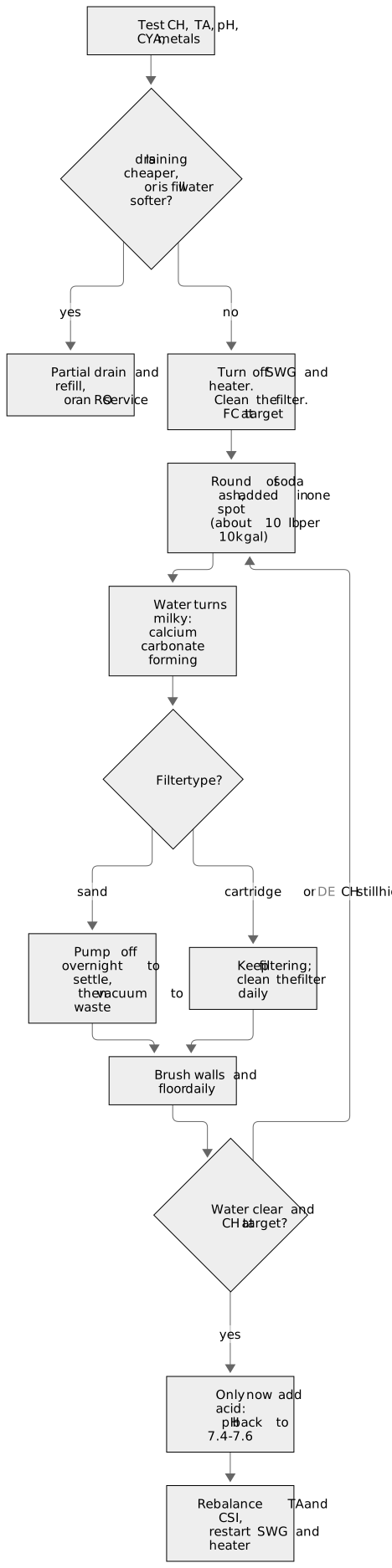
How to use:
- Confirm the need. Test CH, TA, pH, CYA, and metals, and calculate CSI (§1.6). Most plaster pools are happy at CH 200–400.
- Check the alternatives first. A partial drain and refill is simpler if your fill water is softer. Fraction to replace = (current − target) ÷ (current − fill water); for example, CH 800 → 400 with 100 ppm fill water means replacing 57%. A mobile reverse-osmosis (RO) service lowers CH, CYA, and TDS without wasting most of the water.
- Prepare.
- Turn off the SWG cell and heater (scale), and remove robotic cleaners.
- Clean the filter. For a sand filter, set up vacuum-to-waste.
- Raise FC to target. Chlorine is weak at the high pH ahead, so don't let it lapse.
- Dose one round. Add about 10 lb per 10,000 gal, scaled to the table below. Pre-dissolve it or broadcast it in one area with the pump running; concentrated local addition is what makes the pool "milk" (JSPSI). Expect pH to spike to ~9.5–10.
- Let it form, then remove it.
- Brush walls and floor daily so settled precipitate can't bond into scale.
- Retest CH once the water is clear. Repeat rounds until you reach target.
- Only after the solid is out, lower pH to 7.4–7.6 with acid (E1). Acid added while precipitate is still in the water re-dissolves it and puts the calcium back.
- Rebalance TA and CSI, then restart the SWG and heater.
How much — model results per 10,000 gal (start pH 7.6, CYA 40, anhydrous soda ash) · basis: model (best case Ω = 1, equilibrium; "realistic" Ω = 20, precipitation stalls while still supersaturated)
| Starting CH / TA | Soda ash | Peak pH | CH removed — best case | CH removed — realistic | TA after (at pH 7.5) | 31.45% acid to return to 7.5 (realistic) |
|---|---|---|---|---|---|---|
| 600 / 100 | 5 lb | 9.4 | −65 | −40 | 95–106 | 26 fl oz |
| 600 / 100 | 10 lb | 9.75 | −120 | −96 | 95–107 | 27 fl oz |
| 600 / 100 | 15 lb | 9.9 | −175 | −152 | 96–107 | 28 fl oz |
| 600 / 100 | 20 lb | 10.1 | −230 | −207 | 97–108 | 30 fl oz |
| 600 / 100 | 30 lb | 10.2 | −339 | −317 | 99–109 | 35 fl oz |
| 800 / 120 | 10 lb | 9.7 | −130 | −98 | 110–126 | 25 fl oz |
| 800 / 120 | 20 lb | 10.0 | −240 | −210 | 112–126 | 27 fl oz |
| 800 / 120 | 30 lb | 10.2 | −350 | −321 | 113–127 | 29 fl oz |
| 1,200 / 120 | 10 lb | 9.7 | −140 | −101 | 106–124 | 21 fl oz |
| 1,200 / 120 | 20 lb | 10.0 | −251 | −213 | 107–124 | 22 fl oz |
| 1,200 / 120 | 30 lb | 10.2 | −361 | −326 | 108–125 | 23 fl oz |
- Rule of thumb: each pound of soda ash per 10,000 gal removes up to ~11 ppm CH (theory: 11.3), and ~8–10 ppm in practice. Budget roughly 10 lb per 100 ppm.
- Other forms: monohydrate ×1.16 by weight; decahydrate (sal soda) ×2.69.
- Real results depend on how much of the precipitate you actually remove.
Cautions:
- No swimming until the solid is removed and pH is back to normal. pH 9.5–10+ irritates skin and eyes, and chlorine is nearly inactive.
- Precipitate can scale surfaces and equipment. Brush daily. Keep the SWG cell and heater off. On vinyl and fiberglass, vacuum promptly so it doesn't leave a rough film.
- Copper and iron tend to co-precipitate (a bonus), but brush them up before they stain.
- Hard fill water brings CH back with every top-off. Plan for it.
O2 · Neutralize acid spills and acid-wash runoff — around the pool ⚠️
Effect & benefit: A strong, cheap base that turns spilled or spent muriatic acid into salt water, CO₂, and a little sodium. It's the standard neutralizer for acid-wash runoff (see E1 · O2).
How to use:
- Wear goggles and gloves. Keep people and pets away, and ventilate.
- Contain the spill with sand, kitty litter, or a dike of soda ash.
- Sprinkle soda ash slowly from the edges inward. It fizzes hard, so go slowly.
- Continue until fizzing stops. Check with pH paper: you want 6–8.
- Hose down with plenty of water, or scoop up and dispose of per local rules.
How much (per gallon of acid spilled or used) · basis: stoichiometry
| Acid | Soda ash | Baking soda (gentler, E6 · O2) |
|---|---|---|
| 31.45% | 4.4 lb | 7.0 lb |
| ~20% | 2.7 lb | 4.2 lb |
| 14.5% | 1.9 lb | 3.0 lb |
| 34.6% | 4.9 lb | 7.8 lb |
Cautions:
- Excess soda ash is itself caustic (pH ~11). Baking soda can't overshoot past pH ~8.3, so it's the safer choice for spills on skin-contact surfaces.
- Neutralize slowly to avoid foaming over.
O3 · Fiber-reactive dye fixer (tie-dye) — around the house
Effect & benefit: Fiber-reactive dyes (Procion MX type) bond permanently to cotton only at high pH. Pre-soaking fabric in a soda-ash solution makes colors vivid and wash-fast. Dye suppliers sell "soda ash fixer", which is the same chemical as pool pH Up.
How to use:
- Dissolve the soda ash in warm water.
- Soak the 100% cotton (or other plant-fiber) items 15–20 min.
- Wring them out, tie, and dye.
- Let them sit 6–24 h in a warm place, then rinse cold and wash hot.
- Use pure sodium carbonate only: no laundry detergent blends, no pool products with additives.
How much (per gallon of water, not per pool) · basis: rule of thumb (dye-supplier directions)
| Form | Amount |
|---|---|
| Anhydrous 99.5% | ~1 cup per gallon of warm water |
| Sal soda (decahydrate) | ~2½–3 cups per gallon |
Cautions:
- Wear gloves; the solution is pH ~11.
- Not for wool or silk, which are damaged by high pH.
O4 · Laundry booster (washing soda) — around the house
Effect & benefit: Softens hard water and boosts detergent on greasy, heavily soiled loads. That's exactly what "washing soda" is sold for, and pool soda ash is the same chemical.
How to use:
- Add it to the wash with your usual detergent.
- Dissolve it first in warm water for cold washes.
- Don't use it on wool, silk, or delicate dyes.
How much (per load, not per pool) · basis: label (washing soda)
| Machine | Amount |
|---|---|
| Top-loader | ½ cup per load |
| High-efficiency | About half that |
Cautions:
- Alkaline: avoid contact with eyes.
- Can fade some dyes and leave residue in very hard water.
Hazards & storage:
- Alkaline dust that irritates eyes and airways.
- Store it dry, sealed, and away from acids.
E6 · Sodium bicarbonate — baking soda
| Chemistry | NaHCO₃, a mild base. It raises TA by exactly 7.1 ppm per lb per 10k gal, but barely moves pH, which tends toward ~8.3 at most. |
| Sold as | 99%+ (pool "Alkalinity Up" / "Alkalinity Increaser"; grocery and USP baking soda is the same chemical) |
| Pool types | Cl ✅ · SWG ➕ rarely, since TA is kept low · Br ✅ |
| Moves | TA ↑ · pH ↑ only slightly (+0.03–0.05 per 10 ppm TA, model) · sodium ↑ |
| Never mix with | Calcium chloride at the same time (cloudy precipitate) · acid in a bucket (fizzing) |
| Household equivalent | Grocery-store baking soda: identical chemical, often cheaper |
Dose card — to RAISE TA, per 10,000 gal · basis: stoichiometry (Taylor: 1.40 lb per 10 ppm)
| Strength | +10 ppm | +20 ppm | +30 ppm | +40 ppm | +50 ppm |
|---|---|---|---|---|---|
| 99%+ | 1.41 lb (22.5 oz) | 2.82 lb (45.1 oz) | 4.22 lb (67.6 oz) | 5.63 lb (90.1 oz) | 7.04 lb (112.6 oz) |
Labeled uses
L1 · Raise TA with little pH change — Cl · Br · SWG (rarely)
Effect & benefit: Low TA lets pH swing with every dose of chlorine or acid. Raising TA stabilizes pH, protects plaster and metal, and is the standard fix after tablets or acid have eaten the alkalinity.
How to use:
- Test TA and pH. If pH is low and TA is low, add baking soda first, then retest pH.
- Broadcast it over the deep end, or pre-dissolve it, with the pump running.
- Add no more than ~10 lb per 10,000 gal at a time. Very large doses can cloud the water briefly.
- Retest TA after ~6 h of circulation.
How much (per 10,000 gal) · basis: stoichiometry
Use the dose card: 1.4 lb per 10 ppm. For a 400-gal spa, it's ≈ 0.9 oz per 10 ppm.
Cautions:
- It won't raise pH much. If pH also needs to climb, use aeration, borax, or a little soda ash afterward.
- Don't overshoot. Lowering TA again takes acid plus aeration (E1 · L2).
Off-label uses
O1 · "Bicarb start-up" for new plaster — plaster pools
Effect & benefit: Fresh plaster leaches calcium hydroxide into new water. That can dust, discolor, or weaken the surface.
- NPC's traditional start-up brings TA, pH, and CH up over several days while brushing.
- The "bicarb start-up" (onBalance, not endorsed by NPC) instead fills the pool with water so saturated with bicarbonate that the plaster has little reason to leach. Proponents use it to avoid days of brushing.
Follow your plasterer's method. Warranties often specify one.
How to use (bicarb start, onBalance):
- Test the fill water's TA and CH.
- Calculate the bicarbonate to add (formula below). Targets: TA ≥ 120, TA + CH ≥ 400, LSI ≈ +1.0.
- Dissolve the bicarbonate in a drum or bin that the incoming fill water runs through, so the first water touching the plaster is already saturated.
- After filling, add acid to bring pH to 7.7–7.9.
- Keep TA high and pH ≤ 8.2 for the first month. Then step down to normal balance.
For comparison, NPC's traditional start-up (2021 card):
| Day | Steps |
|---|---|
| 1 | TA 80–100, pH 7.2–7.6, CH 80–100 (dissolved CaCl₂ in 10-lb increments; never with bicarb at the same time). No chlorine for 48 h |
| 2 | CH 100–150 |
| 3 | Chlorine 1.5–3.0; no salt for 30 days |
| 4+ | Raise CH slowly to ≥ 200; CYA 30–50; LSI 0.0 to +0.3 |
How much · basis: label (onBalance formula) + stoichiometry
Bicarbonate to add, ppm (as TA) = 500 − (fill TA + fill CH). Pounds = gallons ÷ 71,400 × that ppm, which is the same as 1.40 lb per 10 ppm per 10k gal.
| Fill water (per 10,000 gal) | Add | Baking soda |
|---|---|---|
| TA 60, CH 60 | +380 ppm | ≈ 53 lb |
| TA 80, CH 100 | +320 ppm | ≈ 45 lb |
| TA 100, CH 150 | +250 ppm | ≈ 35 lb |
Cautions:
- Not NPC-endorsed.
- High TA makes pH climb, so watch it daily the first month.
- Never add calcium chloride and bicarbonate at the same time.
- No SWG salt for 30 days on new plaster (NPC).
O2 · Gentle acid-spill neutralizer — around the pool
Effect & benefit: Baking soda neutralizes acid spills and splashes but can't overshoot into caustic territory (it tops out at pH ~8.3). It's the safer choice near skin, decks, and plants. Keep an open box near where you handle acid.
How to use:
- Wear goggles and gloves.
- Pour baking soda over the spill, starting at the edges, until fizzing stops.
- Check with pH paper, then rinse with plenty of water.
- For acid on skin, flush with water first for 15 minutes. Don't rub baking soda into a burn.
How much (per gallon of acid) · basis: stoichiometry
| Acid | Baking soda |
|---|---|
| 31.45% | 7.0 lb |
| ~20% | 4.2 lb |
| 14.5% | 3.0 lb |
| 34.6% | 7.8 lb |
Cautions:
- It foams a lot. Go slowly so it doesn't overflow the containment.
O3 · Waterline scum paste — vinyl · fiberglass · tile
Effect & benefit: A mild, non-scratching abrasive. A baking-soda paste lifts the greasy "bathtub ring" of sunscreen and body oils at the waterline without scratching vinyl or gelcoat, and anything that falls in only nudges TA up.
How to use:
- Mix the paste.
- Rub it onto the scum line with a soft sponge or microfiber cloth.
- Rinse the area with pool water.
- For heavy oil, follow with an enzyme product (K1).
How much (per batch, not per pool) · basis: rule of thumb
| Item | Amount |
|---|---|
| Paste | 3 parts baking soda : 1 part water (½ cup soda + ~2½ tbsp water treats a typical tile line in sections) |
| TA added | Negligible |
Cautions:
O4 · Smother a small grease fire — kitchen ⚠️
Effect & benefit: Heated baking soda releases CO₂ and helps smother a small stovetop grease fire. Water makes grease fires explode, and flour can ignite. A box near the stove (or a pool-supply bucket near the grill) is cheap insurance.
How to use:
- Turn off the heat. Don't carry the pan.
- First choice: slide a metal lid or a baking sheet over the pan.
- If you have no lid and the fire is small, dump baking soda generously over it.
- If the fire isn't out within seconds, or it's bigger than the pan, get out and call 911. Use a Class K or B extinguisher if you're trained.
How much (per fire) · basis: rule of thumb
Enough to cover the burning surface: several cups for a skillet. A 1-lb box is the minimum to keep at the stove.
Cautions:
- ⛔ Never water on grease. ⛔ Never flour.
- Not for oven, electrical, or large fires.
Hazards & storage:
- Very low hazard. Keep it dry: it cakes in humid sheds but still works.
E7 · Sodium hydroxide — caustic soda, lye
| Chemistry | NaOH, the strongest common base. It raises pH and adds one equivalent of TA per mole, about half the TA increase of soda ash for the same pH change. It adds no carbonate. |
| Sold as | 25% and 50% liquid caustic (commercial chemical-feed systems) · solid ~99% beads or flakes (lye; drain openers, soap-making) |
| Pool types | Cl ➕ commercial feeders · SWG ➕ · Br ➕ |
| Moves | pH ↑↑ · TA ↑ (1 eq per mol) · sodium ↑ · releases intense heat when diluted |
| Never mix with | Acids (violent reaction, heat, splatter) · aluminum (hydrogen gas) · water poured onto solid lye (boiling spatter) |
Dose card — per 10,000 gal · basis: stoichiometry (TA) + model (pH; TA 80, CYA 40)
| Strength | +10 ppm TA | pH 7.0 → 7.4 | pH 7.2 → 7.5 | pH 7.2 → 7.6 | pH 7.4 → 7.6 |
|---|---|---|---|---|---|
| 25% liquid | 1.00 qt (32 fl oz) | 1.06 qt (34 fl oz) | 18.9 fl oz | 23.3 fl oz | 9.3 fl oz |
| 50% liquid | 13.4 fl oz | 14.2 fl oz | 7.9 fl oz | 9.7 fl oz | 3.9 fl oz |
| Solid ~99% | 10.8 oz | 11.4 oz | 6.3 oz | 7.8 oz | 3.1 oz |
| TA rise from the pH dose | — | +10.6 ppm | +5.9 ppm | +7.3 ppm | +2.9 ppm |
Labeled uses
L1 · Raise pH in commercial feed systems — Cl · SWG · Br (commercial)
Effect & benefit: A liquid base that a metering pump can feed under pH-controller control. It's used where acid feeds, CO₂, or trichlor drive pH down. Compared with soda ash it adds about half the TA per pH unit and dissolves instantly.
How to use:
- Use only in a feed system rated for caustic, with secondary containment and the controller maker's setup, under the facility's code.
- Calibrate the pH probe. Set feed limits so a stuck probe can't overdose.
How much (per 10,000 gal) · basis: model
See the dose card. In practice the controller meters the feed.
Cautions:
- 25–50% caustic causes deep chemical burns and blindness within seconds. Use a face shield, goggles, gloves, and an apron, and have an eyewash station on site.
- Freezing and crystallization: 50% caustic solidifies below ~55 °F.
Off-label uses
O1 · Lower CH and TA together ("lime-softening" style) — Cl · SWG · Br ⚠️
Effect & benefit: When both CH and TA are too high, sodium hydroxide raises pH so that calcium precipitates using the bicarbonate already in the water:
Ca2+ + HCO3- + OH- → CaCO3 (solid) + H2O
This is the chemistry of municipal lime softening. Each 100 ppm of CH removed also removes about 50 ppm of TA (net), so one treatment fixes both numbers. Soda ash (E5 · O1) lowers CH but leaves TA roughly where it was.
How to use:
- Do this only if TA is well above target (≥ 120) and CH is too high. Otherwise TA will crash; use soda ash instead.
- Follow every preparation and removal step of E5 · O1: SWG and heater off, FC at target, settle or filter, brush, and remove the precipitate before any acid.
- Wear a face shield, goggles, gloves, and an apron.
- Add the 50% caustic very slowly, low, in front of a return in the deep end with the pump running, so it disperses before reaching any surface. Never pour it near people, pets, or the skimmer.
- Retest CH and TA once the water clears. Repeat a smaller round if needed. Bring pH back with acid only after the precipitate is gone.
How much — model results per 10,000 gal (start pH 7.6, CYA 40) · basis: model (best case Ω = 1; realistic Ω = 10)
| Starting CH / TA | 50% NaOH | Peak pH | CH after (best / realistic) | TA after at pH 7.5 (best / realistic) |
|---|---|---|---|---|
| 500 / 140 | 32 fl oz | 9.2 | 445 / 468 | 112 / 123 |
| 500 / 140 | 64 fl oz | 9.7 | 405 / 422 | 93 / 101 |
| 500 / 140 | 96 fl oz | 10.0 | 363 / 375 | 73 / 79 |
| 600 / 150 | 32 fl oz | 9.15 | 539 / 566 | 119 / 132 |
| 600 / 150 | 64 fl oz | 9.6 | 500 / 521 | 100 / 110 |
| 600 / 150 | 96 fl oz | 9.9 | 460 / 475 | 81 / 88 |
| 600 / 150 | 128 fl oz | 10.2 | 418 / 428 | 62 / 67 |
| 800 / 180 | 64 fl oz | 9.5 | 685 / 719 | 123 / 139 |
| 800 / 180 | 128 fl oz | 10.0 | 609 / 628 | 87 / 96 |
With 25% caustic, use 2.4× the volume. Very roughly, each 32 fl oz of 50% per 10k gal removes ~35–60 ppm CH and ~20–30 ppm TA, more in very hard, high-TA water.
Cautions:
- This is the most hazardous procedure in this guide. One splash in an eye can blind. If in any doubt, use soda ash.
- No swimming until the precipitate is removed and pH is normal.
- The scale risk to surfaces and equipment is the same as in E5 · O1.
Hazards & storage:
- Corrosive and dangerous to eyes.
- Store it sealed, away from acids and aluminum, and out of reach of children.
- Solid lye absorbs CO₂ and moisture from air.
E8 · Borax — sodium tetraborate
| Chemistry | Na₂B₄O₇ hydrate. A base that raises pH and supplies borate, a buffer that resists pH rise near 7.6–8 and is mildly algistatic. Pool borates are measured as ppm boron (B); the target is 30–50, and PHTA says not to exceed 50. |
| Sold as | Decahydrate (20 Mule Team laundry borax, ~99.5%, 11.3% B) · pentahydrate (14.9% B; e.g., ProTeam Supreme, labeled 100% sodium tetraborate pentahydrate) · pH-balanced blends (ProTeam Supreme Plus; composition not disclosed) |
| Pool types | Cl ➕ · SWG ✅ borates 30–50 steady the pH · Br ➕ |
| Moves | pH ↑ · TA ↑ (3.1 ppm per lb decahydrate; 4.1 per lb pentahydrate, per 10k gal) · borates ↑ (1.35 / 1.77 ppm B per lb) · acid demand ↑ afterward (more buffering) |
| Never mix with | Acid in the same bucket (add them separately to the pool) |
| Household equivalent | 20 Mule Team Borax (decahydrate), the same chemical as pool borax |
Dose card — per 10,000 gal · basis: stoichiometry (borates) + model (pH; TA 80, CYA 40)
| Form | +10 ppm B (with acid to hold pH) | pH 7.0 → 7.4 | pH 7.2 → 7.5 | pH 7.2 → 7.6 | pH 7.4 → 7.6 |
|---|---|---|---|---|---|
| Decahydrate 99.5% | 7.40 lb + 1.85 qt (59 fl oz) of 31.45% acid | 3.49 lb (55.9 oz) | 1.96 lb (31.3 oz) | 2.45 lb (39.2 oz) | 15.7 oz |
| Pentahydrate 99.5% | 5.65 lb + 1.85 qt (59 fl oz) of 31.45% acid | 2.67 lb (42.7 oz) | 1.49 lb (23.9 oz) | 1.87 lb (29.9 oz) | 12.0 oz |
| TA rise from the pH dose | — | +10.9 ppm | +6.1 ppm | +7.7 ppm | +3.1 ppm |
Labeled uses
L1 · Raise pH with less TA increase than soda ash — Cl · SWG · Br
Effect & benefit: Lifts low pH while adding about half the TA that soda ash would (TFP; matches the model). That's useful when pH is low but TA is already fine. TFP's rule: if pH is below 7.0 and TA is at least 50, use borax to bring pH to ~7.4. Each dose also adds a little borate.
How to use:
- Try aeration first if TA is fine. It raises pH with no chemicals.
- Pre-dissolve borax in a bucket of warm pool water. It dissolves slowly in cold water.
- Pour it around the deep end in front of a return, pump running.
- Circulate 1 h, retest, and finish with the remaining ~25%.
How much (per 10,000 gal) · basis: model
Use the dose card. As a rule of thumb, decahydrate weighs about 2× the soda-ash dose for the same pH change (pentahydrate about 1.5×).
Cautions:
- Each pound of decahydrate adds 1.35 ppm boron. Repeated pH-up use slowly builds borates. Track them if you use borax often.
L2 · Build a borate buffer (with acid) — SWG ✅ · Cl · Br
Effect & benefit: Borates at 30–50 ppm resist the steady pH rise of SWG and aerated pools, so you need less acid between corrections. They also mildly discourage algae, and many people find the water feels "softer". Borax plus muriatic acid gives you borates while the acid cancels borax's pH rise. The net product is boric acid, at a fraction of branded-borate cost.
How to use:
- Test borates; fresh water is ~0. Pick a target of 30–50 ppm, never above 50 (PHTA).
- Work in rounds:
- Dissolve borax in buckets of warm pool water and pour it in, pump running. pH rises.
- Add acid in front of a return to bring pH back to ~7.2–7.4.
- Circulate several hours, retest pH, and repeat.
- TFP's round is about 1 gal of 31.45% acid with ~3½ four-pound boxes (~14 lb) of borax. That adds ≈ 19 ppm B per 10,000 gal per round.
- Retest borates after the last round. Afterward, acid demand rises near pH 7.5–8, by about 2–3× (§6.2). That's the buffer working.
How much (per 10,000 gal) · basis: stoichiometry (borax + acid) + label (ProTeam)
| Borate rise (ppm B) | Decahydrate | or Pentahydrate | Plus 31.45% acid | or dry acid |
|---|---|---|---|---|
| +10 | 7.40 lb | 5.65 lb | 1.85 qt (59 fl oz) | 4.97 lb |
| +20 | 14.79 lb | 11.30 lb | 3.71 qt (119 fl oz) | 9.94 lb |
| +30 | 22.19 lb | 16.95 lb | 1.39 gal (178 fl oz) | 14.92 lb |
| +40 | 29.59 lb | 22.60 lb | 1.85 gal (237 fl oz) | 19.89 lb |
| +50 | 36.98 lb | 28.25 lb | 2.32 gal (297 fl oz) | 24.86 lb |
With ~20% acid, use 1.65× the 31.45% volume. With 14.5% acid, use 2.34×.
Branded borate products, per label:
| Product | Label direction | Equivalent per 10,000 gal |
|---|---|---|
| ProTeam Supreme (pentahydrate) | 2 lb per 1,000 gal, in two halves; correct pH with ¾ lb dry acid or 10 oz muriatic acid per lb of product | 20 lb → ≈ 36 ppm B; 200 fl oz of muriatic acid (theory: 211) or 15 lb dry acid |
| ProTeam Supreme Plus (pH-balanced blend) | 2–3.5 lb per 1,000 gal, in two doses ≥ 8 h apart; "no need to adjust the pH"; TA may rise slightly | 20–35 lb |
Cautions:
- Pets: dogs that drink pool water are the main concern. TFP estimates a 100-lb dog would need ~8 L a day of 50 ppm water to reach the no-adverse-effect level, but don't let pets use the pool as their water bowl. EPA's acceptable boron intake is 0.2 mg/kg/day. EPA and NSF reviews found 30–50 mg/L posed no significant risk to swimmers (PHTA).
- Borates are removed only by dilution.
Off-label uses
O1 · Laundry-aisle borax as the pool's borate and pH-up source — Cl · SWG · Br
Effect & benefit: 20 Mule Team Borax is sodium tetraborate decahydrate, the same chemical pool-store "pH Plus" borax products contain, and typically far cheaper per pound. With grocery muriatic acid it makes the TFP borate recipe above.
How to use:
- Check the box: it should list sodium tetraborate (decahydrate) only. No "with detergent" or scented variants.
- Use it exactly as in L1 (pH up) or L2 (borates).
- Store opened boxes dry; they cake but still dissolve.
How much (per 10,000 gal) · basis: stoichiometry
| Goal | Amount |
|---|---|
| +10 ppm B | 7.4 lb (≈ 1.85 four-lb boxes) + 59 fl oz of 31.45% acid |
| +50 ppm B from zero | ≈ 37 lb (≈ 9¼ boxes) + 2.32 gal of acid |
| pH-up doses | Decahydrate row of the dose card |
Cautions: Same pet and ingestion cautions as L2.
O2 · Laundry booster (reverse direction) — around the house
Effect & benefit: Leftover pool borax softens wash water and boosts detergent, the use it's labeled for in the laundry aisle.
How to use:
- Add it with your detergent.
- Pre-dissolve it in warm water for cold washes.
How much (per load, not per pool) · basis: label (laundry borax)
½ cup per load.
Cautions:
- Pentahydrate pool borate is stronger per cup; reduce to about ⅓ cup.
- Keep it away from children and pets.
Hazards & storage:
- Low acute toxicity, but don't ingest it.
- The EU classifies borates as reproductive toxicants. Wear gloves and avoid dust when adding large amounts.
- Store it dry and out of reach of children.
E9 · Boric acid
| Chemistry | B(OH)₃, a very weak acid. It supplies borates without raising pH: it lowers pH slightly, and TA readings don't change. TFP's preferred way to add borates. |
| Sold as | Technical grade ~99.9% (17.5% boron) in bags from chemical suppliers · some branded borate products |
| Pool types | Cl ➕ · SWG ✅ · Br ➕ |
| Moves | Borates ↑ (2.09 ppm B per lb per 10k gal) · pH ↓ slightly (≈ −0.2 for +30 ppm, ≈ −0.25 for +50 ppm, starting at pH 7.6, TA 80, model) · TA reading unchanged |
| Never mix with | Strong oxidizers in storage · not hazardous with pool chemicals in the water |
Dose card — per 10,000 gal · basis: stoichiometry (PHTA lists 4.57 lb per 10 ppm; the exact figure is 4.77)
| Strength | +10 ppm B | +20 ppm | +30 ppm | +40 ppm | +50 ppm |
|---|---|---|---|---|---|
| 99.9% | 4.78 lb | 9.56 lb | 14.33 lb | 19.11 lb | 23.89 lb |
Labeled uses
L1 · Add borates without raising pH — SWG · Cl · Br
Effect & benefit: The cleanest route to a 30–50 ppm borate buffer (E8 · L2 explains why). No acid juggling is needed, and pH drifts down only a little.
How to use:
- Test borates and pH. Plan the dose, never exceeding 50 ppm.
- With the pump running, broadcast boric acid thinly over the deep end. Don't put it in the skimmer: it dissolves slowly (~0.4 lb per gallon of cool water) and can clog baskets.
- Brush the floor every few hours until the powder is gone, which can take a day or two.
- Retest pH. Expect ~0.2–0.3 lower. Bring it back with aeration, soda ash, or borax.
- Retest borates after 24–48 h.
How much (per 10,000 gal) · basis: stoichiometry
Use the dose card. For a 400-gal spa, +30 ppm is ≈ 0.57 lb (9.2 oz).
Cautions:
- Same pet and ingestion cautions as E8.
- Undissolved piles can stain or etch plaster as they sit; brush them out.
Off-label uses
O1 · Bulk technical boric acid instead of branded borate products — SWG · Cl · Br
Effect & benefit: Branded borate products are boric acid, borax, or blends. A 50-lb bag of technical-grade boric acid from a chemical supplier delivers the same boron, often at a fraction of the price.
How to use:
- Buy technical-grade (≥ 99.9%) boric acid and confirm "boric acid, CAS 10043-35-3" as the only ingredient on the SDS.
- Use it exactly as in L1.
How much (per 10,000 gal) · basis: stoichiometry
| Goal | Amount |
|---|---|
| +50 ppm from zero | ≈ 24 lb |
| +30 ppm | ≈ 14.3 lb |
Cautions:
- ⛔ Don't use insecticide "roach powders" (they may contain dyes or other ingredients).
- ⛔ Never use pool-grade boric acid for eyewash, antiseptic, or any personal-care purpose.
- Keep it labeled and away from food and children.
Hazards & storage:
- The EU classifies boric acid as a reproductive toxicant. Avoid dust and ingestion, and wear gloves and a dust mask for large additions.
- Store it dry.
3F · Hardness & minerals
F1 · Calcium chloride
| Chemistry | CaCl₂, which raises calcium hardness (CH) quickly. Plaster and grout need enough dissolved calcium or the water dissolves calcium out of them. Each ppm of CH also adds ≈ 1.17 ppm of salt (chloride). |
| Sold as | 77–80% flake (mostly dihydrate; pure dihydrate is 75.5% CaCl₂) · 83–87% (DowFlake Xtra) · >90% pellets (Peladow) · 94–97% anhydrous pellets (many "Calcium Hardness Increaser" products; In The Swim 94%) · 100% on some labels (e.g., Clorox) |
| Pool types | Cl ✅ plaster pools · SWG ✅ but keep CSI ≤ 0, since the cell scales · Br ✅ |
| Moves | CH ↑ · chloride (salt reading) ↑ 1.17 ppm per ppm CH · TDS ↑ · releases heat as it dissolves |
| Never mix with | Bicarbonate or soda ash at the same time (instant cloudy calcium carbonate) · water poured onto a pile of anhydrous pellets (spattering heat) |
| Household equivalent | Calcium-chloride ice melt or flake, only if the label lists calcium chloride alone (no other salts, dyes, or corrosion inhibitors) |
Dose card — to RAISE CH, per 10,000 gal · basis: stoichiometry (Taylor: 1.20 lb of 77% per 10 ppm)
| Strength | +10 ppm | +25 ppm | +50 ppm | +100 ppm | 1 lb raises CH by |
|---|---|---|---|---|---|
| 77% | 1.20 lb (19.2 oz) | 3.00 lb (48.1 oz) | 6.01 lb (96.1 oz) | 12.02 lb (192.3 oz) | 8.3 ppm |
| 80% | 1.16 lb (18.5 oz) | 2.89 lb (46.3 oz) | 5.78 lb (92.5 oz) | 11.57 lb (185.1 oz) | 8.6 ppm |
| 83% | 1.11 lb (17.8 oz) | 2.79 lb (44.6 oz) | 5.57 lb (89.2 oz) | 11.15 lb (178.4 oz) | 9.0 ppm |
| 87% | 1.06 lb (17.0 oz) | 2.66 lb (42.5 oz) | 5.32 lb (85.1 oz) | 10.64 lb (170.2 oz) | 9.4 ppm |
| 90% | 1.03 lb (16.5 oz) | 2.57 lb (41.1 oz) | 5.14 lb (82.3 oz) | 10.28 lb (164.5 oz) | 9.7 ppm |
| 94% | 15.8 oz | 2.46 lb (39.4 oz) | 4.92 lb (78.8 oz) | 9.84 lb (157.5 oz) | 10.2 ppm |
| 97% | 15.3 oz | 2.38 lb (38.2 oz) | 4.77 lb (76.3 oz) | 9.54 lb (152.6 oz) | 10.5 ppm |
| 100% | 14.8 oz | 2.31 lb (37.0 oz) | 4.63 lb (74.0 oz) | 9.25 lb (148.1 oz) | 10.8 ppm |
Label cross-checks:
| Source | Label direction | Calculated result |
|---|---|---|
| OxyChem | "One pound raises hardness by about 10 ppm in 10,000 gallons" | Matches its 83–97% grades |
| In The Swim 94% | "6 lb ≈ 50 ppm" | +61; the label is conservative |
| Leslie's Hardness Plus | 1¼ lb per 10 ppm | Implies ~74% material |
| Clorox (100%) | 5 lb = +50 ppm | +54 |
Labeled uses
L1 · Raise calcium hardness — Cl · SWG · Br
Effect & benefit: Water short on calcium (CSI well below −0.3) pulls calcium out of plaster, grout, and pebble finishes. That causes etching, roughness, and pitting. Raising CH to the PHTA ideal (200–400 pools, 150–250 spas) protects them and widens the safe pH range.
How to use:
- Test CH, then calculate CSI (§1.6) and how much CH you need.
- Fill a clean plastic bucket ¾ with pool water, then add the calcium chloride slowly while
stirring. Never add water to the dry product.
- It gets hot: anhydrous pellets can heat a gallon by ~35 °F per pound (calc).
- Flake heats less.
- Do larger amounts in batches.
- Pour it around the perimeter in front of the returns, pump running. Don't dump undissolved pellets on vinyl or plaster.
- For big increases, add in portions (NPC: 10-lb increments on new plaster). Never add it on the same day as baking soda or soda ash.
- Retest after 6–24 h of circulation.
New plaster (NPC start-up card):
| Day | CH target |
|---|---|
| 1 | 80–100 |
| 2 | 100–150 |
| 4+ | Slowly up to ≥ 200 |
See E6 · O1 for the full schedule.
How much (per 10,000 gal) · basis: stoichiometry + label
Use the dose card, then confirm with a CH test.
Cautions:
- Bromide note: OxyChem states that its solid calcium chloride "contains bromide" (amount not given). Bromide turns some chlorine into bromine, which CYA can't protect. If chlorine loss jumps after a very large calcium dose in a sunny pool, suspect this.
- Overshooting CH is fixed only by dilution or precipitation (E5 · O1).
- SWG pools: keep CSI ≤ 0 so the cell doesn't scale.
Off-label uses
O1 · Reduce foaming in very soft-water spas — Br · Cl spas
Effect & benefit: Hot-tub makers often cite low calcium as a cause of foaming. Very soft water (CH under ~100) foams more readily with body oils and soaps. Bringing CH into the spa range (PHTA ideal 150–250) usually reduces it, and it protects heaters and shells from soft, aggressive water.
How to use:
- Test CH and TA. If CH is below ~100, raise it in steps.
- Dissolve the dose in a bucket of spa water and pour it in with the jets running.
- Retest after 30 min.
- If foam persists, the cause is contamination (soaps, lotions, quats). Drain and refill, or use an antifoam as a stopgap (K3).
How much (400-gal spa) · basis: stoichiometry + label (PHTA spa range); foam link = rule of thumb
| Strength | +10 ppm CH | +50 ppm CH |
|---|---|---|
| 77% | 0.77 oz (22 g) | 3.9 oz |
| 94% | 0.63 oz (18 g) | 3.2 oz |
Cautions:
- Don't overshoot. Spa CH above ~250–400 scales heaters.
- This addresses one cause of foam. Most persistent foam is contamination.
O2 · De-ice walkways — around the house ⚠️
Effect & benefit: Calcium chloride is the active ingredient in many "works to −25 °F" ice melts. It releases heat as it dissolves, so it melts faster and colder than rock salt. Leftover pool flake or pellets work the same way.
How to use:
- Scatter thinly on ice or packed snow.
- Shovel the slush once it breaks up.
- Sweep up any leftover granules after the storm.
- Keep it off lawns, garden beds, and plants.
How much (per area, not per pool) · basis: rule of thumb (typical ice-melt label rates)
A light scatter, on the order of 2–4 oz per square yard. Add more only where ice persists.
Cautions:
- Damages concrete less than a year old and can spall weak concrete.
- Corrodes metal and rebar.
- Irritates pets' paws; wipe them.
- Kills plants.
- Track-in leaves residue on floors.
- Keep runoff out of the pool, where it raises CH.
O3 · DIY moisture absorber — around the house
Effect & benefit: Calcium chloride is strongly hygroscopic. It pulls moisture from the air and dissolves into brine, which is how commercial closet "damp-absorber" tubs work. It's useful in musty closets, RVs, boats, and storage bins.
How to use:
- Put the flakes or pellets in a container with a perforated top, such as a plastic cup with holes or a mesh strainer.
- Set it over a second container that catches the brine.
- Check it weekly.
- When the solid is gone, pour the brine down a drain with plenty of water (not on plants) and refill.
How much (per space, not per pool) · basis: rule of thumb
1–2 lb per closet or small enclosed space.
Cautions:
- The brine is corrosive and slippery. Keep it away from metal shelving, electronics, wood floors, children, and pets.
Hazards & storage:
- It absorbs moisture and cakes, so keep the bag sealed.
- Dissolving releases heat.
- It irritates eyes and skin, especially when damp.
F2 · Magnesium & potassium chloride — mineral-pool salts
| Chemistry | MgCl₂ and KCl blends that supply conductivity for magnesium-based chlorination systems, the same job salt does for an SWG. Magnesium adds to total hardness, not calcium hardness, so it doesn't enter the CSI calcium term. |
| Sold as | MagnaPool "Minerals" (Zodiac): 30% magnesium chloride / 70% potassium chloride, 10-kg (22-lb) bags. Other mineral blends exist; follow their maker's numbers. |
| Pool types | SWG ➕ only with systems designed for it · Cl — · Br — |
| Moves | Conductivity, mineral TDS, and total hardness ↑ · CH unchanged · chloride ↑ |
| Never mix with | Nothing hazardous. Don't use it in a standard salt cell unless its maker approves. |
Dose card — per 10,000 gal (converted from Zodiac's metric label) · basis: label + stoichiometry
| Situation | Amount |
|---|---|
| New fill, setup (6 bags per 10,000 L) | ≈ 227 kg (≈ 500 lb, ≈ 23 bags), reading 5,000–5,500 ppm at start |
| Ongoing target | 4,000–4,500 ppm |
| Top-up from 0 (Zodiac: 5 bags per 10,000 L) | ≈ 189 kg (≈ 417 lb, ≈ 19 bags) |
| Each +1,000 ppm of blend | ≈ 83.5 lb (≈ 3.8 bags) |
Meter reading: Zodiac says magnesium "delivers only 0.7:1" of the salinity reading salt does. A salt meter or strip calibrated for sodium chloride therefore reads this blend low. Use the system's own reading or test method.
Labeled uses
L1 · Electrolyte for magnesium mineral-chlorination systems — SWG-type systems built for it
Effect & benefit: Supplies the dissolved minerals the system's cell needs to generate chlorine. Magnesium systems are marketed for a "softer" feel and for flocculating fine particles at the cell. The sanitizer is still chlorine, so FC/CYA rules apply (§1.4).
How to use:
- Confirm your system is designed for magnesium/potassium minerals.
- Turn the cell off. Broadcast the minerals over the deep end with the pump running and brush until dissolved.
- Let it circulate per the system manual (typically 24 h) before restarting the cell.
- Test with the maker's method (see "meter reading" above).
- Balance pH, TA, CH, and CYA per the system maker. Zodiac's own documents disagree on hardness targets (total hardness 500–1,000 or ~800; CH 300–1,200) and on CYA (< 30 vs < 50), so use your installer's sheet.
How much (per 10,000 gal) · basis: label (converted)
Use the dose card. Top up to the ongoing target after dilution.
Cautions:
- Total hardness rises a lot, and magnesium can form scale at the cell at high pH. Keep pH and CSI in check.
- The minerals are mostly potassium chloride, which some stone and metal fixtures dislike just as they dislike salt.
Off-label uses
O1 · Magnesium-chloride de-icer — around the house
Effect & benefit: Magnesium chloride is sold on its own as a de-icer. It's commonly described as gentler on concrete and plants than rock salt or calcium chloride, and it works at lower temperatures than rock salt. Pure MgCl₂ flake is the de-icer. The pool blend is ~70% potassium chloride, a much weaker ice melter, so leftover blend works only moderately.
How to use:
- Scatter thinly on ice and shovel the slush.
- Use pure magnesium-chloride flake for real cold. Leftover pool blend is fine for light frost.
- Sweep up leftovers after the storm.
How much (per area, not per pool) · basis: rule of thumb (typical ice-melt label rates)
A light scatter, a few ounces per square yard. Follow the ice-melt label if you buy flake.
Cautions:
- It's "gentler", not harmless: it still corrodes metal and can harm plants in quantity.
- Keep it out of the pool, where it raises total hardness and TDS.
Hazards & storage:
- Low hazard. Store dry; it absorbs moisture and cakes.
3G · Algaecides
Every product in this section is an EPA-registered pesticide. The label is the law, and off-label uses below are flagged FIFRA (§0.2).
Algaecides are optional. A pool that holds FC at its CYA-indexed level (§1.4) doesn't grow algae, so these products are insurance for chlorine lapses (vacations, SWG outages, winter). They're also adjuncts for stubborn species, never a replacement for chlorine.
| Type | Typical products | Stains? | Foams? | How long it lasts | Bottom line |
|---|---|---|---|---|---|
| Polyquat (G1) | Poly-60/Poly-30, In The Swim Algaecide 60 Plus, ProTeam, BioGuard Algae All 60 | No | Barely | Days; chlorine slowly consumes it | The safe default algaecide |
| Linear quat (G2) | 10% ADBAC, 50%, 60% blends | No | Yes | Days | Cheap, foamy |
| Copper (G3) | CU 7, Swimtrine Plus, HTH Algae Guard+ Ultra | Yes | No | Indefinitely; only dilution removes it | Strong, with lasting side effects; ⛔ SWG |
| Silver / mineral (G4) | Silver Algaedyn, mineral cartridges | Possible | No | Weeks; cartridges replenish | Follow the mineral system's label |
| Mustard boosters (G5) | Yellow Out (ammonium), Yellow Treat (bromide) | No | No | Bromide is permanent | Boost chlorine; not algaecides themselves |
G1 · Polyquat 60 (and 30) — polymeric quat algaecide
| Chemistry | Poly[oxyethylene(dimethyliminio)ethylene(dimethyliminio)ethylene dichloride] ("polyquat", "WSCP"). This cationic polymer binds to the negatively charged surfaces of algae cells and disrupts them. It contains no metal, foams very little at label doses, and is slowly oxidized by chlorine, which is why it's re-dosed weekly. |
| Sold as | 60% (Poly-60, EPA 48520-17, 5.76 lb active per gal · Leslie's Algae Control = In The Swim Algaecide 60 Plus, EPA 11411-11 · ProTeam Polyquat 60 · BioGuard Algae All 60) · 30% (Poly-30, EPA 48520-15) · a minor ingredient in some blends (the Clorox XtraBlue algaecide pairs 6.5% polyquat with copper sulfate; see G3) |
| Pool types | Cl ➕ · SWG ➕ · Br ➕ |
| Moves | No effect on pH, TA, CH, or CYA · a small chlorine demand as chlorine slowly oxidizes it |
| Never mix with | Other chemicals in the bottle or a bucket. Add it on its own, after a shock has done its work. Sequestrant labels warn against adding them within 24 h of cationic polymers (see H1). |
Dose card — fl oz per 10,000 gal · basis: label
| Strength | Fresh / start-up | Maintenance, every 5–7 days | Visible algae | Winterizing (clean / dirty or algae-prone) | Polymer delivered |
|---|---|---|---|---|---|
| 60% (Poly-60, In The Swim 60 Plus, ProTeam, BioGuard) | 6–11 | 2–4 | 11–17 (In The Swim: 11–16) | 6–10 / 12–17 (In The Swim: 12–16) | ≈ 0.54 ppm active per fl oz |
| 30% (Poly-30) | 13–24 | 4–8 | 24–37 | 12–20 / 24–34 | ≈ half per fl oz |
Spas (Poly-60 label): 0.6–1.1 fl oz per 1,000 gal to start, then 0.2–0.4 fl oz per 1,000 gal. For a 400-gal spa that's 7–13 mL to start and 2.4–4.7 mL maintenance. Use a syringe.
Labeled uses
L1 · Prevention (maintenance dose) — Cl · SWG · Br
Effect & benefit: A low weekly dose keeps algae from establishing in a pool whose chlorine sometimes runs short:
- vacations,
- an SWG that can't keep up in a heat wave,
- shaded corners with poor circulation.
It adds no metal (no stains) and barely foams. That's why it's the algaecide to choose if you use one at all.
How to use:
- Keep chlorine at target anyway (§1.4). Polyquat is insurance, not a sanitizer.
- With the pump running, pour the weekly dose slowly around the perimeter or in front of a return.
- Re-dose every 5–7 days per the label, and after heavy rain or a partial drain.
- Brush walls and steps weekly.
How much (per 10,000 gal) · basis: label
| Strength | Every 5–7 days | 400-gal spa |
|---|---|---|
| 60% | 2–4 fl oz | 0.08–0.16 fl oz (2.4–4.7 mL) |
| 30% | 4–8 fl oz | Double the 60% figure |
Cautions:
- It doesn't replace chlorine.
- Heavy overdosing can still cause some foam in spas and water features.
- If you also add a sequestrant, follow its label on spacing from cationic polymers.
L2 · Treatment (start-up or visible algae, alongside shock) — Cl · SWG · Br
Effect & benefit: A larger dose helps chlorine knock back visible algae and slows its return while the water clears. The start-up dose seeds a fresh or newly opened pool.
How to use:
- Brush every surface and clean the filter.
- Shock or SLAM first (A1 · O1). Chlorine does the killing.
- Add the polyquat with the pump running, then circulate 24 h.
- Brush daily, vacuum dead algae (to waste if heavy), and clean the filter.
- Return to the L1 maintenance dose once the water is clear.
How much (per 10,000 gal) · basis: label
| Strength | Start-up / fresh water | Visible algae |
|---|---|---|
| 60% | 6–11 fl oz | 11–17 fl oz (In The Swim: 11–16) |
| 30% | 13–24 fl oz | 24–37 fl oz |
Cautions:
- An algaecide alone rarely clears an algae bloom. Follow the SLAM exit tests (A1 · O1).
L3 · Winter closing — Cl · SWG · Br
Effect & benefit: Chlorine fades in a closed pool. A winterizing dose of polyquat helps the water open clean in spring without metals that could stain over the long idle months.
How to use:
- Balance the water and shock a few days before closing.
- When FC is back in normal range, add the winter dose with the pump running.
- Circulate several hours, then close per your routine.
- In mild climates, or under a mesh cover that lets in light, check the water mid-winter and re-dose if it starts to turn.
How much (per 10,000 gal) · basis: label
| Strength | Clean water | Dirty or algae-prone |
|---|---|---|
| 60% | 6–10 fl oz | 12–17 fl oz (In The Swim: 12–16) |
| 30% | 12–20 fl oz | 24–34 fl oz |
Cautions:
- Avoid copper-based "winter algaecides" in plaster pools; stains set in over the idle months.
Off-label uses
O1 · Decorative fountains and water features — no fish, no drinking animals ⚠️
Effect & benefit: A maintenance-strength dose keeps the green film off recirculating fountains, wall features, and decorative basins. Polyquat is metal-free, so it won't stain stone or copper fittings.
How to use:
- Use it only where nothing drinks or lives in the water: ⛔ no fish ponds, birdbaths, or pet bowls, and no features wildlife drinks from.
- Estimate the volume: length × width × average depth (ft) × 7.48.
- Clean the basin and pump first.
- Dose weekly at the pool maintenance rate scaled to volume. Use a syringe.
- Drain and refill periodically: evaporation concentrates minerals and residue.
How much (60% product) · basis: label (scaled) + rule of thumb
| Feature volume | Weekly maintenance (2–4 fl oz per 10k gal) |
|---|---|
| 100 gal | 0.6–1.2 mL |
| 500 gal | 3–6 mL |
| 1,000 gal | 6–12 mL |
Cautions:
- FIFRA: a pool algaecide used in a fountain is off-label. Buy a product labeled for fountains or water features.
- Quaternary ammonium compounds are toxic to fish and aquatic invertebrates.
- Splashing features may foam at higher doses (K3).
Hazards & storage:
- Eye and skin irritant. Keep it tightly capped, away from heat, and out of children's reach.
- Rinse spills with water.
G2 · Quaternary ammonium algaecides — "linear quats" (ADBAC)
| Chemistry | Alkyl dimethyl benzyl ammonium chloride (ADBAC) and related "linear" quats. These are surfactant-type compounds that disrupt algae cell membranes the way a detergent would, so they also make foam. |
| Sold as | 10% (Stepan BTC 776, EPA 1839-87 · In The Swim 9.96% · HTH Algae Guard 10) · 50% (Stepan, EPA 1839-141) · 60% blend (HTH Algae Guard Advanced: 30% ADBAC + 30% ADEBAC) · 40% blend (BioGuard Back-Up: quats 30% + 10%, sold for mustard algae) |
| Pool types | Cl ⚠️ foams · SWG ⚠️ foams · Br ⚠️ foams badly in spas |
| Moves | No effect on water balance · foam, especially with aeration · a small chlorine demand |
| Never mix with | Soap or detergents (Stepan's label: "should not be mixed with soap") · other chemicals in the bottle or a bucket |
Dose card — fl oz per 10,000 gal · basis: label
| Product (strength) | Start / initial | Maintenance | Other directions |
|---|---|---|---|
| 10% (Stepan BTC 776; In The Swim 9.96%) | 25.6 | 6.4 every 3–5 days | Vacation: 25.6 weekly (In The Swim) |
| 10% (HTH Algae Guard 10) | 26 | 6.4 every 3–5 days | — |
| 40% blend (BioGuard Back-Up) | 12.8 (32 fl oz per 25,000 gal) | 2 weekly (1 fl oz per 5,000 gal) | Marketed for mustard algae |
| 50% (Stepan) | ≈ 5 | ≈ 1¼ every 3–5 days | Winterize: 16 fl oz (label scan partly illegible; check your bottle) |
| 60% blend (HTH Algae Guard Advanced) | 4 | 1 every 3–5 days | — |
Labeled uses
L1 · Algae prevention and treatment — Cl · SWG · Br ⚠️
Effect & benefit: An inexpensive, broad-spectrum algaecide that kills and prevents green algae between chlorine doses. Per dollar, it costs less than polyquat.
How to use:
- Keep FC at target. Shock or SLAM first if algae is visible (A1 · O1).
- With the pump running, pour the dose slowly around the perimeter, not into a splashing feature.
- Brush and run the filter.
- Re-dose on the label's 3–5-day maintenance schedule. Don't exceed the label.
- Spas and water features foam readily, so prefer polyquat (G1) there.
How much (per 10,000 gal) · basis: label
Use the dose card above. For a 400-gal spa, multiply by 0.04: for example, 10% maintenance is ≈ 0.26 fl oz (7.6 mL).
Cautions:
- Foam: overuse, or soap and lotion in the water, creates foam. Knock it down with antifoam (K3), then fix the cause.
- It doesn't replace chlorine.
Off-label uses
No off-label uses worth recommending. Household quat disinfectants are separately registered for hard surfaces. Using a pool algaecide that way is a FIFRA problem, and its strength and directions aren't designed for it. Indoors and around pets, plain soap and water or a labeled disinfectant does the job better.
Hazards & storage:
- Concentrates (50–60%) are corrosive to eyes and skin. Wear goggles and gloves.
- Keep containers closed and out of children's reach.
- Rinse spills with plenty of water, which will foam.
G3 · Copper algaecides — chelated copper, copper sulfate
| Chemistry | Copper ions (Cu²⁺) poison algae at a few tenths of a ppm. Chelated copper (triethanolamine or ethanolamine complexes) stays dissolved longer than plain copper sulfate pentahydrate (25.45% Cu). Some blends use copper citrate. Copper is never consumed: it stays in the water until it's diluted out, or it deposits on surfaces, which is a stain. |
| Sold as | CU 7 / Copper 7 (EPA 48520-20: 23.21% Cu-triethanolamine = 7.00% Cu, 0.75 lb Cu per gal) · Swimtrine Plus (EPA 8959-28, 9.30% Cu) · HTH Algae Guard+ Ultra (5% Cu) · Kem-Tek Mustard Algaecide (3.5% Cu) · copper sulfate pentahydrate (25.45% Cu) · Cutrine-Plus (9% Cu) is labeled for lakes and ponds, not pools · hidden copper: Clorox XtraBlue algaecide (copper sulfate 13.07% + polyquat 6.5% + aluminum sulfate 3–8%), Clorox Shock XtraBlue (A4), HTH Triple Action 3-in-1 tablets (A5) |
| Pool types | Cl ⚠️ stains, green hair · SWG ⛔ plates on the cell (Hayward specifies a non-copper algaecide; Pentair wants metals at "None") · Br ⚠️ stains |
| Moves | Copper ↑, cumulative; nothing removes it but dilution · no effect on pH, TA, CH, or CYA |
| Never mix with | Biguanide systems (CU 7: "not compatible with non chlorine pools/Baquacil") · high pH, which precipitates copper as stains · ascorbic-acid stain treatments while copper is high |
Dose card — copper delivered per 10,000 gal · basis: label (doses) + stoichiometry (ppm Cu)
| Product | Copper | ppm Cu per fl oz | Label initial → ppm Cu | Label maintenance → ppm Cu |
|---|---|---|---|---|
| CU 7 / Copper 7 | 7.00% (0.75 lb/gal) | 0.070 | 4 fl oz → 0.28 | 2 fl oz (interval not stated) → 0.14 |
| Swimtrine Plus | 9.30% | ≈ 0.087–0.091 (density assumed 1.20–1.25) | 3 fl oz for visible algae → ≈ 0.27 · 16 fl oz at start-up → ≈ 1.4 | 1.5 fl oz every 2 weeks → ≈ 0.13 |
| HTH Algae Guard+ Ultra | 5% | ≈ 0.039–0.047 (density assumed 1.0–1.2) | 20 fl oz (2 per 1,000 gal) for visible algae → ≈ 0.8–0.9 | 10 fl oz monthly (1 per 1,000 gal) → ≈ 0.4–0.5 |
| Kem-Tek Mustard Algaecide | 3.5% | ≈ 0.033 | Per label | Per label |
| Clorox XtraBlue algaecide | ≈ 3.3% (from copper sulfate 13.07%) | ≈ 0.030 (assumes the pentahydrate and density 1.15) | Per label | Per label |
| Copper sulfate pentahydrate (solid) | 25.45% | 0.19 per oz by weight | — | — |
The Swimtrine Plus start-up dose (≈ 1.4 ppm Cu) and the HTH visible-algae dose (≈ 0.8–0.9 ppm) both sit above the levels where staining becomes likely (below). Read your current label: EPA required copper-label changes in 2024–25.
Staining and green-hair thresholds:
| Copper | What to expect | Source |
|---|---|---|
| < 0.3 ppm | Safer zone | TFP |
| > 0.3 ppm | Green hair becomes likely, especially in bleached or damaged hair | LADWP |
| < 0.5 ppm | "Unlikely to have much effect" on surfaces | TFP |
| > 0.5 ppm | Staining possible | TFP |
| 1.0 ppm | Spa ceiling on HTH's label | HTH |
Labeled uses
L1 · Algae control (especially mustard and black) — Cl · Br (not SWG) ⚠️
Effect & benefit: Copper is a potent algaecide that keeps working as long as it's in the water. Labels position it for stubborn mustard and black algae and for longer-lasting prevention. It never breaks down, which is both its strength and its problem.
How to use:
- Test copper first. It should read ~0 before you add any. Skip copper entirely in SWG pools.
- Balance the water: pH 7.2–7.6 and CSI ≤ 0 (§1.6). High pH and high CSI precipitate copper onto surfaces.
- Dilute as the label directs (CU 7: at least 9 parts water to 1). Pour it slowly around the deep end with the pump running, away from the walls.
- Brush and keep FC at target. Chlorine is still the sanitizer.
- Test copper weekly and skip maintenance doses whenever it reads ≥ 0.3 ppm.
How much (per 10,000 gal) · basis: label + stoichiometry
Use the dose card. How copper adds up over a season if none is lost:
| Schedule | Per dose | After 10 weeks | After 20 weeks |
|---|---|---|---|
| CU 7, 2 fl oz weekly | +0.14 ppm | +1.4 ppm | +2.8 ppm |
| CU 7, 2 fl oz every 2 weeks | +0.14 ppm | +0.7 ppm | +1.4 ppm |
| Swimtrine Plus, 1.5 fl oz every 2 weeks | ≈ +0.13 ppm | ≈ +0.65 ppm | ≈ +1.3 ppm |
| HTH Algae Guard+ Ultra, 10 fl oz monthly | ≈ +0.4–0.5 ppm | ≈ +1.0–1.2 ppm | ≈ +2.0–2.3 ppm |
Copper rarely climbs that high in the water. The excess plates out onto plaster, grout, and cell plates, which is the stain, or leaves with backwash and splash-out.
Cautions:
- Stains: blue-green or teal on plaster, sometimes darker. Removal means ascorbic or citric treatment (I3, I4) plus a sequestrant (I1).
- Green hair above ~0.3 ppm, especially in light or chemically treated hair.
- SWG: copper plates onto and damages cell coatings. Use non-copper algaecides.
- Only dilution removes copper. Partial drain and refill.
Off-label uses
O1 · "Ionizer-substitute" copper residual — not recommended — Cl · Br ⚠️
Effect & benefit: Some owners try to imitate a copper ionizer by holding a standing copper residual with algaecide, hoping to run less chlorine. The intended benefit is continuous algae suppression. The real effect is a pool that slowly loads its plaster, grout, hair, and equipment with copper, while still needing chlorine for sanitation.
How to use (if you do it anyway):
- ⛔ Never in an SWG pool or a pool with a copper-sensitive finish.
- Test copper with a real copper test, and hold it ≤ 0.3 ppm (TFP's "safer" boundary).
- Keep pH 7.2–7.6, CSI ≤ 0, and a metal sequestrant in the water (I1) to limit staining.
- Keep FC at the CYA-indexed level anyway (§1.4). Copper doesn't replace chlorine's sanitizing role, and the labels don't claim it does.
- Top up only what testing shows is lost. Never dose on a calendar.
How much — from 0 ppm copper, per 10,000 gal · basis: stoichiometry
| Product | To reach 0.2 ppm | To reach 0.3 ppm |
|---|---|---|
| CU 7 (7%) | 2.8 fl oz | 4.3 fl oz |
| Swimtrine Plus (9.3%) | ≈ 2.2–2.3 fl oz | ≈ 3.3–3.4 fl oz |
| HTH Algae Guard+ Ultra (5%) | ≈ 4.3–5.1 fl oz | ≈ 6.4–7.7 fl oz |
| Kem-Tek Mustard (3.5%) | ≈ 6.1 fl oz | ≈ 9.1 fl oz |
| Copper sulfate pentahydrate | 1.05 oz (weight) | 1.57 oz (weight) |
Cautions:
- Why it's not recommended:
- Copper only leaves by dilution or by depositing as stains.
- Green hair starts around 0.3 ppm.
- Hayward and Pentair warn against metals with their salt cells.
- FIFRA: a standing residual held below or between label doses can drift outside the label's directions.
- A properly sized ionizer is a separately designed, registered system. A bottle of algaecide isn't a substitute.
Hazards & storage:
- Copper products are toxic to fish and aquatic life. Keep runoff out of ponds and storm drains.
- Eye irritant. Keep it capped and out of children's reach.
G4 · Silver & mineral cartridges — silver, zinc
| Chemistry | Silver (Ag⁺ or colloidal silver) and zinc are bacteriostatic and algistatic at parts-per-billion levels. In chlorinated water, silver forms barely soluble silver chloride, which is how cartridges meter it. Some cartridges add limestone (calcium carbonate) media that nudges CH and TA up. |
| Sold as | Silver Algaedyn (EPA 68161-1, 0.80% colloidal silver) · mineral cartridges, sticks, and floaters (silver, zinc, sometimes limestone) for in-line, skimmer, or spa use. Each is its own registered system with its own label. "ClearView Silver Strike" is listed by retailers as "non-metallic" with polyquat-style doses, so its composition is unverified. |
| Pool types | Cl ➕ · SWG ➕ check the cell and cartridge makers' compatibility · Br ➕ (spa mineral sticks) |
| Moves | Silver ↑ (ppb) · zinc ↑ (cartridges) · limestone media raises CH and TA slightly · no other balance effect |
| Never mix with | Other metal algaecides at the same time (metals stack) · biguanide systems unless the label allows |
Dose card — Silver Algaedyn (0.80% silver) per 10,000 gal · basis: label (doses) + stoichiometry (ppb)
| Purpose | Dose | Silver added |
|---|---|---|
| Kill algae | ½ qt (16 fl oz), in 8-fl-oz portions 10 min apart | ≈ 100 ppb (0.1 ppm) |
| Weekly maintenance | 4 fl oz | ≈ 25 ppb |
For context, EPA's secondary drinking-water standard for silver is 0.1 mg/L (100 ppb).
Labeled uses
L1 · Mineral algaecide and sanitizer adjunct — Cl · SWG · Br
Effect & benefit: Silver and zinc suppress algae and bacteria between chlorine doses. Mineral systems are marketed for lower chlorine use and gentler-feeling water, and each system's label sets its own reduced chlorine target. Chlorine (or bromine) remains the sanitizer. The FC/CYA relationship (§1.4) still describes how much active chlorine you actually have.
How to use:
- Silver Algaedyn:
- Set pH to 7.2–7.4 and FC to ~3 ppm.
- Add the product in 8-fl-oz portions every 10 minutes in front of a return, pump running.
- Brush, then dose 4 fl oz weekly. The label says not for winterizing.
- Mineral cartridges:
- Install per the maker: in-line, skimmer, or floater.
- Set chlorine to the system's label target.
- Replace the cartridge on schedule, often once a season.
- Test as the maker directs.
- Keep testing FC (or bromine), pH, and CSI as usual.
How much (per 10,000 gal) · basis: label
- Silver Algaedyn: dose card above.
- Cartridges: sized by pool volume. Use the model rated for your gallons.
Cautions:
- Silver salts darken in light, so overdosing can discolor surfaces.
- Don't stack mineral systems with copper algaecides.
- A "low chlorine" target on a mineral label is still a chlorine requirement. Never let FC reach 0.
Off-label uses
No off-label uses worth recommending. Mineral cartridges are single-purpose devices. Colloidal-silver "health" uses are unproven, and pool silver isn't made or labeled for anything but pools.
Hazards & storage:
- Low acute hazard at product strengths. Keep products capped and away from children.
- Spent cartridges: follow the maker's disposal directions.
G5 · Mustard-algae boosters — ammonium sulfate, sodium bromide (and what "mustard algaecides" really are)
| Chemistry | Two unrelated chemistries are sold to help chlorine beat chlorine-tolerant yellow/mustard algae. (1) Ammonium sulfate (Yellow Out, with disodium EDTA) reacts with chlorine to form monochloramine; its maker says it is not an algaecide. (2) Sodium bromide (Yellow Treat, YellowTrine, Stop Yellow, The Yellow Stuff, Bromide Plus) supplies bromide, so the next chlorine shock makes some bromine (B3 · O1). Products labeled "mustard algaecide" are often just a quat (G2) or copper (G3). |
| Sold as | See the dose card. |
| Pool types | Cl ⚠️ · SWG ⚠️ (bromide turns the cell into a bromine generator) · Br — |
| Moves | Ammonium: ammonia-nitrogen ↑, a large chlorine demand until breakpoint, combined chlorine spikes, EDTA chelates a little calcium. Bromide: permanent, so every later chlorine dose partly becomes bromine, which CYA can't protect from sun. |
| Never mix with | Ammonium sulfate + concentrated chlorine in a bucket or the skimmer: toxic chloramine gases. Add each to the pool separately. Sodium bromide + dry oxidizers (cal-hypo, trichlor, MPS): bromine fumes. |
Dose card — per 10,000 gal · basis: label (doses) + stoichiometry (what each adds)
| Product | Active | Label dose | What it adds |
|---|---|---|---|
| Yellow Out (Natural Chemistry / Coral Seas) | Ammonium sulfate + disodium EDTA | ≈ 1.33 lb (2 lb per 15,000 gal), pH ≥ 7.8, then chlorine | ≈ 3.4 ppm ammonia-N → up to ≈ 26 ppm FC demand to breakpoint |
| Yellow Treat | Sodium bromide 88.8% | 5 oz | ≈ 2.6 ppm bromide, permanent |
| Yellow Treat 2 | Sodium bromide 67.6% | 5 oz | ≈ 2.0 ppm bromide |
| YellowTrine · Stop Yellow · Jack's Magic The Yellow Stuff | Sodium bromide 98–99% | 4 oz | ≈ 2.3 ppm bromide |
| Bromide Plus · Trouble Free Algaecide | ~40% sodium bromide liquid | 6 fl oz | ≈ 2.0 ppm bromide |
| BioGuard Back-Up (a "mustard algaecide") | Quats 30% + 10% | 12.8 fl oz to start (32 per 25,000 gal), 2 fl oz weekly | Foam risk (G2) |
| Kem-Tek Mustard Algaecide | Copper 3.5% | Per label | ≈ 0.033 ppm Cu per fl oz (G3) |
US label restriction: current sodium-bromide labels say "not for use in outdoor pools" (EPA's 2021 decision on inorganic halides; §2.3). Most mustard algae grows outdoors.
Labeled uses
L1 · Mustard / yellow algae, alongside a chlorine shock — Cl · SWG ⚠️
Effect & benefit: Mustard algae survives normal chlorine levels, shelters on walls in shade, and reinfects from swimsuits and toys. The boosters change the chemistry of the shock:
- Ammonium forms monochloramine, which penetrates the algae differently.
- Bromide puts bromine into the water.
Either can help a shock that alone keeps failing. The Trouble Free Pool alternative needs no additive: a SLAM followed by 24 h at the mustard level, ≈ 60% of CYA (A1 · O1).
How to use — ammonium sulfate (Yellow Out):
- Brush every surface. Sanitize all gear that touched the water (A1 · O5).
- Raise pH to ≥ 7.8, as the label directs.
- With the pump running, add Yellow Out per the label.
- Then add chlorine, enough to push past breakpoint (table below), and keep FC up.
- Expect a combined-chlorine spike and a chlorine smell until breakpoint. No swimming.
- Brush daily, then return pH to 7.4–7.6.
How to use — sodium bromide boosters: see B3 · O1. Read the outdoor-pool label restriction first.
How much (per 10,000 gal) · basis: label + stoichiometry
Chlorine needed to break through one labeled Yellow Out dose (≈ 26 ppm FC, assuming it's essentially all ammonium sulfate), in addition to your normal target:
| Liquid chlorine | Volume |
|---|---|
| 6% | ≈ 4.3 gal |
| 8.25% | ≈ 3.1 gal |
| 10% | ≈ 2.6 gal |
| 12.5% | ≈ 2.1 gal |
For the other boosters, use the dose card.
Cautions:
- Ammonium + concentrated chlorine = toxic gas. Never premix, and never pour both into the skimmer.
- Ammonium means a big chlorine bill. Plan the chlorine before adding it.
- Bromide is forever, until you drain.
- Quat "mustard algaecides" foam. Copper ones stain and plate SWG cells.
- FIFRA: these are registered products. Follow each label, including where it may be used.
Off-label uses
No off-label uses worth recommending. Both chemistries leave lasting side effects (chlorine demand, permanent bromide), and the additive-free mustard SLAM (A1 · O1) does the same job.
Hazards & storage:
- Store ammonium products far from chlorine products. Spilled together, they can release toxic gases.
- Store sodium bromide dry and away from oxidizers (B3).
3H · Clarifiers, flocculants & phosphate removers
Cloudiness that survives good sanitation and a clean filter usually means particles too small for the filter to catch. Clarifiers clump them so the filter can catch them. Flocculants drag them to the floor so you can vacuum them to waste. Phosphate removers solve a different problem (algae nutrients) and cloud the water briefly while they work.
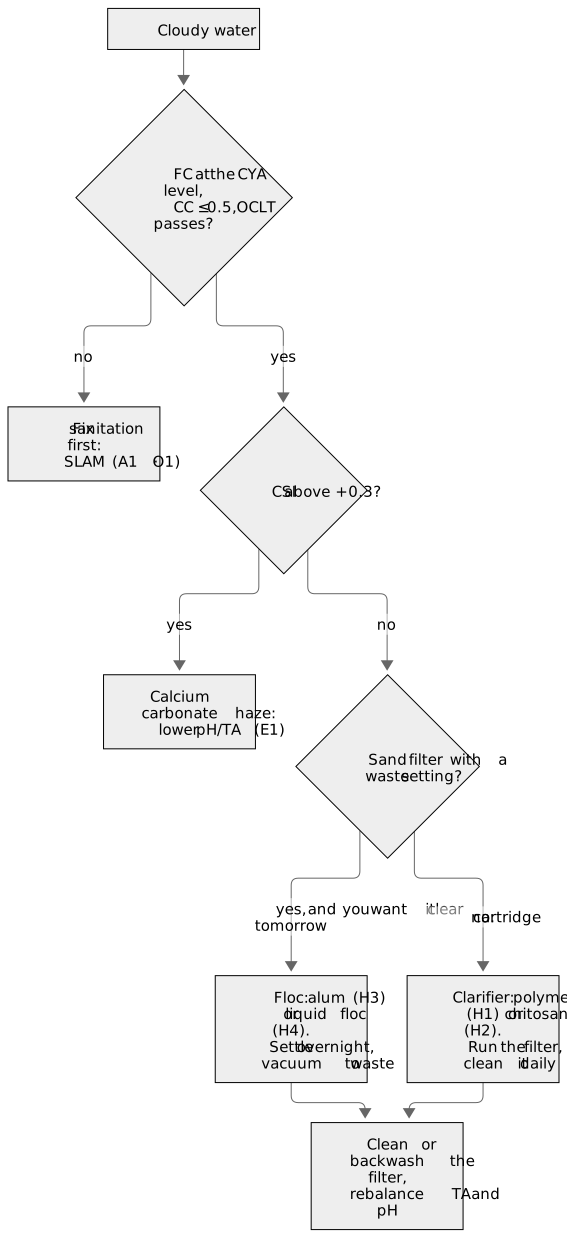
| Product | How it works | Filters | Typical dose per 10k gal | What happens next |
|---|---|---|---|---|
| Polymer clarifier (H1) | A cationic polymer clumps fine particles | All (some exclude DE) | 2–4 fl oz | The filter catches clumps over 1–3 days |
| Chitosan (H2) | A natural cationic polymer | All | 1–7 fl oz | Same |
| Alum (H3) | Aluminum hydroxide floc sweeps particles down | Sand with a waste valve | 2–8 lb (typ. 4) | Settle 12–24 h, vacuum to waste |
| Liquid floc (H4) | Aluminum chloride or PAC | Sand with a waste valve | 8 fl oz | Settle overnight, vacuum to waste |
| Phosphate remover (H5) | Precipitates phosphate as an insoluble salt | All (DE and cartridge have a per-treatment cap) | Depends on ppb | Brief cloudiness; the filter catches it |
H1 · Polymer clarifiers — polyDADMAC, polyamines
| Chemistry | Water-soluble cationic polymers, typically polyDADMAC or polyamines. They neutralize the negative charge that keeps microscopic particles apart, so the particles clump into sizes the filter can trap. |
| Sold as | HTH Clarifier Advanced (SDS: "cationic polymer" 1–6%) · Clorox Pool&Spa Super Water Clarifier (ingredients not listed) · In The Swim Super Clarifier · many others. Concentrations are rarely disclosed, so dose by label. |
| Pool types | Cl ➕ · SWG ➕ · Br ➕ |
| Moves | No effect on water balance. An overdose re-clouds the water and can gum filter media. |
| Never mix with | Floc (use one or the other) · anionic products such as some metal sequestrants on the same day (MetalFree's label says not within 24 h of cationic polymers) |
Dose card — fl oz per 10,000 gal · basis: label
| Product | Very cloudy / initial | Weekly maintenance | Notes |
|---|---|---|---|
| HTH Clarifier Advanced | 4 | 2 | — |
| Clorox Super Water Clarifier | 2 (1 fl oz per 5,000 gal) | 2 | — |
| In The Swim Super Clarifier | 4 | 2 | Not for DE filters |
| 400-gal spa (any of the above) | ≈ 0.16 (4.7 mL) | ≈ 0.08 (2.4 mL) | 0.04 × the pool dose |
Labeled uses
L1 · Clear cloudy water — Cl · SWG · Br
Effect & benefit: Turns a hazy pool clear in 1–3 days through the existing filter. No vacuuming to waste, no water loss, and it works with cartridge filters.
How to use:
- Rule out the real causes first. Low FC or failed sanitation (A1 · O2 OCLT), high CSI (calcium-carbonate haze), or a dirty filter. Clarifier fixes neither sanitation nor balance.
- Clean or backwash the filter.
- Add the "very cloudy" dose with the pump running, in front of a return.
- Run the filter 24/7. Clean it after 1–2 days, because the clumps load it fast.
- Repeat once if needed. Don't double the dose. An overdose re-clouds the water.
How much (per 10,000 gal) · basis: label
Use the dose card's "very cloudy" column.
Cautions:
- ⛔ Fish ponds: cationic polymers are highly toxic to fish (gill damage).
- Check DE compatibility: some products exclude DE filters.
L2 · Maintenance dose — Cl · SWG · Br
Effect & benefit: A weekly small dose helps a marginal filter, especially a sand filter, keep up with fine particles from heavy bather loads, pollen, or dust.
How to use:
- Add the weekly dose with the pump running.
- Keep normal filter run times and cleaning.
- If you need it every week, look at the filter itself: media age, DE charge (L1), or sand-filter aids (H3 · L2, L1 · O1).
How much (per 10,000 gal) · basis: label
Use the dose card's maintenance column.
Cautions:
- Don't stack it with floc or with a phosphate-remover treatment on the same day.
Off-label uses
No off-label uses worth recommending. ⛔ Never in fish ponds, where cationic polymers are toxic to fish. In fishless water features, ordinary filtration and cleaning do the job without it.
Hazards & storage:
- Low acute hazard. Keep it capped and out of children's reach.
- Rinse spills; they're slippery.
H2 · Chitosan — natural clarifier
| Chemistry | Chitosan, a natural cationic polysaccharide made from crustacean-shell chitin. It works like H1, neutralizing charge so particles clump, and it's biodegradable. |
| Sold as | SeaKlear Chitosan (Natural) Clarifier (SDS lists no reportable components) · Leslie's Ultra Bright Advanced (chitosan) · concentrations not published, so dose by label |
| Pool types | Cl ➕ · SWG ➕ · Br ➕ |
| Moves | No effect on water balance. It's biodegradable and adds a little chlorine demand. |
| Never mix with | Floc on the same day · anionic sequestrants on the same day |
Dose card — fl oz per 10,000 gal · basis: label
| Product | Weekly | Cloudy water |
|---|---|---|
| SeaKlear Chitosan Clarifier | 1 | 2–3 (double or triple) |
| Leslie's Ultra Bright Advanced | 3 | 7 |
| 400-gal spa | 0.04 × the pool dose | — |
Labeled uses
L1 · Natural clarifier for cloudy water and weekly maintenance — Cl · SWG · Br
Effect & benefit: Clears haze through the filter like a synthetic polymer, from a natural, biodegradable source. It's popular where owners prefer "natural" products.
How to use:
- Rule out sanitation, balance, and filter problems first (see H1 · L1).
- Add the dose with the pump running.
- Run the filter continuously and clean it after 1–2 days.
- Go back to the weekly dose once clear.
How much (per 10,000 gal) · basis: label
Use the dose card.
Cautions:
- Overdosing can re-cloud the water, as with any clarifier.
- ⛔ Pool products aren't labeled for aquatic life, so keep them out of fish ponds.
Off-label uses
No off-label uses worth recommending. Food and beverage fining uses food-grade chitosan, and pool products aren't food grade. Fishless water features don't need it beyond normal filtration.
Hazards & storage:
- Low hazard. Keep it capped.
H3 · Aluminum sulfate (alum)
| Chemistry | Al₂(SO₄)₃·14H₂O. In pool water it forms sticky aluminum hydroxide floc that sweeps suspended particles to the floor. It consumes alkalinity: 6 equivalents per molecule. |
| Sold as | Granular or lump "alum" (aluminum sulfate) as pool floc and as garden "aluminum sulfate". Not the same as pickling alum (potassium aluminum sulfate). No current branded pool-alum label was found, so the doses below are retailer and trade guidance. |
| Pool types | Cl ➕ · SWG ➕ · Br ➕ |
| Moves | TA ↓ 6.05 ppm per lb per 10k gal · pH ↓ · sulfate ↑ 5.8 ppm per lb · aluminum is mostly removed with the floc |
| Never mix with | Clarifier or liquid floc at the same time · DE or cartridge filters (the floc blinds them) |
Dose card — per 10,000 gal · basis: rule of thumb (dose) + stoichiometry (TA)
| Dose | Use | TA drop | Baking soda to restore TA afterward |
|---|---|---|---|
| 2 lb | Light haze | −12 ppm | 1.7 lb |
| 4 lb | Typical | −24 ppm | 3.4 lb |
| 6 lb | Heavy | −36 ppm | 5.1 lb |
| 8 lb | Severe (upper end) | −48 ppm | 6.8 lb |
Labeled uses
L1 · Floc and vacuum to waste — Cl · SWG · Br (sand filters with a waste setting)
Effect & benefit: Clears very cloudy water overnight. Typical causes: dead algae after a SLAM, dust storms, construction silt, or a party. Everything settles into a layer you vacuum straight out of the pool, bypassing the filter. It's the fastest route to clear water, at the cost of the water you vacuum out.
How to use:
- Confirm you can vacuum to waste:
- Sand filter with a multiport Waste setting: yes.
- Cartridge or DE: only with a separate submersible pump. Otherwise use a clarifier (H1).
- Water should be ≥ 70 °F, since floc forms slowly in cold water. Turn off the SWG.
- Adjust pH to about 7.0–7.2 first (trade guidance) and make sure TA can spare 20–30 ppm.
- Pre-dissolve the alum in a bucket of warm pool water. Pour it around the perimeter with the pump running.
- Circulate 2 h, then turn the pump off for 12–24 h. Don't disturb the water.
- Vacuum the settled layer slowly to waste, a little at a time, so it doesn't billow. Top up the water as you go.
- Restore TA with baking soda (dose card) and pH, then clean the filter.
How much (per 10,000 gal) · basis: rule of thumb (In The Swim: 4 lb, range 2–8)
Use the dose card.
Cautions:
- You'll lose water; check local discharge rules.
- A floc that won't settle usually means pH was off or the water was cold.
- ⛔ Don't run floc through a DE or cartridge filter.
L2 · Sand-filter aid — Cl · SWG · Br (sand filters)
Effect & benefit: A thin gel layer of aluminum hydroxide on top of the sand helps it trap finer particles than clean sand alone. It's a cheap upgrade for sand filters that "can't get it sparkling".
How to use:
- Backwash and rinse.
- With the pump running, sprinkle the dose slowly into the skimmer.
- Expect filter pressure to rise a little.
- Repeat after each backwash.
How much (per filter, not per pool) · basis: rule of thumb (In The Swim: 6 oz per 100 lb of sand)
| Sand in the filter | Alum | TA effect in 10k gal |
|---|---|---|
| 100 lb | 6 oz | −2.3 ppm |
| 150 lb | 9 oz | −3.4 ppm |
| 200 lb | 12 oz | −4.5 ppm |
| 300 lb | 18 oz | −6.8 ppm |
Cautions:
- Too much blinds the sand (pressure spike). Backwash and use less next time.
- An alternative with no TA effect: DE in a sand filter (L1 · O1).
Off-label uses
O1 · Turn bigleaf hydrangeas blue — around the house ⚠️
Effect & benefit: Bigleaf and mountain hydrangeas (Hydrangea macrophylla, H. serrata) bloom blue when their roots can take up aluminum, which happens in acidic soil (≈ pH 5.0–5.5). Aluminum sulfate both supplies aluminum and acidifies the soil. Pure pool alum is the same chemical sold in garden centers.
How to use:
- Test soil pH. Blue needs acidic soil. White varieties and panicle or smooth hydrangeas don't change color.
- Water the plant first.
- Dissolve the alum in water and drench the soil around the drip line. Keep it off the leaves, which it burns.
- Repeat every few weeks in spring for 2–4 applications, then judge by next season's blooms.
How much (per gallon of drench, not per pool) · basis: rule of thumb (common garden guidance)
| Plant | Aluminum sulfate per gallon of water | Applications |
|---|---|---|
| Established, 2–3+ years | ~1 tbsp (≈ ¼ oz) | 2–4 in spring |
| Young plants | ~½ tbsp | 2–3 in spring |
Cautions:
- Too much aluminum burns roots and can kill plants. Don't exceed the rate.
- It acidifies the soil around nearby plants and lawn too.
- Use only pure aluminum sulfate, not a pool floc blend with polymers.
- Keep it away from children and pets.
Hazards & storage:
- Acidic dust that irritates eyes and lungs. Keep it dry: it cakes and corrodes metal when damp.
- Store it away from bases and chlorine products.
H4 · Liquid flocculants — polyaluminum chloride (PAC) & aluminum chloride
| Chemistry | Aluminum chloride (AlCl₃) and polyaluminum chloride (PAC, "aluminum chloride hydroxide"): pre-hydrolyzed aluminum coagulants. Compared with alum, they floc faster over a wider pH range and consume far less alkalinity. Some blends add a polyDADMAC polymer. Most liquid "floc" products are these, not alum. |
| Sold as | HTH Drop Out (aluminum chloride) · In The Swim Super Floc Out (aluminum chloride hydroxide = PAC) · Leslie's Super Floc · Regal Super Floc (aluminum chloride 10–20% + polyDADMAC) · commercial PAC for continuous dosing ahead of sand filters (UK practice) |
| Pool types | Cl ➕ · SWG ➕ · Br ➕ |
| Moves | TA ↓ slightly (≈ 1–2 ppm per 8-fl-oz dose of ~15% aluminum chloride, calc) · pH ↓ slightly · chloride ↑ |
| Never mix with | Clarifier or alum at the same time · DE or cartridge filters (blinding) |
Dose card — per 10,000 gal · basis: label
| Product | Dose | Conditions |
|---|---|---|
| HTH Drop Out | 8 fl oz | Settle overnight, vacuum to waste |
| In The Swim Super Floc Out | 8 fl oz | Same |
| Leslie's Super Floc | 8 fl oz (2–3× for severe cloudiness) | pH 7.6; FC under 3 ppm |
| Regal Super Floc | Per label | — |
| Commercial continuous PAC (PWTAG, UK) | ≈ 0.1 mL per m³ of circulation flow, undiluted | Dosing pump ahead of a sand filter |
Labeled uses
L1 · Floc to the floor (residential) or continuous coagulation (commercial) — Cl · SWG · Br
Effect & benefit: The same overnight "drop it and vacuum it" result as alum (H3), from a liquid that's easier to dose and barely moves TA. Commercial sand-filter plants dose PAC continuously so the filter catches particles it would otherwise pass.
How to use (residential):
- You'll need a way to vacuum to waste (sand filter Waste setting, or a submersible pump).
- Set pH and FC per the label. Leslie's specifies pH 7.6 and FC under 3 ppm.
- Add the dose in front of a return with the pump running. Circulate per the label (typically 1–2 h).
- Pump off overnight.
- Vacuum the settled layer slowly to waste, then clean the filter.
How to use (commercial): a metering pump injects PAC ahead of the sand filter at the rate below, under the facility's code and filter maker's guidance.
How much · basis: label (residential) + trade guidance (commercial)
| Setting | Amount |
|---|---|
| Residential, per 10,000 gal | Dose card |
| Commercial, continuous | ≈ 0.1 mL per m³ of flow. Example: 50 m³/h (~220 gpm) → ≈ 5 mL/h |
Cautions:
- Water lost to waste; check discharge rules.
- An aluminum overdose leaves a stubborn haze ("aluminum carry-over") if pH is off.
- ⛔ Not through DE or cartridge filters.
Off-label uses
No off-label uses worth recommending. Water-treatment coagulants for drinking water or ponds are separately formulated and certified, and pool flocs aren't.
Hazards & storage:
- Acidic liquids: wear goggles and gloves.
- Store them closed and away from bases, chlorine products, and metal.
H5 · Phosphate removers — lanthanum chloride (and a non-lanthanum alternative)
| Chemistry | Lanthanum chloride (LaCl₃): La³⁺ + PO₄³⁻ → LaPO₄, an insoluble solid that briefly clouds the water until the filter catches it. Orenda PR-10,000 is "not lanthanum-based" per Orenda, with the active undisclosed. Phosphate itself is an algae nutrient; see the two schools of thought in §1.2. |
| Sold as | PHOSfree (SDS: lanthanum chloride 7–13%) · SeaKlear Phosphate Remover (strength unpublished) · SeaKlear PhosKlear 4000 (lanthanum chloride hydrate 30–40%) · HTH Phosphate Remover (lanthanum chloride) · Orenda PR-10,000 (non-lanthanum) · enzyme combinations (Pool Perfect + PHOSfree, Orenda CV-700: K1). Note: SeaKlear "90-Day" is a copper algaecide, not a phosphate remover. |
| Pool types | Cl ➕ · SWG ➕ · Br ➕ |
| Moves | Phosphate ↓ · temporary cloudiness · chloride ↑ slightly |
| Never mix with | Clarifier or floc the same day · phosphonate sequestrants at the same time. Lanthanum binds phosphonates too, and sequestrants break down into phosphate (I1). |
Dose card — product needed to remove 1,000 ppb (1 ppm) phosphate from 10,000 gal · basis: label + stoichiometry
| Product | Per 1,000 ppb | Relative strength |
|---|---|---|
| Theory: pure LaCl₃ | 98 g (3.5 oz) anhydrous basis · 148 g heptahydrate | — |
| PHOSfree (7–13%) | ≈ 1.67 L (≈ 56 fl oz) | 1× |
| HTH Phosphate Remover | 16 fl oz | ≈ 3.5× |
| SeaKlear Phosphate Remover | 4 fl oz | ≈ 14× |
| Orenda PR-10,000 (non-lanthanum) | ≈ 3.2 fl oz (1 qt per 10,000 ppb) | ≈ 17× |
Strengths vary about 17-fold, so never swap doses between brands. Most pool phosphate tests report ppb as phosphate (PO₄). If yours reports phosphorus (P), multiply by 3.07 to get PO₄.
Labeled uses
L1 · Initial phosphate removal — Cl · SWG · Br
Effect & benefit: Strips phosphate, an algae nutrient, from the water. It's insurance for pools that sometimes lapse on chlorine or that get heavy phosphate input:
- fertilizer runoff,
- leaves,
- some fill water,
- breakdown of phosphonate sequestrants.
Pools that hold FC at the CYA-indexed level don't strictly need it (§1.2).
How to use:
- Test phosphate (ppb). Clean the filter and balance the water first.
- Add the product per the table below, slowly in front of a return, pump running.
- Expect cloudiness for hours to a day. Run the filter 24 h.
- DE and cartridge filters: respect the per-treatment cap (PHOSfree 1.5 L; Orenda 8 oz). Split big doses, cleaning the filter between them.
- Clean or backwash the filter, then retest after 24–48 h.
How much (per 10,000 gal) · basis: label
| Phosphate (ppb) | PHOSfree | HTH | SeaKlear PR | Orenda PR-10,000 |
|---|---|---|---|---|
| 125 | — | 2 fl oz | ½ fl oz | 2 fl oz (0–500 band) |
| 250 | — | 4 fl oz | 1 fl oz | 2 fl oz |
| ≤ 300 | 0.5 L (17 fl oz) | — | — | — |
| 500 | — | 8 fl oz | 2 fl oz | 2–4 fl oz |
| 600 | 1 L (34 fl oz) | — | — | — |
| 900 | 1.5 L (51 fl oz) | — | — | — |
| 1,000 | — | 16 fl oz | 4 fl oz | 4 fl oz (500–1,000 band) |
| 1,200 | 2 L (68 fl oz) | — | — | — |
| 2,000 | Split treatments | 2 × 16 fl oz | 8 fl oz | 8 fl oz (max per treatment) |
| 9,000 | Split treatments | Split treatments | 32 fl oz (label example) | Repeat 8-fl-oz treatments |
PhosKlear 4000 (30–40% lanthanum) is the most concentrated lanthanum product listed: follow its label.
Cautions:
- Brief cloudiness and a fast-loading filter are normal.
- Don't combine with clarifier or floc the same day.
- Treat phosphate readings that come back after a few weeks as a clue: something keeps adding it.
L2 · Maintenance dose — Cl · SWG · Br
Effect & benefit: A small weekly dose captures new phosphate as it arrives, so readings stay low without big treatments.
How to use:
- After the initial treatment, add the weekly dose with the pump running.
- Retest monthly and adjust.
How much (per 10,000 gal) · basis: label
| Product | Weekly |
|---|---|
| SeaKlear Phosphate Remover | 2 fl oz (1 fl oz per 5,000 gal) |
| HTH Phosphate Remover | 2 fl oz (1 fl oz per 5,000 gal) |
| PHOSfree | Via an enzyme combination (Pool Perfect + PHOSfree, K1) |
| Orenda | Via CV-700, enzyme + phosphate remover (K1) |
Cautions:
- It isn't a substitute for chlorine.
- With phosphonate sequestrants in the water, expect higher remover use, since they break down into phosphate.
Off-label uses
O1 · Phosphate control in fishless water features — fountains, decorative basins ⚠️
Effect & benefit: Fountain algae feeds on phosphate from leaves, fertilizer drift, and tap water. Removing it slows algae without adding an algaecide.
How to use:
- ⛔ Fishless features only: lanthanum is toxic to aquatic life, and pool products aren't labeled for ponds.
- Estimate the volume (gallons) and test phosphate.
- Dose per the label table, scaled to volume (below). Run the pump and clean its prefilter after the cloudiness clears.
- Wipe the basin and drain and refill periodically.
How much (per 100 gal, per 1,000 ppb removed) · basis: label (scaled)
| Product | Amount |
|---|---|
| PHOSfree | ≈ 0.56 fl oz (17 mL) |
| HTH | ≈ 0.16 fl oz (4.7 mL) |
| SeaKlear PR | ≈ 0.04 fl oz (1.2 mL) |
Cautions:
- Phosphate removers make no pesticide claims, so FIFRA doesn't apply, but the label still limits use to pools and spas.
- ⛔ Fish ponds, birdbaths, pet bowls.
- Keep the treated water out of storm drains.
Hazards & storage:
- Eye irritant. Keep it capped and out of children's reach.
- Rinse spills with water.
3I · Sequestrants, chelants, stain & scale treatments
The products in this section do two different jobs:
- Holding: sequestrants and chelants (I1, I2) keep dissolved metals and calcium in solution, so they can't oxidize into stains or grow into scale. They prevent; they don't remove. Metals leave only by dilution.
- Dissolving: acids and reducers (I3–I7) pull deposits that have already formed back into the water. That's why a sequestrant usually follows.
| Stain or deposit | Identify it with | Dissolve it with | Then |
|---|---|---|---|
| Iron: brown, rust, orange | A vitamin C tablet lightens it (I3 · O2) | Ascorbic acid (I3 · O1) | Sequestrant (I1 · O1) |
| Manganese: purple, brown-black | Vitamin C lightens it | Ascorbic acid | Sequestrant |
| Copper: blue-green, teal, gray-black | Vitamin C may lighten or darken it; citric acid lightens it | Citric acid (I4 · O1) | Sequestrant, then dilution |
| Organic: leaves, berries, algae | A trichlor rub lightens it (A5 · O1) | Chlorine (A1 · O7) | — |
| Calcium carbonate scale: white, crusty | Vinegar fizzes on it (§4) | Aggressive water (E1 · O3), EDTA (I2 · O1), or cleaning acids above the waterline (I7) | Scale inhibitor (I1 · L2) |
I1 · Phosphonates & polymer sequestrants — HEDP, PBTC, ATMP, polymaleic/polyacrylic
| Chemistry | Organic phosphonic acids such as HEDP (1-hydroxyethylidene-1,1-diphosphonic acid), PBTC, and ATMP, plus carboxylate polymers (polymaleic, polyacrylic). They wrap dissolved iron, copper, manganese, and calcium so these can't oxidize onto surfaces or grow into scale crystals. Against scale they work at tiny "threshold" doses; against metals they bind roughly 1:1. Nothing is removed: the metals and calcium stay in the water. Chlorine slowly breaks phosphonates down, releasing orthophosphate. |
| Sold as | Liquid "metal & stain control", "scale inhibitor", or "stain & scale" products, typically 10–30% active. SDS-listed actives: HTH Metal, Stain & Scale Control (HEDP 20–30%) · BioGuard Scale Inhibitor (HEDP 10–20% + polymaleic acid 10–20%) · Jack's Magic The Pink Stuff ("diphosphonic acid" 20–30%). Actives not on file: Jack's Magic Blue, Purple, and Magenta; Natural Chemistry MetalFree; Orenda SC-1000. PBTC turns up in EU products; no ATMP pool product was found. The EDTA-based SeaKlear Metal Klear is in I2. |
| Pool types | Cl ➕ · SWG ✅ several labels say salt-safe or claim cell-scale help · Br ➕ |
| Moves | Metals and calcium stay dissolved, so test readings don't change · phosphate readings ↑ as chlorine degrades phosphonates · pH ↓ slightly (acidic liquids) · HEDP "hardness reducers" can make CH read lower without removing calcium |
| Never mix with | Chlorine concentrate in a bucket · cationic clarifiers on the same day (Natural Chemistry's MetalFree label says to wait 24 h) · lanthanum phosphate removers on the same day: lanthanum can bind phosphonates too, which wastes both |
Dose card — product directions per 10,000 gal · basis: label
| Product | Stated target | Start-up | Maintenance | Salt-system statement |
|---|---|---|---|---|
| HTH Metal, Stain & Scale Control (HEDP 20–30%) | Metals, stains, scale | 10 fl oz | 2.5 fl oz weekly | "Safe for … salt" |
| BioGuard Scale Inhibitor (HEDP + polymaleic) | Scale | Per label (not verified) | Per label | — |
| Jack's Magic The Pink Stuff ("diphosphonic acid" 20–30%) | Iron, chlorine pools | 1 qt (32 fl oz) | 6–8 fl oz weekly | — |
| Jack's Magic The Blue Stuff | Copper; chlorine, bromine, and biguanide pools | 1 qt (32 fl oz) | 12 fl oz weekly during a stain treatment | — |
| Jack's Magic The Purple Stuff | Salt systems and high-TDS water | 1 qt (32 fl oz) | 12 fl oz weekly during a stain treatment | Made for salt systems |
| Jack's Magic The Magenta Stuff | Calcium scale | 1 qt per 15,000 gal (≈ 21 fl oz per 10k) | Per label | — |
| Natural Chemistry MetalFree | Metals | 1 L per 20,000 gal (≈ 17 fl oz per 10k) | 4 fl oz weekly | No statement |
| Orenda SC-1000 | Calcium and metals | 32 fl oz (48 fl oz for well water) | 3 fl oz weekly | Maker says it helps with salt-cell scale |
Two stoichiometry checks · basis: stoichiometry, assuming a ~25% HEDP product at SG ≈ 1.2
| Check | 10 fl oz (start-up size) | 2.5 fl oz (weekly) | 1 qt (32 fl oz) |
|---|---|---|---|
| Metal it can hold at 1:1 in 10,000 gal (calcium competes, so real capacity is lower) | ≈ 0.6 ppm iron or 0.7 ppm copper | ≈ 0.16 / 0.18 ppm | ≈ 2.0 ppm iron or 2.3 ppm copper |
| Phosphate it can become once chlorine degrades it | up to ≈ 2,200 ppb PO₄ | up to ≈ 540 ppb | up to ≈ 6,900 ppb |
Labeled uses
L1 · Prevent metal stains — Cl · SWG · Br
Effect & benefit: Dissolved iron, copper, and manganese are invisible until chlorine oxidizes them. Then they come out as brown, blue-green, or purple stains on plaster, grout, and fittings. A sequestrant holds them in solution so the oxidation doesn't deposit them. That's essential with:
- well water,
- water that has had copper algaecide or an ionizer,
- metal-heavy fill water,
- water just after a stain treatment.
How to use:
- Test metals in the pool and in the fill water (§1.2).
- Add the start-up dose with the pump running, in front of a return. For new well-water fills, add it as soon as water is circulating and before shocking.
- Keep FC at the normal target. Very high FC both oxidizes metals and degrades sequestrant faster, so avoid SLAM-level chlorine while metals are present unless you must.
- Add the weekly maintenance dose. Chlorine keeps breaking the sequestrant down.
- To get rid of metals for good, replace water (dilution) or use ascorbic/citric treatment followed by a partial drain.
How much (per 10,000 gal) · basis: label + stoichiometry
Use the dose card. As a sense of scale, a 1-qt start-up dose of a ~25% HEDP product can hold roughly 2 ppm of iron at 1:1, less in hard water. Metal levels above ~1 ppm call for removal or dilution, not just sequestering.
Cautions:
- It doesn't remove metals. When the sequestrant runs out, held metals can stain all at once.
- Phosphonates add phosphorus. A 10-fl-oz dose can eventually read as ~2,000 ppb phosphate. Under the phosphate-control school (§1.2) that matters; under FC/CYA management it doesn't.
L2 · Prevent scale — Cl · SWG · Br
Effect & benefit: At a few ppm, phosphonates and polymaleic acid disrupt calcium carbonate crystal growth ("threshold inhibition"). Water that is slightly scale-forming (CSI 0 to about +0.3) stays clear, and tile lines, heaters, waterfalls, and spa jets crust much more slowly. It's useful where fill water is hard or evaporation keeps concentrating calcium.
How to use:
- Balance first (§1.6). An inhibitor buys margin; it doesn't excuse CSI above ~+0.3.
- Add the start-up dose, then weekly maintenance.
- For existing scale, use a removal method (E1 · O3, I2 · O1, I7), then use the inhibitor to keep it from returning.
How much (per 10,000 gal) · basis: label
| Product | Start-up | Maintenance |
|---|---|---|
| HTH Metal, Stain & Scale Control | 10 fl oz | 2.5 fl oz weekly |
| Orenda SC-1000 | 32 fl oz | 3 fl oz weekly |
| Jack's Magic The Magenta Stuff | ≈ 21 fl oz (1 qt per 15,000 gal) | Per label |
| BioGuard Scale Inhibitor | Per label | Per label |
Cautions:
- Chlorine degrades phosphonates, so a missed weekly dose shows up as scale within weeks in hard water.
- Phosphate readings rise over the season (see the dose card).
L3 · Help keep a salt cell from scaling — SWG
Effect & benefit: A salt cell's plates run at high local pH, which makes them a scale magnet. A salt-compatible inhibitor slows the white crust that cuts output and forces acid washing. Several products say so on the label.
How to use:
- Use only a product whose label says it's safe for salt systems: HTH Metal, Stain & Scale Control; SeaKlear Metal Klear (I2); Jack's Magic The Purple Stuff (made for salt systems). Orenda says SC-1000 helps with cell scale.
- Dose start-up, then weekly, as in L2.
- Still keep CSI between −0.3 and 0, and inspect the cell monthly. Acid-wash only when scale is visible (E1 · O1).
- Remove metals before switching a pool to salt. Hayward's AquaRite manual calls for a metal remover and a non-copper algaecide before start-up in water that isn't new, and Pentair wants metals at "None".
How much (per 10,000 gal) · basis: label
| Product | Start-up | Maintenance |
|---|---|---|
| HTH Metal, Stain & Scale Control | 10 fl oz | 2.5 fl oz weekly |
| SeaKlear Metal Klear (EDTA) | 16 fl oz | 4 fl oz weekly |
| Orenda SC-1000 | 32 fl oz | 3 fl oz weekly |
| Jack's Magic The Purple Stuff | 1 qt (32 fl oz) | 12 fl oz weekly during a stain treatment |
Cautions:
- Sequestering metals doesn't make them safe for the cell. Pentair says metals "can also damage" its cell.
Off-label uses
O1 · Lock metals in solution after an ascorbic-acid treatment — Cl · SWG · Br
Effect & benefit: An ascorbic- or citric-acid treatment (I3 · O1, I4 · O1) dissolves metal stains, which puts the metal back into the water. If chlorine comes back too fast, the metal re-oxidizes and the stains return. A sequestrant dose right after the stains clear holds the metal while you restore chlorine slowly. It's a defined step in Trouble Free Pool's ascorbic procedure.
How to use:
- Finish the acid step, with the stains gone and FC still 0.
- Add the sequestrant's start-up dose, pump running.
- Follow the restore steps in I3 · O1: TA back first, then FC raised slowly over several days, with no SLAM for at least 2 weeks.
- Continue the weekly maintenance dose all season.
- Plan a partial drain to remove the metal permanently. Sequestering only buys time.
How much (per 10,000 gal) · basis: label (dose) + stoichiometry (capacity)
| Situation | Dose |
|---|---|
| After a typical iron treatment | Start-up dose from the dose card, e.g., 1 qt of Jack's Pink, or 10 fl oz HTH |
| Copper after a citric treatment | Jack's Magic Blue (or Purple in salt pools): 1 qt, then 12 fl oz weekly during the stain treatment |
| Heavy metals (> ~1 ppm before treatment) | The start-up dose may be outrun (the 1:1 capacity check above). Plan dilution as well |
Cautions:
- Chlorine gradually destroys the sequestrant. Skip the weekly dose and the stain can return.
- Don't add phosphate remover or cationic clarifier on the same day.
Hazards & storage:
- Acidic liquids that irritate eyes and skin. Wear gloves and goggles.
- Store capped, away from chlorine products.
- "Hardness reducer" products (e.g., HEDP at 370 g/L, sold as lowering CH 100 ppm per 250 mL per 10,000 L) can bind only about 5 ppm of calcium by stoichiometry. The CH drop they show is sequestration or test interference, not calcium removal.
I2 · EDTA salts — tetrasodium and disodium EDTA
| Chemistry | Ethylenediaminetetraacetic acid salts: a true chelant that binds calcium, magnesium, iron, and copper mole for mole. Unlike phosphonates, it can't work at threshold doses. Chlorine slowly oxidizes it. The pool calcium-hardness test is itself an EDTA titration, so EDTA in the water makes CH read low. |
| Sold as | SeaKlear Metal Klear (tetrasodium EDTA 10–20%, salt-safe per label) · some stain and scale removers · technical tetrasodium EDTA (powder, or ~38–40% solution) and disodium EDTA dihydrate (powder) from chemical suppliers · also present in Natural Chemistry's Yellow Out (G5) |
| Pool types | Cl ➕ · SWG ➕ (Metal Klear labeled salt-safe) · Br ➕ |
| Moves | Metals and calcium chelated · CH reads lower by about the EDTA dose · slow chlorine demand · sodium ↑ · tetrasodium form raises pH; disodium form lowers it slightly |
| Never mix with | Concentrated oxidizers (cal-hypo, MPS) in a bucket · lanthanum phosphate remover on the same day |
Dose card — per 10,000 gal · basis: label (Metal Klear) + stoichiometry (capacity at 1:1)
| Product or form | Start-up / per job | Maintenance | Chelates per dose |
|---|---|---|---|
| SeaKlear Metal Klear (10–20%) | 16 fl oz | 4 fl oz weekly | ≈ 0.2–0.4 ppm iron, or ≈ 0.4–0.7 ppm CH-equivalent |
| Tetrasodium EDTA, anhydrous basis | 9.1 oz per 1 ppm iron · 8.0 oz per 1 ppm copper · 3.17 lb per 10 ppm CH-equivalent | — | 1:1 |
| Disodium EDTA dihydrate (99%) | 3.14 lb per 10 ppm CH-equivalent | — | 1:1 |
| Tetrasodium EDTA ~39% solution (SG ≈ 1.28) | 17.5 fl oz per 1 ppm iron · 15.3 fl oz per 1 ppm copper · 0.76 gal (97 fl oz) per 10 ppm CH-equivalent | — | 1:1 |
Labeled uses
L1 · Metal and stain control (where EDTA is the active) — Cl · SWG · Br
Effect & benefit: Chelates dissolved metals so chlorine can't deposit them as stains. Labels present it as a start-up and weekly preventer, compatible with salt systems.
How to use:
- Test metals. Add the start-up dose with the pump running, before raising chlorine in metal-heavy water.
- Add the weekly maintenance dose.
- As with I1, remove metals for good by dilution.
How much (per 10,000 gal) · basis: label
SeaKlear Metal Klear: 16 fl oz start-up, then 4 fl oz weekly. At 10–20% EDTA, a 16-fl-oz dose chelates only ~0.2–0.4 ppm of iron at 1:1. It's a maintenance product, not a cure for heavy metals.
Cautions: Chlorine consumes EDTA over time, so keep up the weekly dose.
Off-label uses
O1 · No-drain calcium scale removal (local application) — Cl · SWG · Br ⚠️
Effect & benefit: EDTA dissolves calcium carbonate by chelating its calcium. Applied locally to scale (tile lines with the water lowered, removable fittings, spa jets), it lifts crust without acid fumes or etching the grout the way acid does.
Dosing the whole pool to dissolve scale is impractical. The water already holds hundreds of ppm of calcium, and EDTA chelates that first. A 10,000-gal pool at CH 300 holds ~11 kg of calcium (as CaCO₃), which would take ~43 kg of tetrasodium EDTA just to chelate.
How to use:
- Confirm it's carbonate scale: vinegar fizzes (§4). EDTA does little to calcium silicate.
- Lower the water a few inches below the scale line, or remove the fitting.
- Apply a strong tetrasodium-EDTA solution (a ~38–40% technical solution, or dissolved powder) with a sponge or brush. Keep it wet for 30–60 min, re-wetting as needed or covering with solution-soaked paper towels.
- Scrub with a nylon brush or pumice (on tile only, if the tile maker allows), rinse with pool water, and repeat until clear.
- Small amounts reaching the pool are harmless, but expect the CH test to read slightly low for a while.
How much · basis: stoichiometry (1 mol EDTA per mol calcium) + rule of thumb (application)
| Scale to dissolve | Tetrasodium EDTA (anhydrous) | Disodium EDTA dihydrate | ~39% solution |
|---|---|---|---|
| 1 oz of CaCO₃ scale | ≈ 3.8 oz | ≈ 3.7 oz | ≈ 7.3 fl oz |
| 1 lb of CaCO₃ scale | ≈ 3.8 lb | ≈ 3.7 lb | ≈ 0.91 gal |
| Whole pool, per 10 ppm of CH (for comparison) | 3.17 lb | 3.14 lb | 0.76 gal |
Cautions:
- CH test interference: the CH test is an EDTA titration, so every bit of EDTA in the water reads as missing calcium. A large dose can show a "drop" that isn't real.
- It's expensive per pound of scale removed. Acid methods (E1 · O3, I7) are cheaper where they're safe.
- Tetrasodium EDTA solution is strongly alkaline (pH ~11). Wear goggles and gloves.
Hazards & storage:
- Eye irritant; alkaline solutions can cause serious eye damage. Wear gloves and goggles.
- Store sealed and away from oxidizers.
I3 · Ascorbic acid — vitamin C
| Chemistry | C₆H₈O₆, a reducing acid. It dissolves oxidized iron (and manganese) from surfaces by reducing it to the soluble form. It reacts instantly with chlorine, one molecule per Cl₂-equivalent, and its breakdown products keep consuming chlorine for days. At pool pH it acts as a monoprotic acid. |
| Sold as | Bulk powder ~99% (food-grade, from bulk and baking suppliers) · vitamin C tablets (spot tests) · some branded metal-stain removers (check the SDS) · sodium ascorbate, the neutral salt, used in water-utility dechlorination products |
| Pool types | Cl ➕ · SWG ➕ (cell off during treatment) · Br ➕ |
| Moves | FC or bromine ↓ (≈ 4.8 ppm FC per lb per 10k, immediate) · pH ↓ · TA ↓ 3.4 ppm per lb · dissolved metals ↑ (the stain goes back into the water) |
| Never mix with | Chlorine products in a bucket · oxidizers in storage |
| Household equivalent | Grocery or bulk vitamin C powder. Tablets with fillers are fine for spot tests only. |
Dose card — per 10,000 gal · basis: stoichiometry + rule of thumb (TFP stain dose)
| Purpose | Ascorbic acid (99%) | Sodium ascorbate | Notes |
|---|---|---|---|
| Destroy 1 ppm FC | 3.3 oz | 3.7 oz | Fast, 1:1 |
| FC destroyed per lb | ≈ 4.8 ppm | ≈ 4.3 ppm | Plus slower demand for days afterward |
| TA change per lb | −3.4 ppm | ≈ 0 | Sodium ascorbate is pH-neutral |
| First whole-pool iron treatment (TFP) | 0.5–1 lb | — | Add more in ½-lb steps if needed |
Labeled uses
L1 · Remove iron and other metal stains — Cl · SWG · Br
Effect & benefit: Ascorbic acid lightens rust-brown iron stains (and manganese stains) within minutes, without acid-washing. Some branded stain removers are ascorbic acid. This use covers spot treatment; the whole-pool version is O1.
How to use:
- Confirm it's a metal stain with the spot test (O2).
- Bring FC down to 0–1 ppm. Chlorine destroys ascorbic acid before it reaches the stain.
- Spot: with the pump off, hold a sock of powder or crushed tablets against the stain for 3–5 min, then brush.
- Branded product: follow the label.
- Add a sequestrant afterward (I1 · O1). The iron is back in the water.
How much · basis: rule of thumb (spot) + label (branded)
| Use | Amount |
|---|---|
| Spot | 1–2 oz of powder or 15–20 crushed tablets in a sock, per stain |
| Effect on 10,000 gal per 2-oz spot | ≈ −0.6 ppm FC, −0.4 ppm TA (negligible) |
Cautions:
- Copper stains may darken rather than lighten. Use citric acid (I4 · O1).
- Restore chlorine slowly afterward.
Off-label uses
O1 · Whole-pool ascorbic-acid treatment (Trouble Free Pool procedure) — Cl · SWG · Br ⚠️
Effect & benefit: When iron stains are widespread (floor, walls, steps), dosing the whole pool dissolves them all at once. Combined with a sequestrant and a slow return to chlorine, it can clear a stained plaster pool without draining or acid washing. TFP's procedure is written for iron; for copper, use citric acid (I4 · O1).
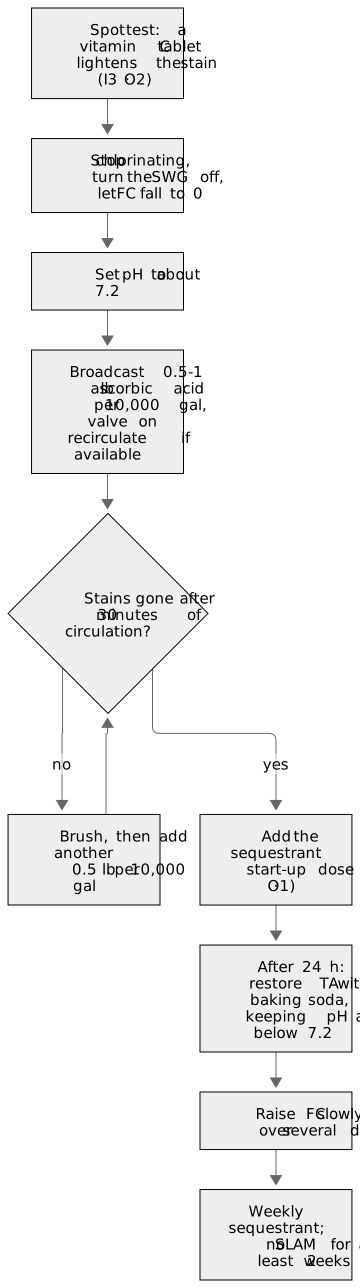
How to use:
- Identify: a vitamin C tablet lightens the stain (O2).
- Chlorine to zero:
- Stop chlorinating and turn off the SWG.
- Let FC fall to 0, or finish it off with ascorbic acid itself (≈ 3.3 oz per ppm per 10k gal).
- Uncovered sun speeds the drop.
- pH to ~7.2.
- Dose:
- Broadcast 0.5–1 lb per 10,000 gal over the stained areas.
- Set the multiport valve to recirculate if you have one.
- Circulate 30 min, then look. If stains remain, brush and add another ½ lb. Repeat until clear.
- Sequestrant: add the start-up dose (I1 · O1).
- After 24 h:
- Restore TA with baking soda (E6), keeping pH at or below 7.2 for now.
- Then raise FC slowly, a ppm or two a day, back to target.
- For at least 2 weeks: no SLAM. Keep up the weekly sequestrant. Plan a partial drain to remove the iron permanently.
How much (per 10,000 gal) · basis: rule of thumb (TFP doses) + stoichiometry
| Step | Amount |
|---|---|
| First dose | 0.5–1 lb |
| Each follow-up | 0.5 lb |
| Chlorine to destroy first, if FC isn't 0 | 3.3 oz per ppm FC (e.g., FC 3 → ≈ 10 oz) |
| TA drop | ≈ 3.4 ppm per lb; restore with 0.48 lb baking soda per lb of ascorbic acid |
Cautions:
- Chlorine demand after treatment: ascorbic acid's breakdown products keep consuming chlorine for days. The FC you add first will disappear faster than usual. That's expected; go slowly.
- Turn the SWG off for the whole treatment, and test FC before turning it back on.
- High FC returning too fast re-oxidizes the metal and brings the stains back.
O2 · Vitamin C tablet spot test — Cl · SWG · Br
Effect & benefit: A cheap, five-minute test that tells metal stains from organic ones before you spend money. Ascorbic acid lightens iron (and manganese) stains but does nothing to organic stains.
How to use:
- Crush 15–20 vitamin C tablets and put the powder in a sock.
- Pump off. Hold the sock firmly against the stain for 3–5 min.
- Lightens → metal (iron). Plan I3 · O1.
- No change → try the trichlor rub test (A5 · O1) for organic stains.
- Darkens or turns gray-black → suspect copper. Test a citric-acid sock (I4 · O1).
How much · basis: rule of thumb (TFP)
| Item | Amount |
|---|---|
| Per test | 15–20 tablets |
| Effect on the pool | Negligible (≈ 10 g of vitamin C destroys ~0.1 ppm FC in 10,000 gal) |
Cautions: Hold the sock still and press firmly. A quick swipe can give a false "no change".
O3 · Dechlorinate water — Cl · SWG · Br
Effect & benefit: Ascorbic acid (or pH-neutral sodium ascorbate) destroys chlorine instantly and leaves no sulfur compounds behind, as thiosulfate and sulfites do. It's handy for:
- getting to FC 0 before a stain treatment,
- dechlorinating drain or backwash water,
- bringing an over-shocked spa down quickly.
Background: water utilities and fire departments use ascorbic-acid and sodium-ascorbate products to dechlorinate water flushed from hydrants and mains.
How to use:
- Test FC and pick the target.
- Dissolve about 75% of the calculated dose in a bucket of pool water. Pour it in front of a return, pump running.
- Circulate 30 min, retest, and finish.
- If pH drops, restore it. Sodium ascorbate avoids the pH drop.
How much (per 10,000 gal) · basis: stoichiometry
| FC drop | Ascorbic acid | Sodium ascorbate |
|---|---|---|
| −1 ppm | 3.3 oz | 3.7 oz |
| −3 ppm | 9.9 oz | 11.2 oz |
| −5 ppm | 1.04 lb (16.6 oz) | 1.17 lb (18.7 oz) |
| −10 ppm | 2.07 lb (33.2 oz) | 2.33 lb (37.3 oz) |
| −20 ppm | 4.15 lb (66.3 oz) | 4.66 lb (74.6 oz) |
Cautions:
- Overshoot leaves a reducer that eats the next chlorine you add.
- The organic breakdown products add chlorine demand for days.
- For discharge, also check your local pH limit.
Hazards & storage:
- Low toxicity. Keep it dry and sealed: it browns and weakens in humid air and light.
- Store away from chlorine products.
I4 · Citric acid
| Chemistry | C₆H₈O₇, a weak triprotic acid and a good chelant for copper, iron, and calcium. At pool pH it releases about 2.9 acid equivalents per molecule. Chlorine oxidizes citrate slowly, so it adds chlorine demand for days. |
| Sold as | Anhydrous ~99.5% (food or canning grade) · monohydrate · some branded metal-stain and copper-stain removers (check the SDS) · household descaling powders |
| Pool types | Cl ➕ · SWG ➕ · Br ➕ |
| Moves | pH ↓ · TA ↓ ≈ 9.0 ppm per lb anhydrous (8.3 monohydrate) per 10k gal · metals chelated into solution · chlorine demand afterward. If fully oxidized, the theoretical ceiling is ≈ 40 ppm FC per lb; real demand is lower |
| Never mix with | Bleach or any chlorine product in a bucket (acid + hypochlorite = chlorine gas) · cal-hypo |
| Household equivalent | Canning/food-grade citric acid. Same chemical. |
Dose card — per 10,000 gal · basis: stoichiometry + rule of thumb (stain dose)
| Form | TA drop per lb | Baking soda to restore per lb | FC-demand ceiling per lb | Whole-pool stain start dose |
|---|---|---|---|---|
| Anhydrous 99.5% | −9.0 ppm | 1.27 lb | ≈ 40 ppm | 1 lb (rule of thumb) |
| Monohydrate | −8.3 ppm | 1.16 lb | ≈ 36 ppm | 1.1 lb (rule of thumb) |
Labeled uses
L1 · Metal-stain removers (where citric acid is the active) — Cl · SWG · Br
Effect & benefit: Citric-based stain products dissolve metal stains, especially copper, and hold the metal in solution while it's treated. The trade press notes they "often succeed where ascorbic acid has failed".
How to use:
- Identify the stain (vitamin C and trichlor tests; I3 · O2).
- Follow the product label. Typically you lower FC, set pH near 7.0–7.2, add the product, and brush.
- Add a sequestrant afterward and restore chlorine slowly (I1 · O1).
How much (per 10,000 gal) · basis: label
Per the product label. The TA drop follows the citric content (≈ 9 ppm per lb of citric acid per 10k gal).
Cautions: Restore TA afterward, and expect a few days of extra chlorine demand.
Off-label uses
O1 · Copper (blue-green, teal, gray-black) stain treatment — Cl · SWG · Br ⚠️
Effect & benefit: Copper stains come from copper algaecides, ionizers, some multi-function tablets, or a heater corroded by low pH. They often ignore ascorbic acid, or even darken with it. Citric acid dissolves and chelates copper, so a whole-pool dose lifts the stains and holds the copper in solution until a sequestrant and dilution take over.
How to use:
- Find and stop the source first: copper algaecide, ionizer, copper tablets, or low pH eating the heater.
- Spot-test: pump off, hold a sock with 1–2 oz of citric acid against the stain for 3–5 min. Lightening confirms copper.
- Chlorine and pH: FC to 0–1 ppm (SWG off) and pH to ~7.0–7.2.
- Dose: broadcast the start dose over the stained areas, pump running, and brush.
- Check after 30–60 min. Add ½ lb more at a time while stains keep fading.
- Sequestrant: add a copper-rated one (Jack's Magic Blue, or Purple in salt pools; or I1) at its start-up dose.
- Restore TA with baking soda, then raise FC slowly over several days. No SLAM for at least 2 weeks.
- Partial drain to remove the copper for good. TFP: copper leaves only by replacing water.
How much (per 10,000 gal) · basis: rule of thumb (dose) + stoichiometry (side effects)
| Step | Amount |
|---|---|
| Spot test | 1–2 oz in a sock |
| Whole-pool start | ~1 lb anhydrous (≈ 1.1 lb monohydrate) |
| Each follow-up | 0.5 lb |
| TA drop | ≈ 9 ppm per lb. Restore with ~1.27 lb baking soda per lb of anhydrous citric acid |
Cautions:
- Chlorine demand afterward can be large (theoretical ceiling ≈ 40 ppm FC per lb). Raise FC in steps and watch CC.
- Keep pH at or above ~7.0: very low pH attacks plaster, grout, and copper heat exchangers.
- Copper back in solution stains again if chlorine rises before the sequestrant is in.
O2 · Hard-water spot and descaling solution — tile · glass · spa fixtures · salt cell only if the maker allows
Effect & benefit: A mild, odorless acid for white hard-water spots and light scale on:
- tile above the waterline,
- glass pool fences,
- stainless rails and fittings,
- spa jet faces and showerheads.
It's safer to handle than muriatic acid and leaves no fumes.
How to use:
- Mix the solution in warm water.
- Spray or wipe it on. Keep it wet 5–15 min, scrub with a nylon pad, and rinse with fresh water.
- Soak removable parts (jets, nozzles, fittings) for 30–60 min, then rinse.
- Salt cell: only if your cell maker allows citric acid. Otherwise use the maker's muriatic ratio (E1 · O1).
- Keep the solution out of the pool. Rinse water reaching it should be minimal.
How much (per gallon of water, not per pool) · basis: rule of thumb
| Job | Strength | Anhydrous citric acid |
|---|---|---|
| Light spots | 5% | 6.7 oz (190 g) per gallon |
| Heavier scale, soaking parts | 10% | 13.4 oz (380 g) per gallon |
Cautions:
- ⛔ Not on marble, limestone, travertine, or other natural stone: it etches them.
- ⛔ Never combined with bleach.
Hazards & storage:
- Eye irritant (powder and strong solutions). Wear goggles for 10% mixes.
- Store dry and sealed; it cakes in humidity.
I5 · Oxalic acid
| Chemistry | (COOH)₂·2H₂O, a strong organic acid and reducing chelant. It dissolves rust (iron oxides) and bleaches tannin stains on wood. Toxic. With calcium it forms insoluble calcium oxalate, so it must not go into pool water in more than trace amounts. |
| Sold as | Crystals ~99% (wood bleach, deck brightener) · household cleansers and rust removers (check the SDS for the oxalic content) |
| Pool types | Spot use only, for Cl · SWG · Br pools |
| Moves (if it reaches the water) | Calcium oxalate haze or scale (≈ 0.8 ppm per oz per 10k gal) · FC ↓ ≈ 0.4 ppm per oz · pH ↓ |
| Never mix with | Bleach or chlorine products (acid + hypochlorite = chlorine gas) · ingestion: kidney-toxic |
Labeled uses
No labeled pool uses. Oxalic acid's labels cover wood bleaching, deck brightening, and household rust removal.
Off-label uses
O1 · Spot-treat rust and organic stains on tile, coping, plaster, and deck — Cl · SWG · Br ⚠️
Effect & benefit: Spot oxalic acid lifts rust spots and tannin stains quickly:
- rust from bobby pins, nails, rebar bleed, and furniture feet,
- leaf tannins on tile, coping, and wood decks.
Applied out of the water, it doesn't disturb pool chemistry.
How to use:
- Put on gloves and goggles. Oxalic acid is harmful through the skin.
- Above the waterline (tile, coping, deck): wet the spot and apply a paste or solution with a brush. Wait 5–10 min, scrub, and rinse well with fresh water. Keep rinse water out of the pool as much as you can.
- Below the waterline: lower the water to expose the spot if practical. Otherwise use a sock of crystals held against the stain for 1–3 min with the pump off, and keep the total that enters the pool small (see the limit below).
- Wood decks: apply the solution, scrub with the grain, and rinse thoroughly.
- Afterward, test pH and FC if any amount reached the pool.
How much · basis: rule of thumb + TFP limit
| Job | Amount |
|---|---|
| Spot paste | ~1 tbsp crystals with a few drops of water, per spot |
| Tile or deck solution | 3–6%: about 4–8 oz crystals per gallon of warm water |
| Most that should reach pool water | ≤ 1 oz per 10,000 gal (TFP), to avoid a calcium-oxalate haze |
Cautions:
- Hazards (SDS): harmful if swallowed or in contact with skin (H302+H312), causes serious eye damage (H318), and the kidneys are a target organ.
- Keep it away from children and pets, and wash tools.
- Test natural stone and colored grout first.
Hazards & storage:
- Store sealed, labeled, and away from food, children, and chlorine products.
- Rinse skin contact immediately.
I6 · Sodium dithionite — sodium hydrosulfite
| Chemistry | Na₂S₂O₄, a powerful reducing agent. It dissolves iron-oxide stains by reducing iron to its soluble form, faster than vitamin C. It destroys chlorine (≈ 0.9 ppm FC per oz per 10k gal) and ends up as sulfate (≈ 0.8 ppm per oz). Self-heating when damp (it can ignite), and it releases sulfur dioxide with acids. |
| Sold as | Household rust-stain removers for sinks, toilets, laundry, and water-softener resin, often blended with sulfites (check the SDS) · technical powder (a textile reducing agent) |
| Pool types | Spot use only ⚠️ |
| Moves (if it reaches the water) | FC ↓ ≈ 0.9 ppm per oz · sulfate ↑ ≈ 0.8 ppm per oz · pH ↓ |
| Never mix with | Acids (sulfur dioxide gas) · chlorine products or oxidizers in storage or a bucket (violent reaction) · water in the container (self-heating) |
Labeled uses
No labeled pool uses. Its labels cover household rust removal. Check whether your product's label mentions pools before using it there.
Off-label uses
O1 · Spot rust-stain treatment — Cl · SWG · Br ⚠️
Effect & benefit: For a stubborn iron spot (a rusted bobby pin, rebar bleed) that vitamin C only partly lightens, a small amount of dithionite held against the spot often removes it completely in a minute or two.
How to use:
- Confirm it's iron (vitamin C lightens it, I3 · O2). Try ascorbic acid first; it's gentler.
- Lower FC to ~0–1 ppm. Chlorine destroys dithionite before it reaches the stain.
- Pump off. Put the powder in a sock, hold it on the spot for 1–3 min, then brush.
- Treat a few spots, then restart the pump. Add a sequestrant if you treated many spots (I1).
- Never broadcast it to treat the whole pool. Use I3 · O1 for widespread stains.
How much · basis: rule of thumb (per spot) + stoichiometry (pool effect)
| Item | Amount |
|---|---|
| Per spot | 1–2 tbsp (≈ ½–1 oz) in a sock |
| Effect of 1 oz on 10,000 gal | ≈ −0.9 ppm FC, +0.8 ppm sulfate |
| Effect of 1 lb on 10,000 gal | ≈ −15 ppm FC, +13 ppm sulfate (one reason not to dose the whole pool) |
Cautions:
- Keep the container closed and dry. Damp powder self-heats and can ignite.
- Never put a wet scoop or sock back in the container.
- Rotten-egg sulfur odor is normal; ventilate.
- Never use it near acid. Sulfur dioxide is a lung irritant.
Hazards & storage:
- Classed as a self-heating solid (UN 1384).
- Store small quantities, sealed and dry, away from oxidizers (cal-hypo, trichlor, MPS) and acids.
I7 · Cleaning-only acids — sulfamic, phosphoric, vinegar
| Chemistry | Sulfamic acid (H₃NSO₃): a dry, strong acid used in descalers. Phosphoric acid (H₃PO₄): in tile and grout cleaners and rust removers. Acetic acid (vinegar): a mild acid for light deposits. All three dissolve calcium carbonate scale on surfaces. None belongs in pool water. |
| Sold as | Sulfamic crystals (descalers, toilet and tile cleaners) · phosphoric-based tile, grout, and rust cleaners (various strengths; follow the label) · household vinegar 5%, "cleaning vinegar" 6%, concentrates up to ~30% |
| Pool types | Cleaning only (Cl · SWG · Br) · ⛔ in pool water |
| Moves (if they reach the pool) | Sulfamic: forms N-chlorosulfamates with chlorine, which read as combined chlorine and tie up FC · phosphoric: adds phosphate and can precipitate calcium phosphate scale · vinegar: small chlorine demand and pH ↓ |
| Never mix with | Bleach or any chlorine product (chlorine gas) · cal-hypo · each other in concentrated form |
Labeled uses
L1 · Tile and fixture descaling products — around the pool
Effect & benefit: Descalers based on these acids remove white hard-water deposits, without muriatic acid's fumes, from:
- tile above the waterline,
- glass fences,
- stainless rails and ladders,
- shower fixtures,
- the jet faces of a drained spa.
How to use:
- Follow the product label: dilution, dwell time, and surfaces.
- Wet the surface, apply, scrub with a nylon pad, and rinse with fresh water.
- Keep rinse water out of the pool.
How much (per gallon of water, not per pool) · basis: label + rule of thumb
| Product | Typical use |
|---|---|
| Commercial descaler | Per label |
| Sulfamic crystals | 5% (≈ 6.7 oz per gallon) for light scale; 10% (≈ 13.4 oz per gallon) for heavy |
| Household vinegar | Undiluted, or 1:1 with water for spraying |
Cautions:
- ⛔ Not on marble, limestone, or travertine.
- Phosphoric cleaners on stainless steel are fine. Rinse well everywhere.
Off-label uses
O1 · Descale removable parts and cells where the maker allows — equipment
Effect & benefit: A gentler soak for light deposits on removable parts: spa jets, eyeball fittings, skimmer lids, light-niche trim, and cleaner parts. It avoids handling concentrated muriatic acid.
How to use:
- Remove the part and rinse off debris.
- Soak in the solution until fizzing stops (usually 15–60 min). Scrub and rinse with fresh water.
- Salt cells: only with a cleaner your cell maker approves. Otherwise use the maker's muriatic ratio (E1 · O1).
- Dispose of spent sulfamic or phosphoric solution away from the pool. Neutralize it with baking soda, then pour it down a household drain with plenty of water. Never pour it into the pool.
How much (per soak, not per pool) · basis: rule of thumb
| Acid | Mix |
|---|---|
| Vinegar 5% | Undiluted for light deposits |
| Sulfamic | 5–10% (≈ 6.7–13.4 oz per gallon of warm water) |
| Phosphoric cleaners | Per label |
Cautions:
- ⛔ Never dose these into the pool:
- Sulfamic creates false "combined chlorine" readings and locks up chlorine.
- Phosphoric adds phosphate and can scale.
- Rubber and some plastics swell in strong acids. Check the part's material.
Hazards & storage:
- Sulfamic acid dust is a strong irritant, and phosphoric concentrates are corrosive. Wear goggles and gloves.
- Store all acids away from chlorine products.
3J · Dechlorinators
These products remove chlorine and bromine. Two others do the same job and are covered elsewhere: hydrogen peroxide (C2 · O1) and ascorbic acid (I3 · O3). The most common mistake with any of them is overshooting. Leftover neutralizer quietly destroys the next chlorine you add, so under-dose and retest.
J1 · Sodium thiosulfate
| Chemistry | Na₂S₂O₃·5H₂O. It reduces chlorine and bromine to chloride and bromide. With excess chlorine it's oxidized all the way to sulfate, so one thiosulfate neutralizes four Cl₂-equivalents. Near zero chlorine it stops partway, so more is needed per ppm. That's why published doses disagree. |
| Sold as | ~99% pentahydrate crystals ("chlorine neutralizer", "chlorine reducer") · anhydrous powder (photographic "hypo") · the "chlorine neutralizer" drops in test kits are a dilute solution of it |
| Pool types | Cl ➕ · SWG ➕ · Br ➕ |
| Moves | FC and bromine ↓ · TA ↓ slightly (≈ 3.5 ppm extra per 10 ppm FC neutralized) · sulfate ↑ ≈ 0.7 ppm per ppm FC · leftover residue destroys new chlorine |
| Never mix with | Acids: releases sulfur dioxide gas and milky sulfur · concentrated oxidizers in a bucket (heat) |
| Household equivalent | Aquarium "water conditioners" are thiosulfate solutions, often with extra additives. Fine for fish tanks, far too costly for pools. |
Dose card — to LOWER free chlorine, per 10,000 gal (pentahydrate) · basis: stoichiometry + label
Published doses span more than 2×. Start near the TFP/theory figure and add more only after retesting.
| Source | −1 ppm | −3 ppm | −5 ppm | −10 ppm | −20 ppm |
|---|---|---|---|---|---|
| Theory: full oxidation to sulfate | 1.17 oz | 3.5 oz | 5.8 oz | 11.7 oz | 1.46 lb (23.4 oz) |
| Trouble Free Pool | 1 oz | 3 oz | 5 oz | 10 oz | 1.25 lb (20 oz) |
| In The Swim | 2 oz | 6 oz | 10 oz | 1.25 lb (20 oz) | 2.50 lb (40 oz) |
| PHTA table (conservative) | 2.6 oz | 7.8 oz | 13 oz | 1.63 lb (26 oz) | 3.25 lb (52 oz) |
| Other forms | Theory per −1 ppm FC |
|---|---|
| Anhydrous thiosulfate | 0.74 oz |
| Pentahydrate, per −1 ppm bromine | 0.52 oz |
Labeled uses
L1 · Lower high chlorine or bromine — Cl · SWG · Br
Effect & benefit: Brings an over-chlorinated pool, or an overdosed spa, back within the label's swim limit in under an hour instead of days. It also protects liners and equipment from prolonged very high chlorine.
How to use:
- Test FC (or bromine). Decide how far to drop. Aim for the top of your normal range, not zero.
- Weigh about 1 oz per ppm of drop per 10,000 gal (theory/TFP), then add half of that first. Dissolve it in a bucket of pool water.
- Pour it around the perimeter with the pump running.
- Circulate 30–60 min and retest. Repeat in small steps until you reach target.
- Don't add acid in the same session.
How much (per 10,000 gal) · basis: stoichiometry + label
| Situation | Amount |
|---|---|
| Any pool | Dose card above. Start from the theory/TFP rows. |
| 400-gal spa, per ppm FC | ≈ 0.05 oz (1.3 g) theory. Weigh it, or use a few drops of test-kit neutralizer for tiny changes. |
Cautions:
- Overshoot is the classic error. Each 1 oz of excess thiosulfate in 10,000 gal will eat about 0.9 ppm of the chlorine you add later.
- Unless you're on a deadline, sunlight with the cover off lowers chlorine for free.
- It adds sulfate and a little acidity.
L2 · Neutralize before draining or backwashing — Cl · SWG · Br
Effect & benefit: Chlorinated water damages lawns and gardens and kills aquatic life in storm drains and creeks. Many cities require dechlorinated water before any discharge. A common standard is no detectable chlorine and pH about 6.5–8.5; some cities require sanitary-sewer discharge only.
How to use:
- Check your local discharge rules: destination, chlorine limit, and pH range.
- If time allows, stop chlorinating 2–7 days ahead and let the sun lower FC.
- Test FC. Dose the theory amount for the full FC, plus a small margin; a slight excess is fine because the water is leaving.
- Circulate 30 min. Confirm 0.0 with a DPD test and check pH.
- Drain slowly to the approved destination.
How much (per 10,000 gal) · basis: stoichiometry
| FC at drain time | Thiosulfate (pentahydrate) |
|---|---|
| 1 ppm | ≈ 1.2 oz |
| 3 ppm | ≈ 3.5–4 oz |
| 5 ppm | ≈ 6–7 oz |
Cautions:
- Large excesses add oxygen demand to receiving water.
- Backwash water carrying DE or sand fines is often prohibited from storm drains no matter the chlorine.
Off-label uses
O1 · Dechlorinate fill water for aquariums and ponds — around the house ⚠️
Effect & benefit: Tap-water chlorine burns fish gills. Thiosulfate neutralizes it instantly. It's the main active ingredient in most aquarium "water conditioners", so a pool-supply jar of pure crystals treats a lot of water.
How to use:
- Check your utility's water report: is it chlorine or chloramine?
- For chlorine: dissolve the dose in a little water, mix it into the new water, wait a few minutes, and confirm 0.0 with a DPD test before adding fish.
- For chloramine: thiosulfate breaks the chlorine off but releases ammonia, which is toxic. Use a conditioner labeled to detoxify ammonia as well.
- For accuracy in small tanks, make a stock solution: 10 g crystals in 1 L of water. 1 mL then neutralizes ~0.3 ppm in 10 gal.
- Use pure (photo or aquarium grade) thiosulfate. Some pool "chlorine reducers" contain other ingredients, so check the SDS.
How much (pentahydrate, for 2 ppm chlorine) · basis: stoichiometry + rule of thumb (2× margin)
| Water volume | Theory | With the usual 2× margin |
|---|---|---|
| 10 gal | 66 mg (≈ 6.6 mL of stock) | 130 mg (≈ 13 mL of stock) |
| 100 gal | 0.66 g | 1.3 g |
| 1,000 gal (pond) | 6.6 g | 13 g (0.47 oz) |
| 10,000 gal (pond) | 66 g (2.3 oz) | 132 g (4.7 oz) |
Cautions:
- ⛔ Not sufficient for chloramine water without an ammonia binder.
- The small excess at these doses is low-toxicity to fish, but don't pile on extra.
- Keep the pool-supply jar labeled and away from food.
Hazards & storage:
- Low acute toxicity. Keep it dry and sealed, away from acids (SO₂) and oxidizers.
- Spilled crystals in contact with pool acid release choking SO₂. Clean them up dry.
J2 · Sulfites — sodium sulfite, bisulfite, metabisulfite
| Chemistry | Sodium sulfite (Na₂SO₃), sodium bisulfite (NaHSO₃), and sodium metabisulfite (Na₂S₂O₅, which becomes bisulfite in water). Each sulfite reduces exactly one Cl₂-equivalent and becomes sulfate, a clean 1:1 reaction without thiosulfate's ambiguity. |
| Sold as | Technical granules or powders (~93–99%); dose assumes ~100%, so adjust for your label · some "chlorine neutralizer" products · dechlorination tablets for discharge hoses (often sodium sulfite) |
| Pool types | Cl ➕ · SWG ➕ · Br ➕ |
| Moves | FC and bromine ↓ · pH and TA ↓ with bisulfite and metabisulfite (≈ 0.7 ppm TA per ppm FC neutralized); ≈ 0 with sulfite · sulfate ↑ ≈ 1.35 ppm per ppm FC |
| Never mix with | Acids: sulfur dioxide gas · oxidizers in a bucket (heat) · moisture in storage (metabisulfite gives off an SO₂ odor) |
Dose card — to LOWER free chlorine, per 10,000 gal · basis: stoichiometry (PHTA's 2.4 oz/ppm for sulfite matches)
| Product | −1 ppm | −5 ppm | −10 ppm | −20 ppm | −1 ppm bromine |
|---|---|---|---|---|---|
| Sodium sulfite | 2.4 oz | 11.9 oz | 1.48 lb (23.7 oz) | 2.97 lb (47.5 oz) | 1.05 oz |
| Sodium bisulfite | 2.0 oz | 9.8 oz | 1.22 lb (19.6 oz) | 2.45 lb (39.2 oz) | 0.87 oz |
| Sodium metabisulfite | 1.8 oz | 9.0 oz | 1.12 lb (17.9 oz) | 2.24 lb (35.8 oz) | 0.79 oz |
Labeled uses
L1 · Chlorine-neutralizer products — Cl · SWG · Br
Effect & benefit: Same job as thiosulfate, with predictable 1:1 chemistry and a fast reaction. PHTA's adjustment table uses sodium sulfite: 2.4 oz per ppm per 10,000 gal.
How to use:
- Test FC or bromine and set a target at the top of your normal range.
- Pre-dissolve about 75% of the dose-card amount in a bucket of pool water. Pour it around the perimeter with the pump running.
- Circulate 30 min, retest, and finish.
- Check pH afterward if you used bisulfite or metabisulfite.
How much (per 10,000 gal) · basis: stoichiometry + label
| Situation | Amount |
|---|---|
| Any pool | Dose card above |
| Spa, per ppm FC per 400 gal | Sulfite ≈ 2.7 g · bisulfite ≈ 2.2 g · metabisulfite ≈ 2.0 g |
Cautions:
- Overshoot persists. Each 1 oz of excess in 10,000 gal destroys ~0.4 ppm (sulfite) to ~0.6 ppm (metabisulfite) of chlorine added later.
- Sulfite dust can trigger asthma in sulfite-sensitive people.
- Adds sulfate.
Off-label uses
O1 · Dechlorinate discharge water at the hose — Cl · SWG · Br
Effect & benefit: Instead of treating the whole pool first, a dechlorination tablet holder or diffuser on the drain hose neutralizes water as it leaves. This is the same hardware utilities use for hydrant flushing. It's handy when you're draining only part of the water, or the FC is high.
How to use:
- Check local discharge rules: destination, chlorine limit, and pH.
- Fit a dechlorination diffuser or tablet holder (sodium-sulfite tablets) to the discharge hose, or dose the pool as in L1.
- Test the outflow with DPD. It should read 0.0. Slow the flow if it doesn't.
- Check that the pH of the outflow is within your local limit.
How much · basis: stoichiometry
| Situation | Amount |
|---|---|
| Whole pool, per 10,000 gal | Dose card above |
| Capacity of 1 lb of sodium sulfite | Neutralizes about 6.7 ppm in 10,000 gal (67,000 "ppm-gallons"). Budget tablets from your FC × gallons drained. |
Cautions:
- ⛔ Never let sulfite contact acid.
- Bisulfite and metabisulfite lower the pH of the discharge.
- Overdosing adds oxygen demand downstream.
Hazards & storage:
- Keep it dry, sealed, and cool, away from acids and oxidizers.
- Metabisulfite slowly releases SO₂ when damp. Open it outdoors and avoid breathing the dust.
3K · Enzymes, surfactants & foam control
K1 · Enzyme blends — oil and scum digesters
| Chemistry | Liquid blends of hydrolase enzymes: proteins that cut oils, lotions, sunscreens, and other non-living organic films into small pieces that chlorine and the filter then remove. Exact blends are proprietary. Some products also contain a phosphate remover (H5). |
| Sold as | Natural Chemistry Pool Perfect and Pool Perfect + PHOSfree · Orenda CV-600 (enzyme) and CV-700 (the same enzyme plus a phosphate remover) · spa-specific enzyme products, which carry their own labels |
| Pool types | Cl ➕ · SWG ➕ · Br ➕ |
| Moves | Nothing on a test kit: pH, TA, CH, CYA, and salt are unchanged · less oily scum and waterline ring · makers say it lowers chlorine demand from bather oils · not a sanitizer or algaecide |
| Never mix with | Concentrated chlorine or bromine: oxidizers denature enzymes. Add only when FC is below 5 ppm (Pool Perfect label), never during a SLAM · other chemicals in the same bucket |
Dose card — per 10,000 gal · basis: label
| Product | Start-up / purge | Weekly | 400-gal spa (scaled, reference only) |
|---|---|---|---|
| Pool Perfect / Pool Perfect + PHOSfree | No separate start-up dose; start with the weekly dose | 5.0 fl oz (label: 4 oz per 8,000 gal) | 0.2 fl oz weekly |
| Orenda CV-600 / CV-700 | 1.00 qt (32 fl oz) | 2 fl oz (light bather load) · 5 (moderate) · 10–12 (heavy) · 20+ (extreme) | 1.3 fl oz start-up · 0.1–0.8 fl oz weekly |
Labeled uses
L1 · Initial dose: break down oils, lotions, and scum — Cl · SWG · Br
Effect & benefit: A larger first dose clears the backlog of non-living organics — sunscreen, body oils, cosmetics, pollen film. Orenda calls this the start-up or annual "purge." These organics coat the waterline, foul filters, and make chlorine work harder. Once they're gone, the water looks polished, the scum line returns more slowly, and the filter stays cleaner.
How to use:
- Test FC. If it's 5 ppm or higher, for example right after a shock, wait for it to drop. Strong oxidizers denature enzymes.
- Brush the waterline and empty the skimmer baskets.
- With the pump running, pour the dose in front of a return or into the skimmer.
- Run the pump normally, at least 8 h. If filter pressure climbs over the next few days, clean the filter. That's the oil the enzymes released.
- Then switch to the weekly dose (L2).
How much (per 10,000 gal) · basis: label
| Product | Initial dose |
|---|---|
| Orenda CV-600 / CV-700 | 1.00 qt (32 fl oz), at start-up or as an annual purge |
| Pool Perfect / + PHOSfree | No separate start-up dose: use the weekly 5.0 fl oz (4 oz per 8,000 gal) |
Cautions:
- Enzymes don't kill algae or germs. Keep FC at its CYA-indexed level (§1.4).
- Products that include a phosphate remover (Pool Perfect + PHOSfree, CV-700) can briefly cloud the water and load the filter (H5).
- ⛔ Don't substitute laundry or dish detergent because it "contains enzymes." Its surfactants foam.
L2 · Maintenance dose — Cl · SWG · Br
Effect & benefit: A weekly dose keeps up with what swimmers and the environment add, so oils never build into a scum line or a greasy filter. Heavier use needs more; Orenda scales its dose by bather load.
How to use:
- Pick a fixed day. The day after the weekend's swimming works well.
- Confirm FC is below 5 ppm.
- With the pump running, add the weekly dose in front of a return.
- Increase the dose after parties, heavy sunscreen days, or when the scum line comes back. Decrease it in the off-season.
How much (per 10,000 gal, weekly) · basis: label
| Product and bather load | Weekly dose |
|---|---|
| Pool Perfect / + PHOSfree | 5.0 fl oz (label: 4 oz per 8,000 gal) |
| Orenda CV-600 / CV-700, light load | 2 fl oz |
| Orenda, moderate load | 5 fl oz |
| Orenda, heavy load | 10–12 fl oz |
| Orenda, extreme load | 20+ fl oz |
For other volumes, multiply by your gallons ÷ 10,000 (§0.3). Spas should use a spa-labeled enzyme where possible. Scaled to 400 gal, the pool products work out to 0.1–0.8 fl oz weekly.
Cautions:
Off-label uses
O1 · Cartridge-filter enzyme soak — equipment
Effect & benefit: Body oils and sunscreen glue dirt into cartridge pleats. Hosing can't remove them. Acid on an oily cartridge makes it worse: Pentair warns it causes permanent flow restriction. An overnight soak in an enzyme solution digests the oily film gently, with no strong alkali and no foaming detergent residue, so the cartridge rinses clean and recovers its flow. Enzyme filter cleaners are sold for exactly this. Using a pool-water enzyme product for it is off-label.
How to use:
- Hose loose debris off the cartridge, top to bottom, working between the pleats.
- In a clean trash can or tub big enough to submerge the cartridge, mix the enzyme solution in warm (not hot) water.
- Soak 8–24 h, out of direct sun.
- Rinse thoroughly with a hose.
- If white mineral scale remains, follow with a dilute acid soak, but only after this degreasing step (E1 · O4).
- Reinstall the cartridge and note the new clean pressure.
How much (per soak, not per pool) · basis: label (enzyme filter cleaner) or rule of thumb (pool enzyme)
| Product | Amount |
|---|---|
| Enzyme filter cleaner | Per its label |
| Pool enzyme (Pool Perfect, CV-600) | About 1 cup (8 fl oz) per 5 gal of warm water (rule of thumb) |
Cautions:
- Don't add chlorine or bleach to the soak. It destroys the enzymes, and Pleatco warns that bleaching agents damage filter fabric.
- Very greasy cartridges may still need a degreaser (L3).
- Pour the used soak water down a drain, not into the pool.
O2 · Waterline scum spot treatment — Cl · SWG · Br (tile, vinyl, fiberglass)
Effect & benefit: The greasy "bathtub ring" at the waterline is mostly oils and sunscreen, which is exactly what enzymes digest. Full-strength enzyme on a sponge loosens the ring so it wipes off without abrasives. Whatever drips into the pool just counts toward the weekly dose.
How to use:
- Wet a soft sponge or microfiber cloth and pour a little enzyme product onto it.
- Rub along the scum line in arm-length sections.
- Leave it a few minutes, wipe again, and rinse the sponge in pool water.
- For stubborn rings, alternate with a baking-soda paste (E6 · O3).
How much (per cleaning; counts toward the pool) · basis: rule of thumb
About 1–2 fl oz per pass around a typical residential waterline. Reduce that week's maintenance dose by the same amount.
Cautions:
Hazards & storage:
- Low hazard. Store cool and out of direct sun, and don't let it freeze or bake: heat and age degrade enzymes.
- Keep it capped and away from chlorine products.
K2 · Surfactant line flush — "spa purge"
| Chemistry | Concentrated cleaning blends of surfactants (detergents), often with enzymes or chelants. They loosen the biofilm lining spa plumbing, jets, and air channels so it flushes out before the water is changed. Formulas are proprietary. |
| Sold as | Liquid "spa purge," "line flush," "jet clean," or "system flush" products, dosed per spa |
| Pool types | Br ✅ spas · Cl ➕ spas · SWG ➕ spas — ⛔ not for pools |
| Moves | Foam ↑↑ · organic load and sanitizer demand ↑ from the released biofilm (acceptable, because the water is drained right after) |
| Never mix with | Concentrated sanitizers or other chemicals in a bucket · a pool you aren't draining |
Dose card · basis: label
Purge products are dosed per spa (or per 100 gal) on their label, and their timing varies: some run 20–60 minutes, others overnight. There's no pool dose. ⛔ These products aren't meant for a pool that stays filled.
Labeled uses
L1 · Purge spa plumbing biofilm before draining — Br · Cl · SWG (spas)
Effect & benefit: Biofilm is bacteria living in a slime layer inside pipes and jets. It survives normal sanitizer levels, re-seeds fresh water within days, and is where the bacteria behind "hot tub rash" (Pseudomonas) shelter. Purging before each drain strips it out. The refill then starts clean, needs less sanitizer, and stays clear longer.
How to use:
- Schedule it for the day you drain, or the evening before if the label says overnight.
- With the jets running and the cover open, add the purge product per its label.
- Cycle every jet, diverter, air control, and blower so the solution reaches every line.
- Expect heavy foam and floating brown flecks: that's the biofilm coming out. Skim it, and don't let foam overflow onto the deck.
- Drain the spa. Wipe the shell and the waterline.
- Clean or replace the filter cartridge (L3); it just caught the gunk.
- Refill, then balance and sanitize from scratch.
How much · basis: label
Follow the product label for your spa's volume (a typical spa holds 300–500 gal).
Cautions:
- Don't use it in a spa you aren't draining that day. The foam and released biofilm overwhelm the sanitizer.
- Follow local discharge rules when draining.
- Wear gloves and eye protection when pouring concentrate.
Off-label uses
No off-label uses worth recommending. The product's whole purpose is to release biofilm into water you're about to discard. ⛔ In a pool you aren't draining, it would dump a large organic load, foam heavily, and consume a lot of chlorine. For biofilm in pool plumbing, hold a SLAM with the pump running around the clock instead (A1 · O1).
Hazards & storage:
- The concentrate is an irritant. Keep it capped, store it cool, and keep it away from sanitizers.
K3 · Silicone antifoam — defoamer
| Chemistry | A polydimethylsiloxane (dimethicone) emulsion. The silicone spreads across bubble walls and thins them until they pop. It removes foam, not the cause of foam. HTH Spa Defoamer's SDS lists dimethicone at 27–29%. |
| Sold as | Liquid "defoamer," "anti-foam," or "foam down" products (e.g., HTH Spa Defoamer, BioGuard Anti Foam) |
| Pool types | Cl ➕ · SWG ➕ · Br ➕ — mostly spas |
| Moves | Foam ↓ within minutes · no change to pH, TA, CH, CYA, or sanitizer · with repeated use, silicone builds up on filter media and at the waterline |
| Never mix with | Nothing hazardous; don't premix it with other chemicals |
Dose card · basis: label
| Water | Product | Amount |
|---|---|---|
| Pool, per 10,000 gal | BioGuard Anti Foam | 4 fl oz |
| Spa, per 200 gal | HTH Spa Defoamer | 0.5 fl oz |
| Spa, per 200 gal | BioGuard Anti Foam | 1 tsp |
| 400-gal spa | HTH Spa Defoamer · BioGuard Anti Foam | 1.0 fl oz · 2 tsp (0.33 fl oz) |
Products differ in strength, so use your bottle's own rate.
Labeled uses
L1 · Knock down foam — Cl · SWG · Br
Effect & benefit: Foam on a spa or pool looks bad, hides the water surface, and can spill onto the deck. A defoamer collapses it within minutes, so the spa is usable right away.
How to use:
- Find the cause before reaching for the bottle; defoamer only hides it. Common causes:
- With the jets or pump running, add the label dose directly onto the foam.
- Deal with the cause: oxidize with a shock (A1 · L2) or MPS (C1). In a spa, plan a drain if the foam returns daily.
How much · basis: label
Use the dose card. In a spa, start with half the dose and add more only if needed.
Cautions:
- Repeated use coats cartridge pleats with silicone and can cut filter flow. Clean the filter afterward (L3).
- Overdosing can leave an oily sheen or haze.
- Foam that keeps coming back means contaminated water, which a defoamer doesn't fix.
Off-label uses
O1 · Fountain and water-feature foam — around the house
Effect & benefit: Recirculating fountains foam from organic buildup or the occasional dish-soap prank. A small amount of pool or spa defoamer flattens it immediately.
How to use:
- If soap got in, drain, rinse, and refill. Defoamer is only a stopgap.
- Otherwise, with the pump running, add a small dose at the foam.
- Clean the basin and the pump intake. Foam from organic buildup returns until you do.
How much (by fountain volume) · basis: label rate, scaled
| Fountain volume | BioGuard pool rate (4 fl oz per 10,000 gal) | HTH spa rate (0.5 fl oz per 200 gal) |
|---|---|---|
| 50 gal | ≈ ⅛ tsp | ≈ ¾ tsp |
| 100 gal | ≈ ¼ tsp | ≈ 1½ tsp |
| 300 gal | ≈ ¾ tsp | ≈ 0.75 fl oz (1½ tbsp) |
Cautions:
- ⛔ Not for fish ponds, birdbaths, or any water animals drink.
- Wipe the silicone film off the pump intake when you clean.
Hazards & storage:
- Low hazard, but slippery when spilled. Shake before use and don't let it freeze.
3L · Filter media & filter cleaners
L1 · Diatomaceous earth — pool-grade DE
| Chemistry | Fossilized diatom shells (silica). Pool grade is flux-calcined: heated with a flux, which makes it a white, rigid powder and converts much of it to cristobalite, a crystalline silica (35–50% per Celatom's SDS). Coated onto fabric grids, it forms the filter cake that actually catches fine particles. |
| Sold as | Pool-grade DE powder (e.g., Celatom), sold by weight in bags and boxes |
| Pool types | Cl ✅ · SWG ✅ · Br ✅ — any pool with a DE filter · ➕ as an assist in sand filters (O1) |
| Moves | Nothing in the water chemistry · finer filtration · filter pressure ↑ as the cake loads |
| Never mix with | Not a reactive chemical. The hazard is the dust. |
| Household equivalent | None. Food-grade DE is a different, uncalcined product (0.1–4% crystalline silica). ⛔ Never use pool DE for food, pets, garden, or pest control. Food-grade DE isn't sold as pool filter media. |
Dose card — full charge by filter area (not pool volume) · basis: label (filter makers)
| Filter area | Hayward Pro-Grid (0.125 lb/ft²) | Pentair FNS Plus (0.1 lb/ft²) | EP Minerals (≈ 1 lb per 10 ft²) | Level 1-lb coffee cans (≈ ½ lb DE each) |
|---|---|---|---|---|
| 24 ft² | 3.0 lb (48 oz) | 2.4 lb (38 oz) | 2.4 lb (38 oz) | 5–6 |
| 36 ft² | 4.5 lb (72 oz) | 3.6 lb (58 oz) | 3.6 lb (58 oz) | 7–9 |
| 48 ft² | 6.0 lb (96 oz) | 4.8 lb (77 oz) | 4.8 lb (77 oz) | 10–12 |
| 60 ft² | 7.5 lb (120 oz) | 6.0 lb (96 oz) | 6.0 lb (96 oz) | 12–15 |
The amount on your filter's own label (usually printed on the tank) wins.
Labeled uses
L1 · Precoat a DE filter — Cl · SWG · Br (DE filters) ⚠️
Effect & benefit: The grids in a DE filter are only support fabric. The DE cake on them does the filtering, catching particles down to a few microns. Commonly cited figures are about 3–5 µm for DE, 10–20 µm for cartridges, and 20–40 µm for sand, which is why DE filters give the clearest water. The cake also keeps oils and fine dirt off the grid fabric.
How to use:
- Start with a clean filter: just backwashed, or with grids freshly cleaned (L3).
- Set the valve to filter, start the pump, and let the pressure settle.
- Outdoors, wearing an N95 or better dust mask, mix the full charge with water in a bucket to make a thin slurry. Wetting it first keeps the dust down.
- With the pump running, pour the slurry slowly into the skimmer closest to the filter. Never add DE with the pump off.
- Note the new "clean" pressure. Clean or backwash when it rises 8–10 psi above that (rule of thumb; follow your manual).
- If DE puffs back into the pool, stop. A torn grid or cracked manifold is letting it through.
How much · basis: label
Use the dose card for your filter area, or the amount printed on the tank.
Cautions:
- Too little leaves bare spots where oils and fine dirt foul the grid fabric. Too much can "bridge," packing solid between grids, which cuts filter area and can damage them.
- Dry DE dust is respirable crystalline silica. Never pour it dry into the skimmer in a cloud.
- Backwash water carries DE, and many cities prohibit discharging it to sewers or storm drains. Use a separation tank or bag, and dispose of the solids as your local rules require.
L2 · "Bump" or re-coat after cleaning — Cl · SWG · Br (DE filters)
Effect & benefit: A backwash flushes most of the cake to waste. If it isn't replaced, the bare grids clog. "Bump" filters (flex-tube designs) work differently: you knock the cake off and redistribute it several times before a full change, which stretches the time between cleanings.
How to use:
- Grid filters: after every backwash, recharge with fresh DE exactly as in L1. Use the full charge unless your manual says less.
- Bump filters: with the pump off, work the bump handle as the manual describes, then restart the pump so the loosened DE re-coats the tubes. Add fresh DE only when the manual calls for it.
- When backwashing no longer restores pressure, take the filter apart and clean (degrease) the grids or tubes (L3). That's typically once or twice a season (rule of thumb).
How much · basis: label
| Filter type | Amount |
|---|---|
| Grid filter | The full charge from the dose card after each backwash |
| Bump filter | The maker's own (smaller) charge |
Cautions:
- Backwashing a DE filter without recharging it is the most common way grids get ruined.
- The dust and disposal cautions from L1 apply.
Off-label uses
O1 · DE-assist for sand filters — Cl · SWG · Br (sand filters) ⚠️
Effect & benefit: A thin DE layer on top of the sand catches much finer particles than sand alone. It's a cheap way to clear dead algae faster after a SLAM (A1 · O1) or to polish dull water. Trouble Free Pool describes the method; filter makers don't list it.
How to use:
- Backwash and rinse the sand filter. Return the valve to filter and note the clean pressure.
- Wearing a mask, stir about ¼ cup of DE into a bucket of water to make a slurry.
- With the pump running, pour it into the skimmer.
- Wait a few minutes and read the gauge. Keep adding ¼-cup slurries until pressure is about 1 psi above clean.
- Repeat after every backwash, because backwashing removes the DE.
How much (per sand filter, not per pool) · basis: rule of thumb (TFP)
| Step | Amount |
|---|---|
| Each addition | ¼ cup (well under an ounce by weight; DE is very light) |
| Typical total | 1–2 cups (a few ounces by weight). Stop at +1 psi. |
Cautions:
- More isn't better. Too much DE can clog the sand bed and drive pressure up fast.
- DE showing up in the pool suggests a cracked lateral or standpipe inside the filter.
- The dust and disposal cautions from L1 apply.
Hazards & storage:
- Respirable crystalline silica. Celatom's SDS classifies flux-calcined pool DE (35–50% cristobalite) as an OSHA Category 1A carcinogen by inhalation. Wear an N95 or better mask when handling dry DE, wet it before pouring, and work outdoors.
- ⛔ Never use pool DE as an insecticide, garden amendment, or food or pet supplement. "Food-grade" DE is uncalcined (0.1–4% crystalline silica) and is a different product.
- Store bags dry. Spent DE from the filter is wet waste: dispose of it per local rules, not down a drain.
L2 · Perlite & cellulose fiber — DE alternatives and filter aids
| Chemistry | Perlite: expanded volcanic glass (amorphous aluminosilicate). A light, porous powder that forms a filter cake like DE. Cellulose fiber: finely divided plant fiber that also builds a filter cake, and is biodegradable. |
| Sold as | Filter-grade perlite (a DE substitute) · cellulose "DE alternatives" and filter aids (e.g., Jack's Magic Filter Fiber, labeled for cartridge and sand filters) |
| Pool types | Cl ➕ · SWG ➕ · Br ➕ |
| Moves | Nothing in the water chemistry · finer filtration · pressure ↑ as the cake loads |
| Never mix with | Not reactive. Handle perlite dust with a mask. |
| Household equivalent | None. Garden perlite is a different, coarser grade and isn't a filter aid. |
Dose card · basis: label
| Product | Filter | Amount |
|---|---|---|
| Perlite | DE filter | About half the DE weight (EP Minerals): 24 ft² 1.2–1.5 lb (19–24 oz) · 36 ft² 1.8–2.3 lb (29–36 oz) · 48 ft² 2.4–3.0 lb (38–48 oz) · 60 ft² 3.0–3.8 lb (48–60 oz) |
| Cellulose (Jack's Magic Filter Fiber) | Cartridge | 3 oz by weight per 25 ft² of cartridge: 100 ft² 12 oz · 200 ft² 1.50 lb (24 oz) · 300 ft² 2.25 lb (36 oz) · 400 ft² 3.00 lb (48 oz) |
| Cellulose (Jack's Magic Filter Fiber) | Sand | 3-oz additions until pressure rises 2 psi, 9 oz maximum |
Labeled uses
L1 · DE alternatives and filter aids — Cl · SWG · Br
Effect & benefit:
- Perlite does DE's job in a DE filter at about half the weight per charge, so a bag lasts longer.
- Cellulose builds a similar cake, is biodegradable, and has no crystalline-silica dust. That helps where DE disposal is restricted or dust is a concern.
How to use:
- Clean or backwash the filter as you would for DE.
- Wet the product into a slurry in a bucket. Wear a mask for perlite; it's dusty.
- With the pump running, pour it slowly into the skimmer nearest the filter.
- Note the new clean pressure. Clean or backwash when it rises 8–10 psi (rule of thumb; follow the filter manual).
How much · basis: label
Use the dose card. For perlite, start from your filter's DE charge and use about half that weight.
Cautions:
- Perlite is light and can float at first, so mix the slurry well.
- Check that your filter maker allows a substitute. Some warranties specify DE.
Off-label uses
O1 · Cellulose as a sand- or cartridge-filter aid — Cl · SWG · Br
Effect & benefit: A thin cellulose layer catches finer particles than sand or cartridge fabric alone. On a cartridge it also shields the pleats from oils and fine dirt, so cleanings are easier and less frequent. Some cellulose products, such as Jack's Magic Filter Fiber, are labeled for these filters. Using a cellulose product labeled only for DE filters this way is off-label.
How to use:
- Cartridge: after cleaning the cartridge, with the pump running, pour the slurried dose into the skimmer. Hose it off at the next cleaning.
- Sand: after backwashing, add 3-oz portions through the skimmer until pressure rises about 2 psi (9 oz maximum). Repeat after each backwash.
How much · basis: label (Filter Fiber)
| Filter | Amount |
|---|---|
| Cartridge | 3 oz per 25 ft² of cartridge area (100 ft² → 12 oz) |
| Sand | 3-oz additions up to +2 psi, 9 oz maximum |
Cautions:
- Overdosing a cartridge blinds the pleats. Stick to the area-based dose.
- At each cleaning, hose the cellulose off the cartridge before any degreaser or acid.
Hazards & storage:
- Perlite dust irritates eyes and lungs. Wear a mask and wet it before pouring.
- Store both products dry.
L3 · Filter degreasers — TSP, sodium metasilicate, commercial cleaners
| Chemistry | Alkaline cleaners: trisodium phosphate (TSP), sodium metasilicate, and carbonate/surfactant blends. They saponify and emulsify the body oils, lotions, and sunscreens trapped in cartridge pleats and DE grids. Automatic-dishwasher detergent works the same way. |
| Sold as | Commercial cartridge and filter cleaners (liquid concentrates and soak products) · hardware-store TSP and phosphate-free "TSP substitute" · automatic-dishwasher detergent |
| Pool types | Cl ✅ · SWG ✅ · Br ✅ — for cleaning equipment only, never added to pool water |
| Moves | Not dosed into the pool. If rinsed in: pH ↑, foam, and phosphate ↑ (TSP). |
| Never mix with | Acid in the same soak: each neutralizes the other, and acid sets any oil left on the fabric · chlorine bleach (Pleatco: bleaching agents damage filter fabric) |
| Household equivalent | Hardware-store TSP and automatic-dishwasher detergent, both listed by Pentair |
Dose card — per 5 gal of soak water (not per pool) · basis: label (Pentair cleaning guide)
| Step | Product | Amount | Time |
|---|---|---|---|
| 1. Degrease | Commercial filter cleaner | Per its label | ≥ 1 h |
| 1. Degrease (alternatives) | TSP or automatic-dishwasher detergent | 1 cup per 5 gal | ≥ 1 h |
| 2. Rinse | Hose | — | Until no suds remain |
| 3. Descale (only if needed) | 31.45% muriatic acid (E1 · O4) | 1 part acid : 20 parts water (≈ 1 qt in 5 gal) | ≈ 10 min per half |
Labeled uses
L1 · Degrease cartridges and DE grids — Cl · SWG · Br (equipment)
Effect & benefit: Oils glue fine dirt into filter fabric. Hosing removes the dirt but not the glue, so pressure creeps back up within days. A degreasing soak restores both flow and filter life. It must come before any acid: Pentair warns that acid on an oily cartridge "will result in permanent restriction" of flow.
How to use:
- Remove the cartridge (or the DE grids). Hose off loose debris top to bottom, between the pleats. A strong pressure washer held close can fray the fabric.
- Soak at least 1 h in the degreaser (dose card). Heavily oiled filters can soak overnight.
- Rinse thoroughly until no suds remain.
- Only if white mineral scale is left, do a short dilute-acid soak (E1 · O4), then rinse again.
- Reinstall, and precoat DE grids (L1). Note the new clean pressure.
How much · basis: label (Pentair)
Use the dose card.
Cautions:
- Use acid sparingly. Unicel calls acid washing "perhaps the biggest single factor leading to premature cartridge failure." An older Hayward manual gives 1:1 acid for calcium deposits; Pentair's gentler 1:20 is the safer default.
- ⛔ No bleach soaks (Pleatco).
- TSP is strongly alkaline. Wear gloves and goggles.
- Rinse off every trace of cleaner. TSP is a phosphate, and detergents foam.
Off-label uses
O1 · TSP for deck and house prep cleaning — around the house ⚠️
Effect & benefit: TSP is the classic pre-paint cleaner. It cuts grease, grime, and chalky paint on walls, siding, and concrete decks, and dulls gloss slightly so new paint or sealer bonds. A box bought for filter cleaning handles this job too.
How to use:
- Wear gloves and goggles; TSP is caustic.
- Wet nearby plants, and cover the pool or keep runoff away from it.
- Mix the solution in warm water. Scrub with a brush or sponge, working in sections.
- Rinse thoroughly with clean water. Residue prevents paint from adhering.
- Let the surface dry fully before painting or sealing.
How much (per gallon of water, not per pool) · basis: rule of thumb (typical TSP label directions)
| Job | Amount |
|---|---|
| Light cleaning | ≈ ¼ cup per 2 gal of warm water |
| Heavy prep (grease, chalking) | ≈ ½ cup per 2 gal of warm water |
The directions on your box win.
Cautions:
- ⛔ Keep it out of the pool. TSP is a phosphate: one cup rinsed into 10,000 gal adds roughly 1,500–3,500 ppb of phosphate, depending on the product's form (calc).
- Phosphate runoff feeds algae in ponds and streams, and some areas restrict phosphate cleaners. Phosphate-free "TSP substitute" avoids this.
- TSP can darken aluminum and spot glass. Rinse splashes promptly.
Hazards & storage:
- Alkaline (pH about 12 in solution): an eye and skin irritant. Store it dry, sealed, and away from acids.
- Never mix cleaners with acid or bleach in a soak.
3M · Evaporation, winterizing & diagnostics
M1 · Liquid solar cover — fatty-alcohol monolayer
| Chemistry | A long-chain fatty alcohol (e.g., stearyl alcohol) in a carrier. It spreads into a film one molecule thick on the water surface, which slows evaporation, a major source of an outdoor pool's heat loss. HeatSavr: 90% ethanol carrier plus a 10% patented active (unnamed). COVERfree: stearyl alcohol 3–7%, propylene glycol 1–5%. |
| Sold as | Liquids (HeatSavr, COVERfree), dosed by surface area · slow-release "pill" (SolarPill: the large pill treats up to 30,000 gal for about a month) |
| Pool types | Cl ➕ · SWG ➕ · Br ➕ |
| Moves | Evaporation and heat loss ↓ · nothing on a test kit · the film breaks up with wind, swimmers, and skimmers, then re-forms |
| Never mix with | Nothing hazardous. HeatSavr's concentrate is mostly ethanol, so it's flammable. |
Dose card — by surface area · basis: label
| Product | Label rate | Typical 10,000-gal pool (≈ 270–330 ft²) |
|---|---|---|
| HeatSavr (daily method) | 1 fl oz per 400 ft² per day | ≈ ¾ fl oz per day |
| HeatSavr (home, weekly) | 4 fl oz weekly per 400–600 ft² | ≈ 2–3 fl oz weekly (scaled) |
| COVERfree | 4 fl oz weekly per 667 ft² (or per 20,000 gal) | ≈ 2 fl oz weekly |
| SolarPill (large) | 1 pill per up to 30,000 gal | 1 pill per ~month |
Surface area of a 10,000-gal pool = 10,000 ÷ (7.48 × average depth in ft):
| Average depth | 3.5 ft | 4 ft | 4.5 ft | 5 ft | 5.5 ft |
|---|---|---|---|---|---|
| Surface area | 382 ft² | 334 ft² | 297 ft² | 267 ft² | 243 ft² |
Labeled uses
L1 · Reduce evaporation and heat loss — Cl · SWG · Br
Effect & benefit: Evaporation takes heat with it as well as water. An invisible monolayer slows it, so a heated pool holds its temperature longer and needs less top-off water, without hauling a physical cover on and off. It works best on calm water and complements a solid or bubble cover rather than replacing it.
How to use:
- Work out your surface area from the shapes in §0.3 or the table above.
- Pour the dose at the upwind edge so the film spreads across the pool. The pump can keep running.
- Re-dose on the label's schedule (daily or weekly), and again after heavy swimming, rain, or a drain and refill.
- If you also have a physical cover, use it overnight. The two together beat either one alone.
How much · basis: label
Use the dose card. A typical 10,000-gal pool takes about ¾ fl oz a day (HeatSavr daily method) or about 2 fl oz a week (COVERfree).
Cautions:
- Wind, waterfalls, swimmers, and skimmers keep breaking the film, so savings drop on windy sites.
- HeatSavr concentrate is flammable. Keep it away from heaters and open flames.
- It doesn't keep debris out or block sunlight the way a solid cover does.
Off-label uses
O1 · Fountains and water features — around the house
Effect & benefit: Sunny fountains, reflecting pools, and still water features can lose a surprising amount of water to evaporation. The same monolayer slows it and cuts top-offs. It works best on calm basins; spray and falling water keep breaking the film.
How to use:
- Measure the basin's water-surface area: length × width, or 0.785 × diameter² for a round basin.
- Add the scaled dose at the upwind edge.
- Re-dose on the product's schedule and after cleaning or refilling.
How much (by basin surface area) · basis: label rate, scaled
| Basin surface | HeatSavr daily rate (1 fl oz per 400 ft²) | COVERfree weekly rate (4 fl oz per 667 ft²) |
|---|---|---|
| 10 ft² | ≈ ⅛ tsp per day | ≈ ⅓ tsp per week |
| 40 ft² | ≈ ½ tsp per day | ≈ 1½ tsp per week |
| 100 ft² | ≈ 1½ tsp per day | ≈ 1¼ tbsp per week |
Cautions:
- ⛔ Not for fish ponds, birdbaths, or water animals drink. These products are labeled for pools.
- Splashing features get little benefit.
Hazards & storage:
- HeatSavr is mostly ethanol: flammable. Keep it tightly closed and away from heat.
- The other products are low hazard. Spills make decks slippery.
M2 · Propylene glycol pool antifreeze
| Chemistry | Propylene glycol (PG) in water, often dyed pink. It lowers the freezing point of water left in plumbing so pipes don't crack. PG has low toxicity, unlike automotive ethylene glycol. |
| Sold as | Pool antifreeze (PG) · RV and marine antifreeze (PG-based; check the label, since some blends use ethanol) |
| Pool types | Cl ➕ · SWG ➕ · Br ➕ — winterizing in freezing climates |
| Moves | Nothing in the pool if used as directed. In pool water it's organic load: it consumes chlorine and feeds bacteria. |
| Never mix with | ⛔ Ethylene glycol (automotive antifreeze), which is toxic and never belongs in pool plumbing · the pool water itself |
| Household equivalent | RV antifreeze labeled propylene glycol. For drinking-water lines, it must also say "safe for potable water systems." |
Dose card — by length of water-filled pipe · basis: rule of thumb (In The Swim) + calc
Rule of thumb: about 1 gal per 10 ft of water-filled pipe, added after the lines are blown out. That's the volume of 10 ft of 1½-inch pipe. For reference, Schedule 40 PVC holds:
| Pipe size | Volume per 10 ft |
|---|---|
| 1½ in | 1.06 gal |
| 2 in | 1.74 gal |
| 2½ in | 2.49 gal |
| 3 in | 3.84 gal |
Labeled uses
L1 · Winterize plumbing lines — Cl · SWG · Br (freezing climates)
Effect & benefit: Water left in buried or exposed lines expands as it freezes and can split pipes, fittings, and skimmer throats. Blowing the lines out removes most of it. Antifreeze protects what's left in low spots and in lines you can't fully clear. The product's own rule is the one to remember: it's "for the pipes, not for the pool."
How to use:
- Lower the water as your skimmer and cover require. Balance and sanitize the water for closing.
- Turn off power to the equipment. Drain the pump, filter, heater, and chlorinator, and store the salt cell indoors per its manual.
- From the equipment pad, blow out each line with a shop vac or blower until air bubbles out of the return or skimmer. Then plug it (a winter plug, or a skimmer plug or Gizzmo).
- If a line can't be fully cleared, or the climate is very cold, pour PG antifreeze into it per the product label before plugging.
- At opening: remove the plugs and send the first water from the lines to waste before circulating it into the pool. Leftover glycol creates chlorine demand.
How much · basis: rule of thumb + calc
Use the dose card (about 1 gal per 10 ft of water-filled pipe) or the product label's directions.
Cautions:
- ⛔ Propylene glycol only. Never automotive ethylene glycol.
- ⛔ Don't pour antifreeze into the pool water as a "winterizer." It does nothing for the water and only adds chlorine demand.
- Some RV antifreezes contain ethanol. Prefer straight PG products.
Off-label uses
O1 · RV and boat plumbing — around the house ⚠️
Effect & benefit: The same propylene glycol protects RV and boat water lines, seasonal cabins, and sink and toilet traps from freezing. Leftover pool antifreeze can handle drain traps. Lines you'll drink from need an antifreeze labeled safe for potable water systems.
How to use:
- Check the label for propylene glycol. For drinking-water lines it must also say "safe for potable water systems." Pool antifreeze often doesn't, so use it only in drains and traps.
- Drain the water system, and bypass or drain the water heater per the RV or boat manual.
- Pump antifreeze through the supply lines until it runs pink from every faucet, hot and cold.
- Pour antifreeze into each drain trap and toilet.
- In spring, flush every line with fresh water until the color and taste are gone.
How much (per system, not per pool) · basis: rule of thumb
| Item | Amount |
|---|---|
| Typical RV supply system, water heater bypassed | ≈ 2–3 gal |
| Each sink or shower trap | ≈ 1 cup |
| Each toilet | ≈ 1–2 cups |
The RV or boat maker's numbers win.
Cautions:
- ⛔ Never use ethylene glycol in any water system.
- Don't drink it or let pets drink it, and flush thoroughly before using the water.
Hazards & storage:
- Low toxicity, but not for drinking. Keep containers closed and away from pets and children.
- Spills are slippery.
M3 · Phenol red & leak-detection dyes
| Chemistry | Phenol red: the pH-indicator dye in most pool test kits. It shifts from yellow near pH 6.8 to red and purple near pH 8.2. Leak-detection dyes: concentrated colored solutions, often made denser than water so they sink and drift toward a leak (one product's SDS lists mostly water and salt). |
| Sold as | pH test reagent (phenol red solution in a dropper bottle) · leak-detection dye in syringes or bottles |
| Pool types | Cl ➕ · SWG ➕ · Br ➕ |
| Moves | Nothing at drop quantities (a few mL in thousands of gallons) · high chlorine bleaches dyes |
| Never mix with | Nothing hazardous at these amounts |
| Household equivalent | Food coloring works as a leak dye in a pinch (rule of thumb). It isn't weighted to sink, so release it right at the spot. |
Dose card — per test, not per pool · basis: rule of thumb
| Use | Amount |
|---|---|
| pH test | Per your kit (usually a few drops per sample) |
| Leak test, commercial dye | A small puff, about 1–5 mL, at each suspect spot |
| Leak test, phenol red | A few drops to about 1 mL per spot |
Labeled uses
L1 · pH indicator reagent and leak-detection dye — Cl · SWG · Br
Effect & benefit: Phenol red's labeled job is the pH test. Leak dye's labeled job is to show water moving. Released next to a crack, fitting, or light niche in still water, the dye drifts toward and into a leak, pinpointing it.
How to use (leak hunting):
- Confirm the leak with a bucket test first. Set a bucket on a step and fill it to the pool's water level. Mark both levels. After 24 h, compare: if the pool dropped more than the bucket, it's a leak, not evaporation. Repeat for another 24 h with the pump off.
- Narrow it down using the two results (diagram below).
- Turn the pump off and wait for the water to go completely still.
- Wearing goggles, hold the dye tip within an inch of each suspect spot and release a small puff. Suspect spots include cracks, return and drain fittings, the skimmer throat, the light-niche conduit, and step and tile joints.
- If the dye is drawn in, mark the spot. Repair it, or call a leak-detection pro for underground plumbing.
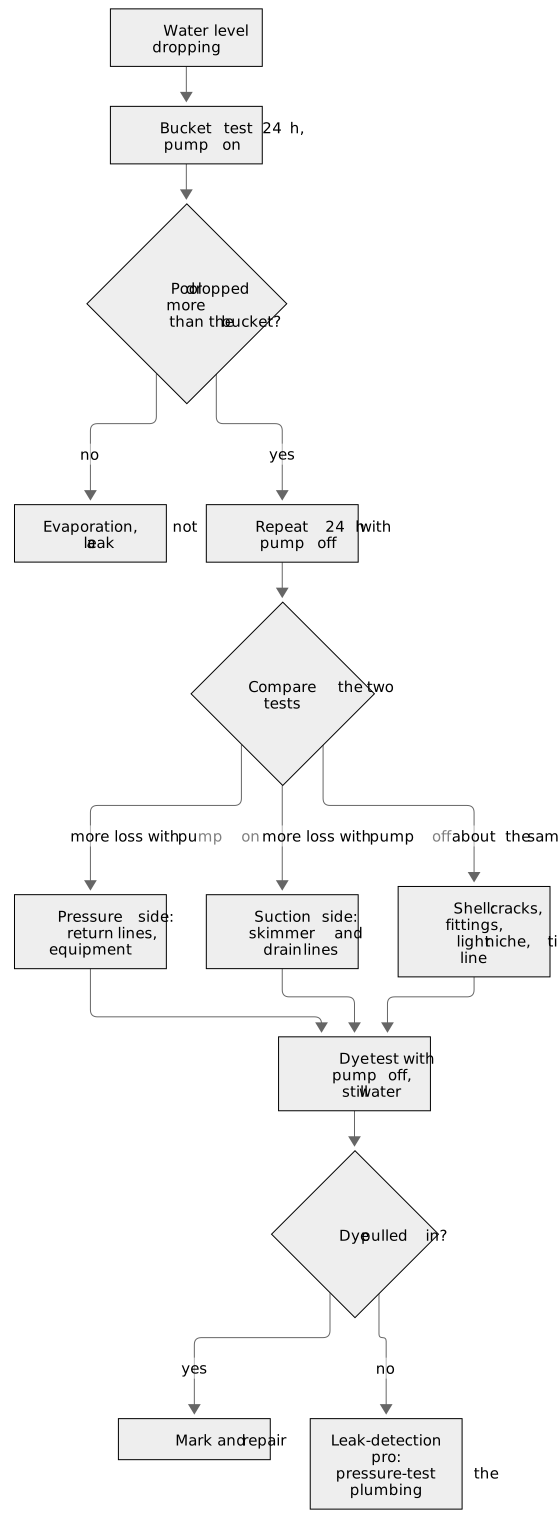
The pump-on and pump-off comparison is a common field rule of thumb, not a guarantee.
How much · basis: rule of thumb
Use the dose card. A few puffs per spot are enough.
Cautions:
- Dye won't show anything in a running pool. Turn the pump off and wait.
- Leaks in underground plumbing need pressure testing. Dye only finds leaks you can reach.
Off-label uses
O1 · Find leaks with your test kit's phenol red — Cl · SWG · Br
Effect & benefit: You already own a leak dye. In normal pool water (pH about 7.4–7.8), phenol red turns orange-red to red. A little released at a suspected crack or fitting shows whether water is being drawn in, with no special purchase.
How to use:
- Draw some phenol red into a clean syringe or eyedropper. Don't dip the reagent bottle's own tip into the pool, which would contaminate your pH reagent.
- Do the bucket test and narrow down the area first (L1).
- With the pump off and the water still, release a few drops right at each suspect spot.
- Watch for the color being pulled in. Mark leaks with tape or a grease pencil.
How much (per spot, not per pool) · basis: rule of thumb
A few drops to about 1 mL per spot. A small reagent bottle covers a dozen or more spots. Replace it afterward so your pH tests stay reliable.
Cautions:
- Very high chlorine (above about 10 ppm) bleaches phenol red quickly. Hunt for leaks when FC is normal.
- Phenol red isn't weighted to sink like commercial dye, so get the tip very close to the spot.
Hazards & storage:
- Kit reagents are low hazard at these amounts. Keep them capped, out of the sun, and away from children.
- Replace reagents on the kit maker's schedule. Old phenol red gives false pH readings.
4 · Goal index — "I want to…"
Every way this guide offers to reach a goal, labeled first, then off-label, then non-chemical. Codes point into the monographs: A1 · O1 means monograph A1, off-label use O1.
Decision aids
pH and TA
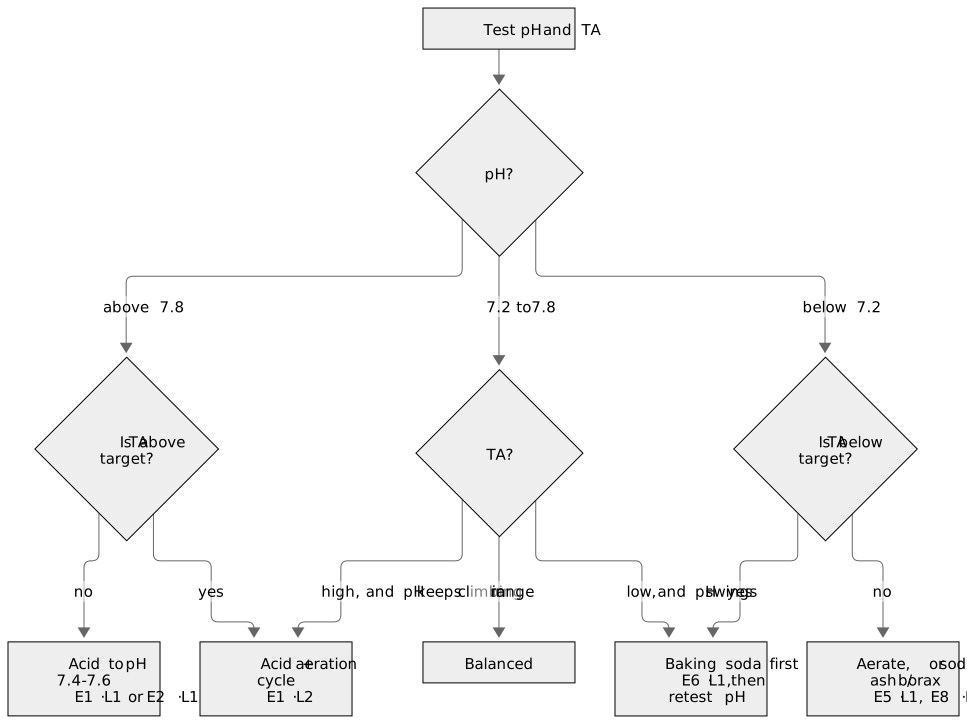
Cloudy or green water
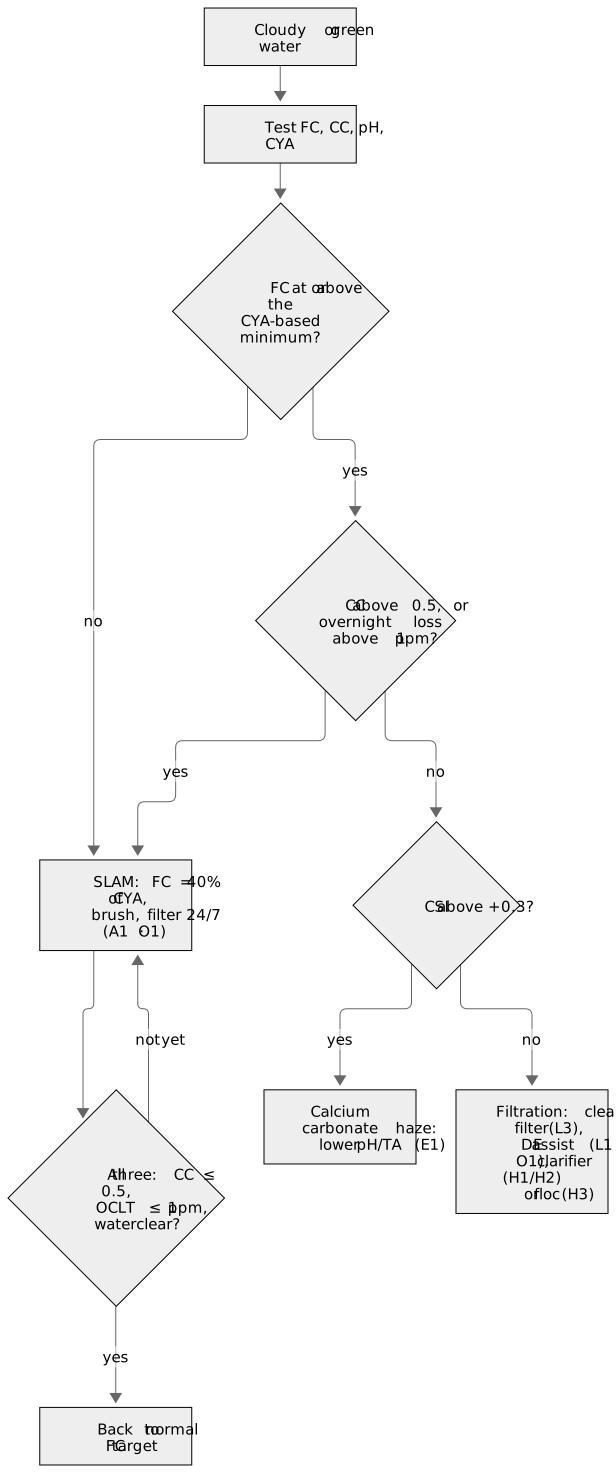
Stain identification
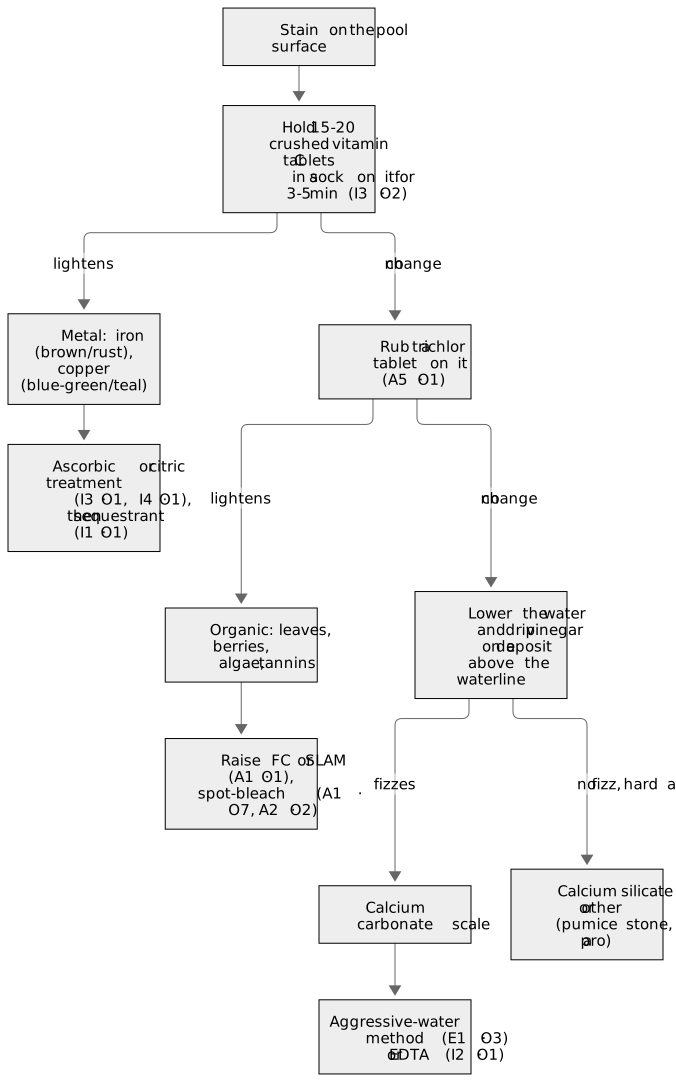
Index
| I want to… | Labeled options | Off-label options | Non-chemical |
|---|---|---|---|
| Raise free chlorine | A1 L1 · A2 L2 · A4 L1 · A5 L1 · SWG output (A6 L1) | — | — |
| Lower free chlorine | J1 L1 · J2 L1 | C2 O1 · I3 O3 | Stop dosing, remove the cover, let sunlight work |
| Kill green algae | A1 L3 · A2 L3 · G1 L2 | A1 O1 (SLAM) | Brush, run filter 24/7 |
| Kill mustard/yellow algae | G5 L1 ⚠️ · G3 L1 ⚠️ | A1 O1 at the mustard level · B3 O1 ⚠️ | Sanitize swimsuits, toys, brushes; brush daily |
| Kill black algae | A2 L3 · G3 L1 ⚠️ | A1 O1 · A2 O2 (sock) | Stainless brush to break the heads (plaster only) |
| Clear chloramine smell / high CC | A1 L2 · A2 L1 · C1 L1 | A1 O1 | UV/ozone; ventilate indoor pools |
| Find hidden algae or organics | — | A1 O2 (OCLT) | — |
| Know my pool's volume | — | A1 O8 | Measure and calculate (§0.3) |
| Lower pH | E1 L1 · E2 L1 · E3 L1 · E4 L1 | A5 O2 · C1 O1 | Lower TA so it drifts less |
| Raise pH | E5 L1 · E8 L1 · E7 L1 | — | Aeration: fountains, jets, spillover (raises pH without changing TA) |
| Lower TA | E1 L2 · E2 L2 | E7 O1 (with CH) | Aeration between acid doses |
| Raise TA | E6 L1 · E5 L1 | — | — |
| Raise calcium hardness | F1 L1 | A2 O1 | Hard fill water |
| Lower calcium hardness | — | E5 O1 · E7 O1 | Partial drain and refill with softer water; reverse osmosis (RO) service |
| Raise CYA | D1 L1 · A4 L3 · A5 L2 | A4 O1 · A5 O2 | — |
| Lower CYA | D2 L1 | — | Partial drain and refill; RO |
| Raise salt | A6 L1 | — | — |
| Lower salt, TDS, nitrate, bromide, sulfate | — | — | Dilution (drain and refill) or RO only |
| Add borates | E8 L2 · E9 L1 | E8 O1 · E9 O1 | — |
| Lower phosphates | H5 L1/L2 | — | Dilution |
| Clear cloudy water | H1 L1 · H2 L1 · H3 L1 · H4 L1 | L1 O1 · L2 O1 | Run the filter longer; clean it; check the sanitizer first |
| Remove oily film / scum line | K1 L1 | K1 O2 · E6 O3 | Tennis ball in the skimmer; wipe the tile |
| Stop foam | K3 L1 | F1 O1 (soft-water spas) | Find the cause: quats (G2), soaps, lotions |
| Identify a stain | — | I3 O2 · A5 O1 | Vinegar fizz test (see diagram) |
| Remove metal stains | I3 L1 · I4 L1 | I3 O1 · I4 O1 · I5 O1 · I6 O1 | — |
| Remove organic stains | A1 L2 | A1 O7 · A2 O2 | Brush |
| Remove scale | I2 L1 · I7 L1 | E1 O3 · E1 O2 ⚠️ · I2 O1 | Pumice stone on plaster or tile |
| Prevent metal stains and scale | I1 L1/L2/L3 | I1 O1 | Keep CSI −0.3…0; avoid copper products |
| Get metals out of fill water | I1 L1 | A1 O4 + H3 L1 | Hose pre-filter on the fill line |
| Clean the salt cell | — | E1 O1 · I7 O1 · I4 O2 | Keep CSI ≤ 0 so it needs less cleaning |
| Clean a cartridge or DE grids | L3 L1 | K1 O1 · E1 O4 | Hose rinse |
| Help a sand filter catch finer particles | H3 L2 | L1 O1 · L2 O1 | — |
| Winterize | M2 L1 · G1 L3 | — | Blow out lines; lower the water |
| Cut evaporation and heat loss | M1 L1 | — | Solid or solar cover |
| Find a leak | M3 L1 | M3 O1 | Bucket test |
| Neutralize before draining | J1 L2 | J2 O1 · C2 O1 · I3 O3 | Let FC fall naturally in sun |
| Neutralize acid-wash rinse water | — | E5 O2 · E6 O2 | — |
Around the house (off-label)
| I want to… | Use | Notes |
|---|---|---|
| Make emergency drinking water | A1 O6 (household bleach) · A2 O3 (cal-hypo stock) | EPA method; plain unscented products only |
| Disinfect surfaces, toys, mildew | A1 O5 | FIFRA: use a product labeled for it where possible |
| Tie-dye / laundry | E5 O3, O4 · E8 O2 | Pool soda ash = washing soda |
| De-ice a walkway | F1 O2 · F2 O1 | Hard on concrete and plants |
| Dry out a closet | F1 O3 | — |
| Turn hydrangeas blue | H3 O1 | Acidic soil required |
| Smother a small grease fire | E6 O4 | Never water on grease |
| Clean a toilet bowl or hard-water spots | E2 O1 · I4 O2 | — |
| Dechlorinate aquarium/pond water | J1 O1 | Not for chloramine water without an ammonia binder |
| Clean a deck or masonry | E1 O5 · L3 O1 | Test a small area first |
| Protect RV or boat plumbing | M2 O1 | Propylene glycol only |
| Keep a fountain clean | B1 O1 · G1 O1 · H5 O1 · K3 O1 · M1 O1 | FIFRA for sanitizers/algaecides; never with fish, pets, or wildlife drinking |
| Regenerate a water softener | A6 O1 | Pure salt only |
5 · Never mix — hazards & compatibility
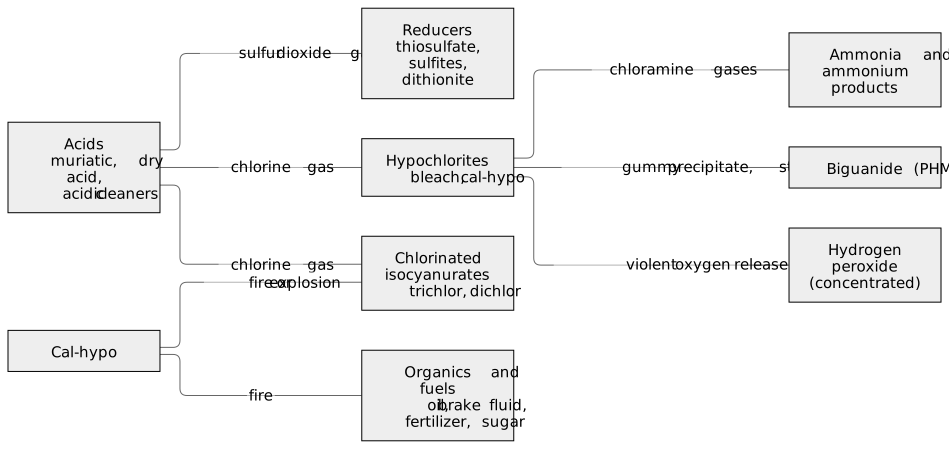
| Never combine | What happens | How to prevent it |
|---|---|---|
| Any acid + any chlorine product (bleach, cal-hypo, trichlor, dichlor) | Chlorine gas | Store apart; add to the pool at different times and places; never in the same bucket or skimmer |
| Trichlor or dichlor + cal-hypo | Violent reaction; fire or explosion. Can form explosive nitrogen trichloride | Separate scoops and buckets; never put cal-hypo in a trichlor feeder or the reverse. Replace, don't just rinse, a feeder when switching types |
| Cal-hypo + organics or a little water (oil, brake fluid, fertilizer, sugar, damp debris) | Heat, fire, toxic smoke | Keep dry, sealed, away from garage chemicals; never add water to cal-hypo |
| Chlorine + ammonia (household ammonia, ammonium-based products, concentrated urine) | Chloramine gases | No ammonia cleaners near pool chemicals |
| Bleach + vinegar, citric acid, toilet-bowl cleaners | Chlorine gas | Same rule as acid + chlorine |
| Reducers (thiosulfate, sulfites, dithionite) + acid | Sulfur dioxide gas | Don't acidify dechlorinators; keep dithionite dry (it can self-heat when damp) |
| Concentrated hydrogen peroxide + concentrated chlorine | Rapid oxygen release, heat, splatter | Add peroxide to the pool, never to a chlorine jug |
| Bromine tablets + chlorine tablets in one feeder | Dangerous reaction in the feeder | One feeder per product family |
| Chlorine + biguanide | Gummy precipitate, staining, cloudy water | Full conversion procedure |
| Calcium chloride with soda ash or bicarbonate (at once) | Calcium carbonate clouds the pool | Add hours apart; dissolve calcium separately (it gets hot) |
| Acid + soda ash or bicarbonate (concentrated) | CO₂ fizzing, splatter (not toxic) | Add separately |
Adding chemicals to the pool, in order:
- One product at a time.
- Acid goes into the deep end in front of a return, poured slowly, with the pump running.
- Wait 15–30 min before chlorine, longer before calcium or alkalinity products.
- Calcium and alkalinity products go in hours apart.
- Clarifier, floc, and phosphate remover each go on their own day, after the water is balanced and sanitized.
6 · Appendices
6.1 Formulas
Grams for a ppm change      g = Δppm × 37.85 × (gallons / 10,000) ÷ active fraction
Ounces (weight)             oz = g ÷ 28.35            1 ppm in 10k gal = 1.335 oz of 100% active
Liquid chlorine             fl oz per +1 ppm per 10k gal = 128 ÷ strength%   (10% → 12.8 fl oz)
Bromine vs chlorine         ppm Br₂ = 2.25 × ppm Cl₂;  1 ppm bromine needs 0.444 ppm FC to regenerate
Acid for TA                 31.45% HCl: 25.6 fl oz per −10 ppm TA per 10k gal (exact)
Bicarbonate for TA          1.40 lb per +10 ppm TA per 10k gal (exact)
Calcium chloride            0.925 lb ÷ purity per +10 ppm CH per 10k gal
Cyanuric acid               13.35 oz ÷ purity per +10 ppm CYA per 10k gal
Salt                        83.5 lb per +1,000 ppm per 10k gal
CYA from trichlor           0.61 ppm per ppm FC;  dichlor 0.91 ppm per ppm FC
CH from cal-hypo            0.71 ppm per ppm FC
Dilution                    fraction to replace = (current − target) ÷ (current − fill water)
SLAM                        FC = 0.40 × CYA   (≈ 10 ppm when CYA is 0)
Minimum FC                  ≈ 0.075 × CYA
6.2 pH dose tables (basis: model)
These amounts are fluid ounces of 31.45% muriatic acid per 10,000 gal to make the listed pH change at the listed TA, for 77 °F and no borates.
To convert to another product, multiply by:
| Product | Factor |
|---|---|
| 14.5% acid | × 2.34 |
| Dry acid (93.2% sodium bisulfate) | × 1.34 — the result is ounces by weight |
How these tables were built. The model is a closed carbonate system with cyanurate and borate buffers. Real pools add CO₂ outgassing and temperature effects, so add ~75%, circulate, and retest.
Acid, CYA 0
| pH change | TA 50 | TA 60 | TA 80 | TA 100 | TA 120 | TA 150 |
|---|---|---|---|---|---|---|
| 8.2 → 7.6 | 6 | 7 | 9 | 11 | 13 | 17 |
| 8.0 → 7.5 | 6 | 7 | 9 | 11 | 14 | 17 |
| 7.8 → 7.5 | 4 | 5 | 6 | 8 | 10 | 12 |
| 7.8 → 7.4 | 6 | 7 | 9 | 12 | 14 | 17 |
| 7.6 → 7.2 | 9 | 10 | 14 | 17 | 20 | 26 |
Acid, CYA 40
| pH change | TA 50 | TA 60 | TA 80 | TA 100 | TA 120 | TA 150 |
|---|---|---|---|---|---|---|
| 8.2 → 7.6 | 8 | 9 | 11 | 14 | 16 | 19 |
| 8.0 → 7.5 | 8 | 10 | 12 | 14 | 16 | 20 |
| 7.8 → 7.5 | 6 | 7 | 8 | 10 | 11 | 14 |
| 7.8 → 7.4 | 9 | 10 | 12 | 14 | 17 | 20 |
| 7.6 → 7.2 | 12 | 14 | 17 | 21 | 24 | 29 |
Acid, CYA 70
| pH change | TA 50 | TA 60 | TA 80 | TA 100 | TA 120 | TA 150 |
|---|---|---|---|---|---|---|
| 8.2 → 7.6 | 10 | 11 | 13 | 15 | 17 | 21 |
| 8.0 → 7.5 | 10 | 12 | 14 | 16 | 18 | 22 |
| 7.8 → 7.5 | 7 | 8 | 10 | 11 | 13 | 15 |
| 7.8 → 7.4 | 11 | 12 | 14 | 17 | 19 | 22 |
| 7.6 → 7.2 | 15 | 17 | 20 | 24 | 27 | 32 |
Borates raise acid demand a lot near pH 7.5–8. TA 80, CYA 40:
| pH change | No borates | 50 ppm borates | Ratio |
|---|---|---|---|
| 8.0 → 7.5 | 12 fl oz | 35 fl oz | ×3.0 |
| 7.8 → 7.5 | 8 fl oz | 19 fl oz | ×2.4 |
| 7.8 → 7.4 | 12 fl oz | 26 fl oz | ×2.1 |
Raising pH — ounces (weight) of soda ash per 10,000 gal.
To convert to another product:
| Product | Factor | TA increase compared with soda ash |
|---|---|---|
| Borax decahydrate | × 2.0 (oz by weight) | about half |
| 50% sodium hydroxide | × 0.5 (fl oz) | about half |
Every 1 lb of soda ash raises TA by 11.3 ppm per 10k gal.
Soda ash, CYA 0
| pH change | TA 50 | TA 60 | TA 80 | TA 100 | TA 120 |
|---|---|---|---|---|---|
| 7.0 → 7.4 | 14 | 17 | 23 | 29 | 35 |
| 7.0 → 7.5 | 17 | 20 | 27 | 34 | 41 |
| 7.2 → 7.5 | 8 | 9 | 13 | 16 | 19 |
| 7.2 → 7.6 | 10 | 12 | 16 | 19 | 23 |
| 7.4 → 7.6 | 4 | 5 | 6 | 8 | 9 |
Soda ash, CYA 40
| pH change | TA 50 | TA 60 | TA 80 | TA 100 | TA 120 |
|---|---|---|---|---|---|
| 7.0 → 7.4 | 19 | 22 | 28 | 34 | 40 |
| 7.0 → 7.5 | 23 | 26 | 33 | 40 | 47 |
| 7.2 → 7.5 | 11 | 13 | 16 | 19 | 22 |
| 7.2 → 7.6 | 14 | 16 | 20 | 24 | 28 |
| 7.4 → 7.6 | 6 | 6 | 8 | 9 | 11 |
Soda ash, CYA 70
| pH change | TA 50 | TA 60 | TA 80 | TA 100 | TA 120 |
|---|---|---|---|---|---|
| 7.0 → 7.4 | 23 | 26 | 32 | 38 | 43 |
| 7.0 → 7.5 | 28 | 31 | 38 | 44 | 51 |
| 7.2 → 7.5 | 14 | 15 | 18 | 21 | 25 |
| 7.2 → 7.6 | 17 | 19 | 23 | 27 | 31 |
| 7.4 → 7.6 | 7 | 8 | 9 | 11 | 12 |
Two more facts from the same model:
- Baking soda barely moves pH. 1.4 lb (+10 ppm TA) raises pH by only ~0.03–0.05.
- CO₂ lowers pH without changing TA. Bringing pH from 7.8 to 7.5 takes roughly 0.2–0.3 lb of dissolved CO₂ per 10k gal (TA 60–100).
6.3 Unit conversions
| From | To | Multiply by |
|---|---|---|
| US gallons | liters | 3.785 |
| US fl oz | mL | 29.57 |
| quarts | fl oz | 32 |
| gallons | fl oz | 128 |
| ounces (weight) | grams | 28.35 |
| pounds | grams | 453.6 |
| pounds | ounces | 16 |
| ppm in 10,000 gal | grams of 100% active | 37.85 |
| ppm in 1,000 gal | grams of 100% active | 3.785 |
| ppm in 100 gal (spa) | grams of 100% active | 0.3785 |
| °F | °C | (°F − 32) × 5⁄9 |
| ppm Cl₂ reading | ppm Br₂ | 2.25 |
6.4 Household equivalents
| Pool product | Household or hardware equivalent | OK? | Watch for |
|---|---|---|---|
| Liquid chlorine | Plain, unscented household bleach (6–8.25%) | ✅ | Avoid "splash-less", scented, "with cleaners", or color-safe products |
| Soda ash (pH Up) | Washing soda labeled 100% sodium carbonate | ✅ | Not "washing powder" detergents |
| Alkalinity Up | Grocery baking soda | ✅ | Identical chemical, usually cheaper |
| Borate products | Laundry borax (sodium tetraborate decahydrate) | ✅ | Needs acid to offset its pH rise (E8) |
| Muriatic acid | Hardware-store muriatic acid (31.45%) | ✅ | "Green"/low-fume versions are weaker (E1) |
| Calcium Hardness Up | Calcium-chloride ice melt or flake | ⚠️ | Only if the label says 77–97% calcium chloride with no other ingredients |
| Pool salt | Water-softener "solar" crystals | ⚠️ | ≥ 99.4–99.8% NaCl only. No rust-out additives, no pellet binders, no YPS anti-caking |
| Stain remover (vitamin C) | Bulk ascorbic acid powder | ✅ | Tablets with fillers are fine for spot tests only |
| Citric stain remover | Canning/food-grade citric acid | ✅ | — |
| Chlorine neutralizer | Sodium thiosulfate crystals (photo/aquarium supply) | ⚠️ | Aquarium conditioners may contain other ingredients |
| Pool antifreeze | RV antifreeze labeled propylene glycol | ✅ | ⛔ Never ethylene glycol (automotive) |
| Filter degreaser | Hardware-store TSP | ✅ | Rinse thoroughly; keep phosphate out of the pool |
| Pool DE | Food-grade DE | ⛔ | Not interchangeable in either direction (L1) |
| Dry acid | Toilet-bowl cleaners | ⛔ | Bowl cleaners contain other ingredients; only the reverse (dry acid as a cleaner) is OK |
6.5 Method notes
Stoichiometric doses use molecular weights. 1 ppm = 1 mg/L, and 10,000 US gal = 37,854 L. Each product's stated strength is applied as follows:
- Liquid chlorine: treated as g available Cl₂ per 100 mL.
- Acids: HCl normality comes from CRC density tables. 31.45% HCl is 9.98 N, and 14.5% is 4.26 N.
The buffer model (pH tables and precipitation):
- System: closed carbonate system, plus cyanuric acid (pKa 6.88) and boric acid (pKa 9.24).
- Temperature: 25 °C equilibrium constants (pK₁ 6.35, pK₂ 10.33).
- Activity: Davies activity corrections at ionic strength 0.03 (0.05 for the precipitation runs).
- Calcite: Ksp = 10⁻⁸·⁴⁸.
- What it ignores: CO₂ exchange with air (it's a "just after dosing" prediction) and temperature. Expect ±15%.
The FC/CYA rules are the Trouble Free Pool method, based on the O'Brien chlorine–cyanurate equilibrium.
Label doses came from manufacturer labels, SDS sheets, and manuals current in 2026. Brands change formulations, so your label always wins.
6.6 Sources & further reading
Every product figure in this guide was checked in October 2026 against the sources below. The guide's source files also keep fuller research notes (confidence tags, verbatim label quotes) and the calculator that produced every computed table:
- Research notes: 01 · sanitizers, oxidizers, neutralizers, salt · 02 · balance, stabilizer, calcium, borates · 03 · algaecides, clarifiers, specialty products
- Dose calculator:
calc/pool_model.py· generated tables:calc/dose-tables.md
Regulatory and public health
- US EPA — Emergency Disinfection of Drinking Water (updated 2026-02-24): https://www.epa.gov/ground-water-and-drinking-water/emergency-disinfection-drinking-water
- US EPA — Inorganic Halides amended interim registration review decision (2021), the source of the outdoor-pool bromine label statement: https://downloads.regulations.gov/EPA-HQ-OPP-2009-0168-0037/content.pdf
- US EPA Pesticide Product Label System (stamped labels for every registered sanitizer and algaecide cited here): https://ordspub.epa.gov/ords/pesticides/f?p=PPLS:1
- CDC — Model Aquatic Health Code (2024), bromine section: https://cmahc.org/mahc_sections/1731
Industry references
- PHTA — Pool & Hot Tub Operator Handbook (2021), Appendix B ranges and adjustment tables: https://www.phta.org/pub/?id=C2C6DCB4-1866-DAAC-99FB-F3F6E7B592FA
- PHTA — borate and LSI technical bulletins: https://www.phta.org/pub/?id=2EADC5DA-1866-DAAC-99FB-C832DE9556FC · https://www.phta.org/pub/?id=0944F15C-1866-DAAC-99FB-94B844527165
- National Plasterers Council — pool start-up card (rev. 03-2021): https://finestfinishpools.com/wp-content/uploads/2022/08/npc-pool-start-up-english.pdf
- Taylor Technologies — K-1003 / K-1005 treatment tables: https://www.novatech-usa.com/pdf/Taylor K-1005 Instruction Manual.pdf; technical FAQs: https://taylortechnologies.com/pages/technical-faqs
- Hales, Latta & Skinner, "Lowering calcium hardness with soda ash", JSPSI 6(2):14–19 (2023): https://www.poolhelp.com/wp-content/uploads/2023/03/JSPSI_V6N2_pp14-19.pdf
- Wojtowicz, carbon dioxide for pH control, JSPSI 1(3):19–26: https://www.poolhelp.com/wp-content/uploads/2017/05/JSPSI_V1N3_pp19-26.pdf
- onBalance — The mechanics of the bicarb start: https://www.poolhelp.com/home/onbalance-research/education/the-bicarb-start/the-mechanics-of-the-bicarb-start/
Equipment and product makers
- Hayward AquaRite manual: https://hayward.com/media/wysiwyg/pdf/aqua_rite_product_manual.pdf
- Pentair IntelliChlor installation & user's guide (2023): https://www.pentair.com/content/dam/extranet/nam/pentair-pool/residential/sanitizers/intellichlor/intellichlor-installation-users-guide-ic15-ic20-ic40-ic60.pdf
- Jandy AquaPure manual: https://www.jandy.com/-/media/zodiac/global/downloads/jandy/water-sanitizers/h0325600.pdf
- CircuPool RJ Plus manual: https://www.circupool.com/assets/doc/CircuPool-RJ-PLUS-Manual.pdf
- OxyChem calcium chloride for pools: https://www.oxycalciumchloride.com/where-to-use/other-uses/pool-spa/
- ProTeam Supreme EPA label: https://www3.epa.gov/pesticides/chem_search/ppls/057787-00027-20160929.pdf
- Bio-Active CYA reducer FAQ: https://www.bioactivenow.com/faq
- Zodiac MagnaPool minerals: https://www.zodiac.com.au/magnapool/magnapool-minerals
Method and community references
- Trouble Free Pool — CYA/chlorine relationship: https://www.troublefreepool.com/wiki/index.php?title=CYA_Chlorine_Relationship
- Trouble Free Pool — FC/CYA chart: https://www.troublefreepool.com/blog/2019/01/18/free-chlorine-and-cyanuric-acid-relationship-explained/
- Trouble Free Pool — mustard algae: https://www.troublefreepool.com/blog/2019/01/18/mustard-algae/
- Trouble Free Pool — CSI and LSI: https://www.troublefreepool.com/wiki/index.php?title=CSI_and_LSI
- Trouble Free Pool — borates: https://www.troublefreepool.com/wiki/index.php?title=Borates_in_pool
- Trouble Free Pool — acid: https://www.troublefreepool.com/wiki/index.php?title=Acid
- Trouble Free Pool — pH and TA: https://www.troublefreepool.com/wiki/index.php?title=Managing_pH_and_Total_Alkalinity
- Orenda — LSI: https://blog.orendatech.com/langelier-saturation-index
- Orenda — acid alternatives: https://blog.orendatech.com/sulfuric-acid-sodium-bisulfate-muriatic-alternatives
- Orenda — hard fill water: https://ask.orendatech.com/knowledge/hard-water-tap
Specialty products
- Poly-60 polyquat label (EPA 48520-17): https://www3.epa.gov/pesticides/chem_search/ppls/048520-00017-20250409.pdf · Poly-30 (EPA 48520-15): https://www3.epa.gov/pesticides/chem_search/ppls/048520-00015-20241230.pdf
- Stepan BTC 776 quat algaecide label (EPA 1839-87): https://www.stepan.com/content/dam/stepan-dot-com/webdam/website-product-documents/EPA-labels/EPA087.pdf
- CU 7 copper algaecide label (EPA 48520-20): https://www3.epa.gov/pesticides/chem_search/ppls/048520-00020-20240606.pdf · Swimtrine Plus (EPA 8959-28): https://www3.epa.gov/pesticides/chem_search/ppls/008959-00028-20250321.pdf
- Silver Algaedyn label (EPA 68161-1): https://www3.epa.gov/pesticides/chem_search/ppls/068161-00001-20100603.pdf
- Trouble Free Pool — copper in pool water: https://www.troublefreepool.com/wiki/index.php?title=Copper_in_Pool_Water; ascorbic acid treatment: https://www.troublefreepool.com/wiki/index.php?title=Ascorbic_Acid_Treatment; stains: https://www.troublefreepool.com/blog/2019/01/18/stains-in-your-pool/; DE in a sand filter: https://www.troublefreepool.com/blog/2019/01/18/add-de-to-a-sand-filter/
- LADWP — green hair causes and cures: https://www.ladwp.com/sites/default/files/documents/Green_Hair_Causes_and_Cures.pdf
- Pool & Spa / Pool Pro — the chemistry of copper: https://poolpromag.com/the-chemistry-of-copper/
- HTH Drop Out flocculant: https://hthpools.com/products/hth-pool-care-drop-out-flocculant · PWTAG on PAC dosing: https://www.pwtag.org/polyaluminium-chloride-pac-dosing-february-2014/
- SeaKlear chitosan clarifier: https://seaklear.com/pool-maintenance-products/chitosan-clarifier/ · SeaKlear phosphate remover: https://seaklear.com/pool-problem-solving-products/phosphate-remover/
- PHOSfree instructions: https://labelsds.com/images/user_uploads/Phosfree Instr 3-16-21.pdf · Orenda PR-10,000: https://ask.orendatech.com/knowledge/how-to-use-pr-10000 · Orenda enzymes: https://ask.orendatech.com/knowledge/how-to-use-enzymes
- Natural Chemistry Pool Perfect: https://naturalchemistry.com/pool-products/pool-maintenance/pool-perfect/
- Jack's Magic stain-treatment procedures: https://jacksmagic.com/wp-content/uploads/2020/09/JM-Passive-Stain-Treatment-Procedures-Blue-Purple.pdf · Filter Fiber: https://jacksmagic.com/wp-content/uploads/2016/05/filter-fiber.pdf
- Hayward Pro-Grid DE filter manual: https://hayward.com/media/akeneo_connector/asset_files/I/S/ISDE2423EF_RevE_de8a.pdf · Pentair FNS Plus manual: https://www.pentair.com/content/dam/extranet/nam/pentair-pool/residential/filters/fns-plus/manual/fns-plus-vertical-grid-de-filter.pdf
- Pentair Clean & Clear Plus cartridge cleaning guide: https://www.pentair.com/content/dam/extranet/nam/pentair-pool/residential/filters/clean-and-clear-family/clean-and-clear-plus/clean-and-clear-plus-guides-manuals/clean-and-clear-plus-cleaning-guide.pdf
- Cosmetic Ingredient Review — diatomaceous earth safety assessment (crystalline silica content): https://www.cir-safety.org/sites/default/files/FR_DiatomaceousEarth_092022.pdf
- HeatSavr FAQ: http://liquidpoolcovers.com/faqs · SolarPill: https://www.aqua-pill.com/solarpill/
- In The Swim — pool antifreeze FAQ: https://www.intheswim.com/blog/swimming-pool-antifreeze-faq.html; alum flocculant: https://www.intheswim.com/blog/how-to-use-alum-flocculant-in-pools.html; acid washing: https://www.intheswim.com/eguides/acidwash.html